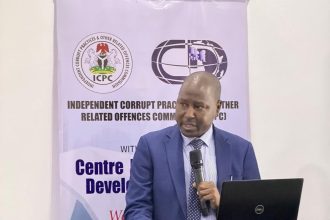


By Julius Peter
The Chairman of the Economic and Financial Crimes Commission (EFCC), Ola Olukoyede, has disclosed that more than five officials of the anti-graft agency are currently facing prosecution over allegations bordering on corruption and financial malpractice.
Olukoyede made the disclosure in a video statement shared on Monday, September 7, 2026, while explaining the measures being taken by the commission to strengthen accountability and discipline within its own ranks.
According to the EFCC chairman, the decision to prosecute its personnel forms part of a broader effort to ensure that officers responsible for investigating and prosecuting financial crimes are themselves held to the same standards of accountability expected of other public officials.
He disclosed that more than 40 EFCC personnel had been dismissed over corruption and financial malpractice in less than three years, adding that additional case files were being prepared for prosecution.
Olukoyede explained that the commission could not credibly investigate and prosecute corruption in other government institutions while shielding its own personnel from criminal accountability.
He questioned why an EFCC official found to have engaged in wrongdoing should merely be dismissed when officers of other Ministries, Departments and Agencies are prosecuted for similar offences.
The EFCC chairman said the principle guiding the commission was straightforward: personnel of the anti-graft agency must also be subject to the law.
The development represents a significant aspect of the institutional reforms undertaken under Olukoyede’s leadership, particularly his emphasis on internal discipline, professional ethics and accountability.
Olukoyede said that when he assumed office, he was confronted with reports of some EFCC personnel living in expensive properties in Abuja’s Maitama district and driving luxury vehicles, including Range Rovers.
According to him, questions were raised about how some officers whose official earnings could not ordinarily justify such lifestyles came to possess the assets.
He said some of the explanations offered by officers included claims that the properties and vehicles were gifts from relatives based abroad.
The concerns, according to Olukoyede, contributed to the commission’s decision to strengthen its internal mechanisms for monitoring gifts, assets and potential conflicts of interest.
As part of the reforms, the commission introduced a formal Gift and Hospitality Policy designed to provide clearer rules on what its personnel can receive in the course of their duties.
Under the policy, assets or gifts above prescribed thresholds are expected to be declared and properly documented.
The policy is intended to distinguish legitimate traditional or personal gifts from benefits that could compromise an officer’s independence or create a conflict of interest.
The chairman’s disclosure comes against the backdrop of the EFCC’s broader efforts to strengthen internal controls and restore public confidence in the commission.
Olukoyede also disclosed that the EFCC had renamed its former Internal Affairs Department as the Department of Ethics and Integrity.
The change, he explained, was intended to better reflect the department’s responsibility for promoting ethical conduct and ensuring internal accountability within the commission.
The department is expected to play a key role in identifying misconduct, monitoring compliance with institutional policies and supporting the commission’s internal cleansing efforts.
The reforms also include policies addressing conflict of interest and the security and management of exhibits, among other areas.
Olukoyede’s position is that the EFCC’s credibility depends not only on the number of arrests it makes or convictions it secures, but also on the integrity of the officers responsible for carrying out its mandate.
He argued that it would be contradictory for the commission to investigate and prosecute officials in other government institutions for corruption while allowing its own personnel accused of similar conduct to escape criminal prosecution.
The chairman therefore maintained that officers found to have committed offences would face appropriate disciplinary and legal consequences.
The latest disclosure indicates that the EFCC’s internal accountability programme goes beyond administrative sanctions, with criminal prosecution being pursued where investigators believe the evidence supports such action.
The disclosure comes shortly after Olukoyede presented a three-year stewardship report outlining the commission’s activities since he assumed office.
Between October 2023 and July 2026, the EFCC said it received 49,673 petitions, investigated 39,615 cases, filed 14,476 cases in court and secured 10,872 convictions.
The commission reported a 75.1 per cent conviction-to-filing ratio during the period. In the first six months of 2026 alone, it said it secured 1,370 convictions from 1,889 filings.
The EFCC also reported significant recoveries during Olukoyede’s tenure, including N1.23 trillion and $684.47 million in proceeds of crime and other foreign currencies, according to figures presented by the chairman.
The commission’s enforcement activities have extended beyond traditional corruption cases to areas including money laundering, cybercrime, illegal mining, unlicensed bureau de change operations, virtual assets and terrorist financing.
The EFCC said it handled 920 specialised cases involving these areas, with hundreds of cases still active and others resulting in convictions.
Olukoyede has repeatedly maintained that the EFCC’s mandate must apply irrespective of the status, position or influence of an individual.
The commission has consequently continued to prosecute former governors, ministers, senior government officials, financial-sector executives and other prominent Nigerians in cases involving alleged financial crimes.
The latest disclosure about EFCC personnel places the commission’s internal reforms at the centre of the debate about the effectiveness and credibility of Nigeria’s anti-corruption campaign.
For an agency whose core responsibility is to investigate and prosecute economic and financial crimes, the conduct of its own personnel is particularly significant.
The prosecution of serving or former EFCC officials accused of corruption could therefore serve as a test of the commission’s commitment to the principle that no individual is above the law.
However, as with all criminal allegations, the officers facing prosecution remain presumed innocent until the courts determine otherwise.
Olukoyede’s message is that the commission’s fight against corruption must include an examination of its own house — and that EFCC personnel who allegedly cross the line should face the same legal process as those they are mandated to investigate.