
By Julius Peter, Abuja
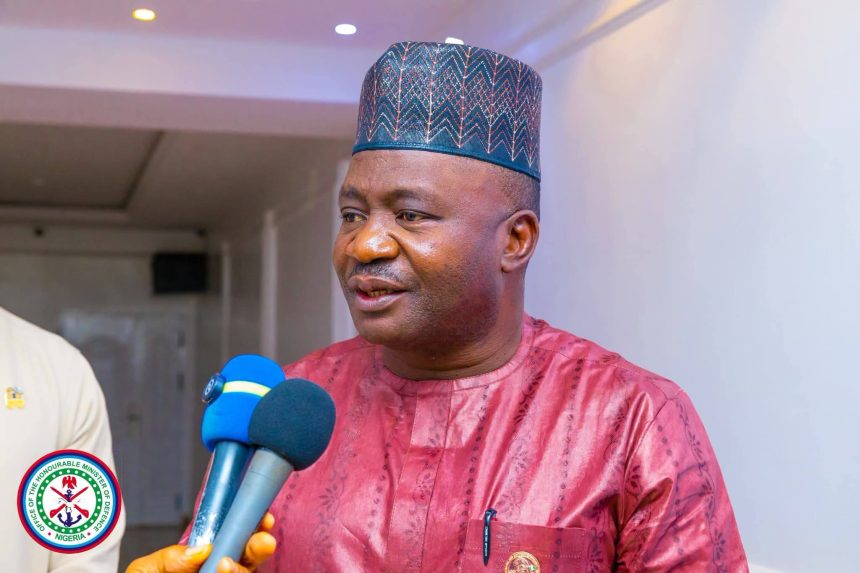
The Minister of Defence, General Christopher Gwabin Musa (Rtd), OFR, has called for the reintroduction of modernised, technology-driven tollgates across major highways in Nigeria, describing them as essential security infrastructure capable of tracking criminal activities, monitoring vehicular movements and protecting lives and property.
The minister also identified national unity, an effective digital identification system and strengthened civil policing as critical requirements for addressing the country’s security challenges and ensuring sustainable peace.
Musa made the call while participating as a panellist at the Abuja Round Table, tagged “Promise to Proof: The Renewed Hope Conversation,” during a session titled “Safe to Farm, Travel and Trade: Protecting Lives and Livelihoods in Every Community.”
He argued that the removal and destruction of tollgates across the country represented a strategic mistake, noting that properly managed toll facilities could serve purposes beyond revenue generation, particularly in intelligence gathering, crime prevention and the monitoring of movements along major transportation corridors.
According to him, developments in Information and Communications Technology (ICT) have made it possible to operate tollgates more efficiently through automated systems without the operational challenges associated with traditional cash-based toll collection.
The Defence Minister explained that modern tolling technology could capture vehicle registration numbers, monitor movements across interstate highways and provide security agencies with useful information for identifying and tracking suspected criminals.
“With modern Information and Communications Technology (ICT) and automation, toll collection no longer requires cash transactions,” he stated.
He maintained that automated tolling systems, when properly integrated with national security databases, could provide security agencies with timely information to trace suspicious vehicles and apprehend criminal suspects.

While acknowledging that traditional tollgate operations were previously associated with abuses and other administrative challenges, Musa stressed that technological innovations could address such shortcomings and make the facilities effective components of Nigeria’s non-kinetic security architecture.
He explained that the proposed modernisation would transform tollgates into strategic security monitoring points, helping authorities strengthen surveillance and intelligence operations along major highways.
The minister also stressed the need for Nigeria to establish a streamlined, reliable and comprehensive national identification system to address identity-related security loopholes.
He observed that the absence of a fully integrated identification architecture had continued to create challenges for security agencies in verifying individuals’ identities and accessing reliable information during investigations.
Drawing attention to international best practices, Musa advocated the integration of unique identification numbers, facial recognition technology and biometric information into a centralised digital identification system.
According to him, such an arrangement would eliminate identity ambiguities, improve record verification and strengthen intelligence gathering across the country.
He noted that a reliable national database would enable relevant government institutions and security agencies to access accurate information when necessary, thereby improving their ability to identify individuals linked to criminal activities.
The minister emphasised that technology must remain a central component of Nigeria’s evolving security strategy, particularly as criminal networks increasingly exploit weaknesses in information management and intelligence coordination.
Addressing the deployment of military personnel for internal security operations, Musa clarified that the primary constitutional responsibility of the Armed Forces of Nigeria was to defend the country’s territorial integrity against external aggression.
However, he acknowledged that the military had increasingly been required to support internal security operations in different parts of the country because of the scale and complexity of security threats confronting the nation.
He explained that military intervention became necessary in situations where security challenges exceeded the operational capacity of the police and other civilian law enforcement agencies.
Nevertheless, the Defence Minister expressed concern over the prolonged deployment of military personnel on internal security assignments, warning that sustained operations without adequate rest could affect the welfare and operational effectiveness of troops.
He particularly highlighted the situation of soldiers who had spent several years operating in conflict-affected areas, including parts of the Northwest, far away from their families and loved ones.
“Our troops have spent years deployed across regions such as the Northwest, away from their families and loved ones,” he said.
Musa stressed that although the Armed Forces remained committed to protecting Nigerians, the responsibility for routine internal security should progressively return to properly equipped and adequately trained civilian policing institutions.
To address the situation, the minister disclosed that the Federal Government was taking steps to improve police recruitment, training and operational capacity to enable the Nigeria Police Force to respond more effectively to internal security challenges.

He explained that strengthening the police would allow the military to gradually reduce its involvement in domestic security operations and concentrate more on its constitutional responsibility of defending the nation’s territorial integrity.
According to him, the ultimate objective is to develop a robust civil policing system capable of maintaining law and order, preventing crime and responding effectively to security threats at the community level.
He added that such reforms would enable military personnel deployed for prolonged internal operations to return to their primary military formations and enjoy the necessary rest and recovery.
The minister further indicated that the government was working towards repositioning the country’s security architecture from a largely reactive approach to a more proactive and intelligence-driven system, particularly as Nigeria approaches the 2027 general elections.
Beyond military operations, policing and technological interventions, Musa identified national unity as one of the most important ingredients for overcoming Nigeria’s security challenges.
He argued that the country’s difficulties were not fundamentally caused by a shortage of resources or military firepower, but were also rooted in internal divisions, mistrust and the inability of citizens to see themselves as members of one national community.
The minister urged Nigerians to rise above ethnic, religious and regional differences, stressing that national cohesion was indispensable to building a peaceful, secure and prosperous country.
He called on citizens to move beyond historical grievances and embrace mutual understanding, tolerance and a shared sense of responsibility for the country’s future.
“We must begin to view one another simply as human beings and fellow citizens, rather than dividing ourselves along ethnic, regional, or religious lines,” he appealed.
Musa maintained that insecurity could not be effectively addressed through military action alone, noting that cooperation among citizens, communities, traditional institutions and government agencies was equally important.
He emphasised that when Nigerians work together and develop mutual trust, security agencies would find it easier to obtain useful information, identify threats and prevent criminal activities before they escalate.
The Defence Minister reaffirmed the Federal Government’s commitment, under President Bola Ahmed Tinubu’s Renewed Hope Agenda, to creating an environment where Nigerians could freely engage in farming, transportation, commerce and other economic activities without fear of attacks.
He noted that security remained fundamental to national development, as farmers, traders, transport operators, investors and other economic actors required a peaceful environment to contribute meaningfully to the nation’s growth.
According to him, protecting lives and livelihoods must remain a shared national priority, requiring coordinated action by government institutions, security agencies and ordinary citizens.
The minister’s position reflects a broader approach to national security that combines military operations with technology, intelligence gathering, effective policing and community cooperation.
His advocacy for modernised tollgates and a centralised digital identification system also underscores the growing importance of technology in strengthening Nigeria’s capacity to prevent crime and respond to emerging security threats.
Ultimately, Musa stressed that Nigeria’s ability to overcome insecurity and guarantee safe movement, farming and trading across the federation would depend not only on the strength of its security institutions but also on the willingness of its citizens to embrace unity, patriotism and collective responsibility.