
By Julius Peter
The Nigerian Meteorological Agency (NiMet) and the General Directorate of Meteorology (DGM) of the Kingdom of Morocco have signed a Memorandum of Understanding (MoU) to strengthen cooperation in meteorological services, weather forecasting, climate research and early warning systems.
The agreement is aimed at promoting the exchange of expertise, knowledge and technological innovations between the two institutions, while enhancing their capacity to provide timely and reliable weather and climate information for the benefit of Nigeria, Morocco and other African countries.
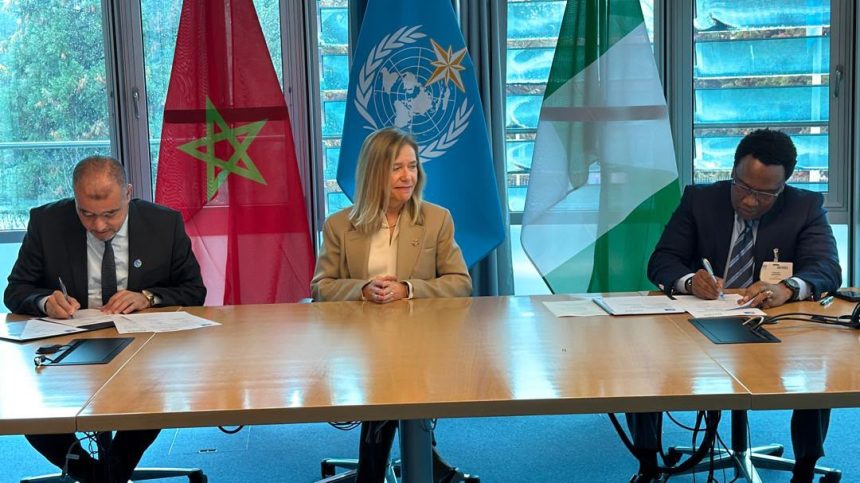
The Director-General/Chief Executive Officer of NiMet, Prof. Charles Anosike, and his Moroccan counterpart, the Director-General of DGM, Mr. Mohammed Dkhissi, signed the agreement on the sidelines of the ongoing session of the Commission for Observation, Infrastructure and Information Systems (INFCOM) at the Secretariat of the World Meteorological Organisation (WMO) in Geneva, Switzerland.
The signing ceremony was attended by the Secretary-General of the WMO, Prof. Celeste Saulo, who commended the partnership and described cooperation as a fundamental component of the organisation’s mission.
Speaking at the event, Anosike emphasised the importance of demonstrating Africa’s capacity and expertise in meteorology and climate science, noting that stronger collaboration among African meteorological institutions would help advance the continent’s ability to respond to weather and climate-related challenges.
He said the partnership between NiMet and DGM would strengthen the technical capabilities of both institutions and create opportunities to extend assistance and expertise to other meteorological services across the region.
According to him, the collaboration would contribute to ensuring that no African country is left behind in the development of effective meteorological services and climate information systems.
Anosike noted that the agreement reflects the objectives of the WMO in promoting international cooperation and strengthening the capacity of national meteorological and hydrological services.
“This partnership signifies what the WMO has been doing, and together we can do better,” he said.
The NiMet chief executive stressed that the agreement would provide a platform for African meteorological institutions to work together, share technical knowledge and develop solutions capable of addressing the continent’s growing weather and climate challenges.
He also highlighted the importance of leveraging the expertise of professionals within both institutions to improve forecasting capabilities and strengthen the delivery of climate services to communities and economic sectors.
In his remarks, Dkhissi said the agreement was based on mutual benefit and would not be a one-sided arrangement, but rather a partnership in which both institutions would contribute their experiences, expertise, knowledge and technological advancements.
He explained that the collaboration would enable NiMet and DGM to learn from each other, improve their operational capabilities and jointly develop innovative approaches to meteorological service delivery.
“This MoU is not for the shelf but for immediate implementation,” Dkhissi said.
He expressed confidence that the agreement would translate into practical programmes and projects capable of delivering measurable benefits to both countries.
The WMO Secretary-General, Saulo, congratulated the two Permanent Representatives for facilitating the agreement and reaffirmed the organisation’s commitment to supporting cooperation between meteorological institutions.
She said the partnership demonstrated the importance of bilateral collaboration in strengthening global meteorological services and noted that the WMO also stood to learn from the experiences and outcomes of the relationship between Nigeria and Morocco.
The MoU is expected to leverage the institutional strengths of NiMet and DGM, including their youthful technical experts and the cordial bilateral relationship between Nigeria and Morocco, to achieve meaningful impacts on weather and climate services.
Under the agreement, the two institutions will cooperate in several critical areas, including weather forecasting, seasonal climate prediction and the development of early warning systems.
Other areas of collaboration include meteorological and climate research, the development of climate services for socioeconomic sectors, meteorological observation and measurement systems, as well as metrology and calibration.
The partnership will also cover information, telecommunication and database systems, institutional capacity-building, peer-to-peer technical support, knowledge and technology transfer, and the co-development of operational tools.
In addition, the agreement provides for joint innovation in meteorological technologies and digital services, including the application of artificial intelligence (AI) to weather forecasting and climate science.
The two agencies will also collaborate on Quality Management Systems (QMS) and undertake other projects that may be mutually agreed upon.
The collaboration is expected to strengthen the ability of both institutions to provide more accurate and timely weather information, improve preparedness for extreme weather events and support climate-sensitive sectors such as agriculture, aviation, water resources, transportation and disaster management.
With weather and climate risks increasingly affecting livelihoods, infrastructure and economic activities across Africa, the agreement represents a significant step towards building stronger regional cooperation and improving access to reliable meteorological information.
The partnership also reinforces the importance of African-led technical collaboration in advancing climate resilience, strengthening early warning systems and ensuring that communities and governments have the information required to make informed decisions.