
By Julius Peter, Abuja
The Nigerian Meteorological Agency (NiMet) Unions Joint Action Committee (NJAC) has honoured the Director-General and Chief Executive Officer of the Agency, Professor Charles Anosike, in recognition of his exemplary leadership, administrative excellence and remarkable contributions to the transformation of the institution.
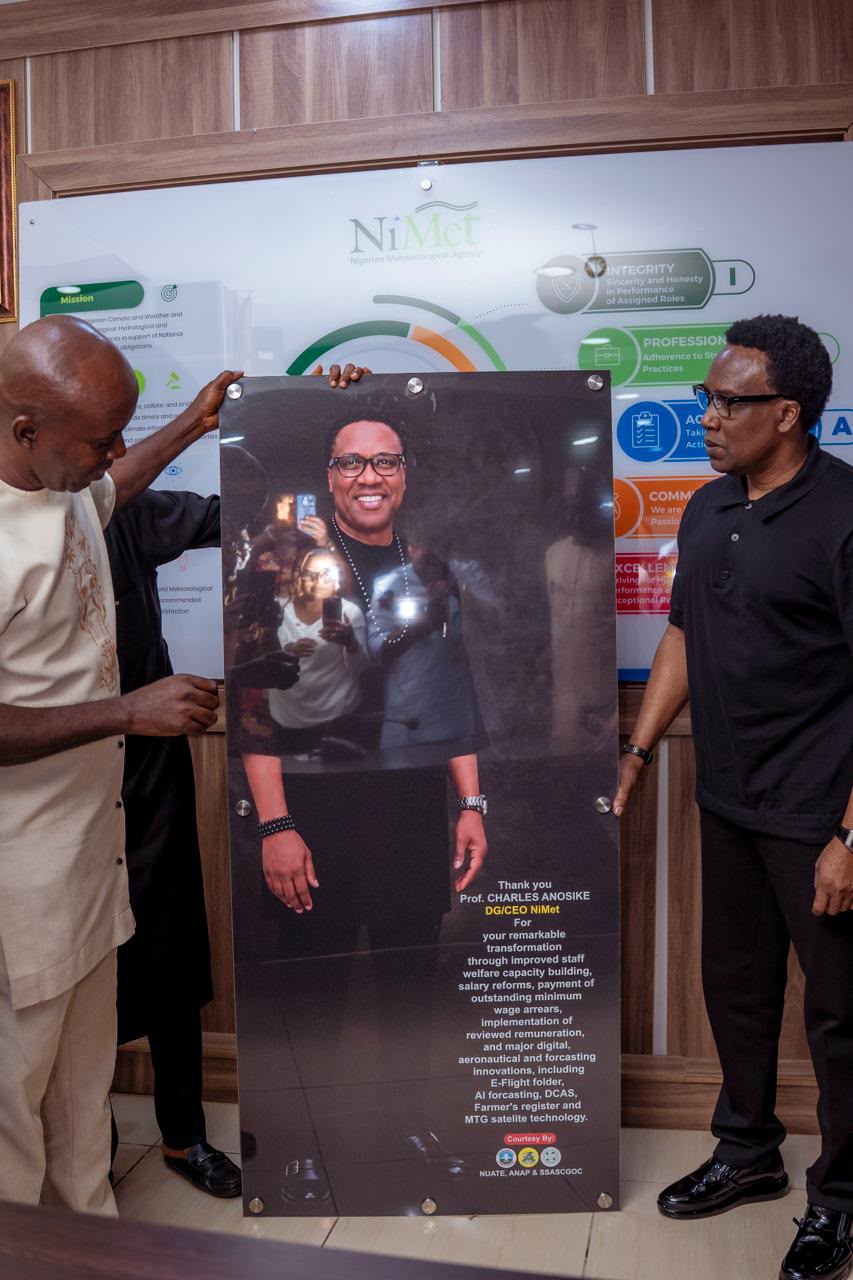
The unions, which comprise the various labour organisations operating within the Agency, presented a gigantic portrait bearing inscriptions of his achievements to Anosike, describing his administration as one that has demonstrated transparency, commitment to staff welfare, institutional development and improved operational efficiency.
The presentation was also aimed at appreciating the Director-General’s sustained efforts to improve workers’ conditions of service, strengthen institutional capacity and introduce far-reaching reforms to reposition NiMet for more effective and efficient service delivery.
In particular, the NJAC commended the Anosike-led administration for its achievements in staff welfare and remuneration, including the facilitation of salary reforms, payment of outstanding minimum wage arrears and implementation of the reviewed remuneration structure.
According to the unions, these interventions have significantly demonstrated management’s commitment to improving staff welfare, promoting industrial harmony and creating a more conducive working environment for increased productivity.
The labour organisations also acknowledged the administration’s investment in human capacity development, noting that continuous training and professional development remain critical to strengthening the competence of personnel and enhancing the Agency’s ability to meet emerging challenges in meteorological services.
Beyond workers’ welfare, the unions applauded the introduction of technological and operational innovations designed to modernise NiMet’s activities and improve the quality of its services, particularly in weather observation, forecasting and aeronautical meteorological operations.
Among the notable initiatives highlighted were the digitalisation and automation of administrative and financial processes, including the automation of accounting operations and the introduction of the Electronic Flight Folder (E-Flight Folder).
The unions also recognised the integration of Artificial Intelligence (AI) into weather forecasting and the adoption of Meteosat Third Generation (MTG) satellite technology to strengthen meteorological observation, monitoring and forecasting capabilities.
These innovations, they noted, reflect the Agency’s determination to embrace modern technology, improve institutional efficiency, strengthen financial accountability and deliver more accurate, timely and reliable weather information to Nigerians.
The adoption of advanced satellite technology and AI-driven forecasting systems is particularly significant at a time when accurate weather information has become increasingly important for agriculture, aviation, disaster risk reduction, transportation, water resources management and national development.
Responding to the honour, Professor Anosike expressed appreciation to the NJAC and the various unions for the recognition, describing the gesture as a strong encouragement for the management to sustain the ongoing transformation of the Agency.
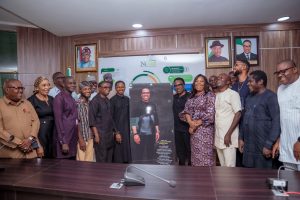
He acknowledged the critical role of organised labour in institutional development, stressing that constructive engagement, cooperation and mutual understanding between management and workers were essential to achieving sustainable progress.
The Director-General emphasised that the relationship between management and organised labour should continue to be built on mutual respect, open communication and a shared commitment to the overall success of the Agency.
He also acknowledged the support of President Bola Ahmed Tinubu’s administration and the Minister of Aviation and Aerospace Development, Festus Keyamo, SAN, noting that their support had been instrumental in the achievements recorded by NiMet.
Anosike further commended members of the Agency’s management team and the entire workforce for their dedication, cooperation and contributions to the reforms, stressing that the progress being witnessed was the product of collective effort rather than the achievement of one individual.
He reaffirmed his administration’s commitment to prioritising staff welfare, promoting professional development, strengthening institutional reforms and accelerating the modernisation of the Agency’s operations.
The Director-General maintained that improving workers’ welfare and investing in modern technology would remain important pillars of his administration’s efforts to position NiMet as a more efficient, innovative and globally competitive meteorological institution.
The recognition by the NJAC is seen as an indication of the positive working relationship between NiMet management and organised labour, particularly in an institution where staff cooperation and technical expertise are essential to effective service delivery.
It also underscores the importance of harmonious industrial relations in driving institutional reforms, enhancing workforce morale and achieving organisational objectives.
With increasing demand for reliable weather and climate information to support national planning, agricultural productivity, aviation safety and disaster preparedness, the ongoing reforms at NiMet are expected to further strengthen the Agency’s capacity to fulfil its statutory responsibilities.
The presentation of the portrait therefore represents not only an appreciation of Professor Anosike’s leadership but also a recognition of the collective commitment of NiMet’s management and workforce to building a technologically advanced, professionally driven and service-oriented institution.