

By Julius Peter, Abuja
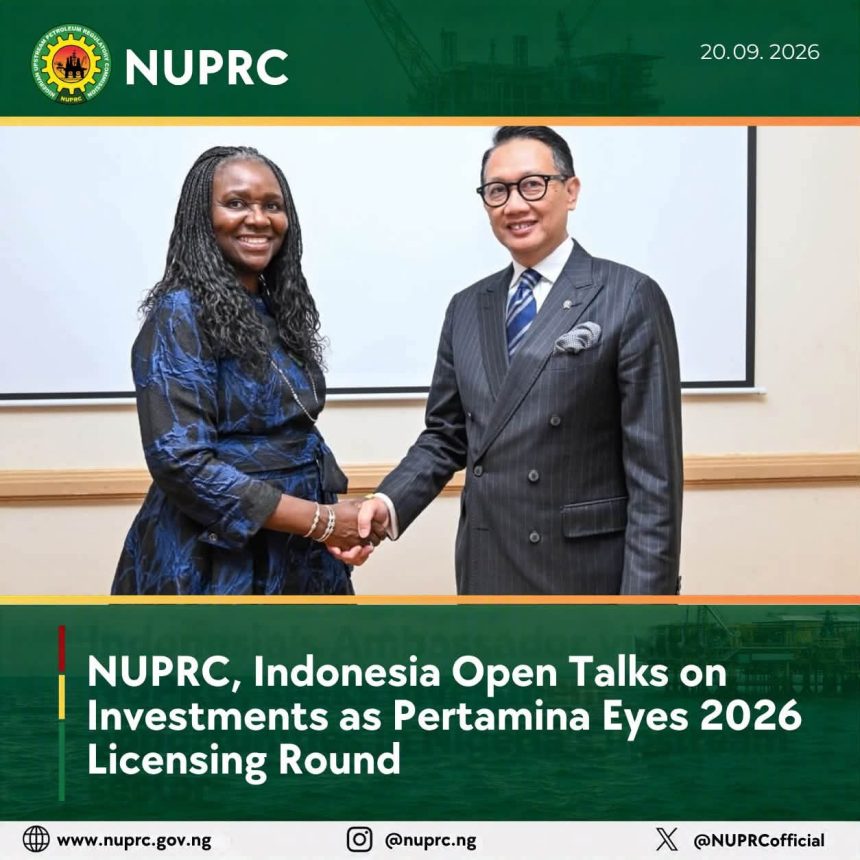
The Nigerian Upstream Petroleum Regulatory Commission (NUPRC) has opened discussions with the Indonesian government and its national oil company, Pertamina, on opportunities for increased investment and collaboration in Nigeria’s upstream oil and gas sector.
The development followed a high-level meeting between the Commission Chief Executive of NUPRC, Mrs. Oritsemeyiwa Eyesan, Indonesia’s Vice Minister of Foreign Affairs, Arif Havas Oegroseno, and Toriq Abdat, Vice President for Upstream Business Development at Pertamina.
A major outcome of the engagement was Pertamina’s expressed interest in participating in Nigeria’s forthcoming 2026 Licensing Round, signalling potential fresh Indonesian investment in Nigeria’s oil and gas industry.
The discussions come against the backdrop of efforts by both Nigeria and Indonesia to increase hydrocarbon production, attract fresh capital into their upstream sectors and maximise the value of their petroleum resources.
Nigeria currently produces around 1.7 million barrels of crude oil and condensate per day. The latest NUPRC data showed that the country produced an average of 1,677,777 barrels per day of crude oil and condensate in August 2026, representing a 0.4 per cent increase over July. Crude oil production alone stood at 1,500,190 barrels per day, with Nigeria meeting its OPEC quota for the fourth consecutive month.
The Federal Government has set an ambitious production trajectory, with the country targeting three million barrels per day by 2030. The NUPRC has consequently been pursuing measures aimed at increasing production, attracting investment, accelerating field development and improving regulatory predictability.
For Indonesia, the push for increased production is equally significant as the country seeks to raise output substantially from its current level. Its national target is understood to require additional investment and development beyond what can be achieved from existing domestic fields alone.
The engagement between the NUPRC and Indonesian officials therefore provides an avenue for the two oil-producing countries to explore areas of mutual interest, particularly in upstream investment, technology, technical cooperation and the development of new petroleum assets.
Pertamina’s interest in Nigeria’s 2026 Licensing Round is particularly significant as the NUPRC moves towards a new cycle of acreage offerings following the completion of the 2025 licensing process.
The 2025 round attracted considerable investor interest, with 143 companies submitting 200 bids for 37 of the 50 oil and gas blocks put on offer. Thirty-one companies emerged as winners of 37 blocks across different geological terrains, including the Niger Delta, Benue Trough, Chad Basin, Anambra Basin and Benin Basin.

The Commission has indicated that it intends to maintain predictable and periodic licensing rounds to provide investors with a continuous pipeline of opportunities.
Speaking at the commercial bid conference for the 2025 Licensing Round, Eyesan said regular access to acreage was necessary to sustain exploration, replenish reserves and provide investors with greater certainty.
She also disclosed that President Bola Ahmed Tinubu had given approval for the commencement of another licensing round, with the Commission expected to return with a fresh basket of investment opportunities.
The emerging interest from Pertamina comes as the NUPRC seeks to position Nigeria as a more attractive destination for upstream investment through improved regulation, faster approvals and increased transparency.
Eyesan had earlier outlined three major pillars of her agenda for the upstream sector: production optimisation and revenue expansion; regulatory predictability and speed; and safe, governed and sustainable operations. The Commission has also been working to accelerate approvals for near-ready field development plans, well interventions and rig mobilisation.
Nigeria’s investment case is further strengthened by the size of its petroleum reserves. According to the NUPRC’s official reserves position as of January 1, 2026, the country had 37.01 billion barrels of total oil and condensate reserves, while total proven gas reserves stood at 215.19 trillion cubic feet.
The Commission has also been pursuing policies aimed at unlocking deep offshore investment. NUPRC recently stated that the 2026 Deep Offshore Oil and Gas Project Incentives (Tax Remission) Executive Order could unlock up to $50 billion in investments and potentially support additional production from deep offshore developments.
The regulatory reforms are coming at a time when Nigeria is seeking to reverse production declines, attract new capital and bring previously undeveloped or underdeveloped assets into production.
For Pertamina, participation in Nigeria’s licensing opportunities could provide access to one of Africa’s largest petroleum resource bases while offering opportunities for cooperation between two major energy-producing countries.
Beyond crude oil production, the engagement could also open discussions around gas development, technology transfer, upstream project management, capacity building and other areas of the petroleum value chain.
Nigeria is increasingly looking towards international partnerships as part of its strategy to mobilise the capital and technical expertise required to develop its oil and gas resources. At the same time, the government has been seeking to ensure that investments translate into higher production, employment, revenue and broader economic benefits.
The NUPRC’s engagement with Indonesia and Pertamina therefore represents another step in the Commission’s broader efforts to deepen international cooperation and attract investment into Nigeria’s upstream sector.
With the 2026 Licensing Round expected to provide another opportunity for investors to acquire petroleum acreage, the expression of interest by Pertamina could add a major international player to the pool of prospective investors.
The outcome of the ongoing discussions and the eventual participation of Pertamina in the licensing process will be closely watched by industry stakeholders, particularly as Nigeria seeks to achieve sustained production growth and meet its longer-term target of three million barrels per day by 2030.
The development also underscores the increasing competition among oil-producing countries to attract international capital, technology and expertise as the global energy industry continues to evolve.