
By Julius Peter, Abuja
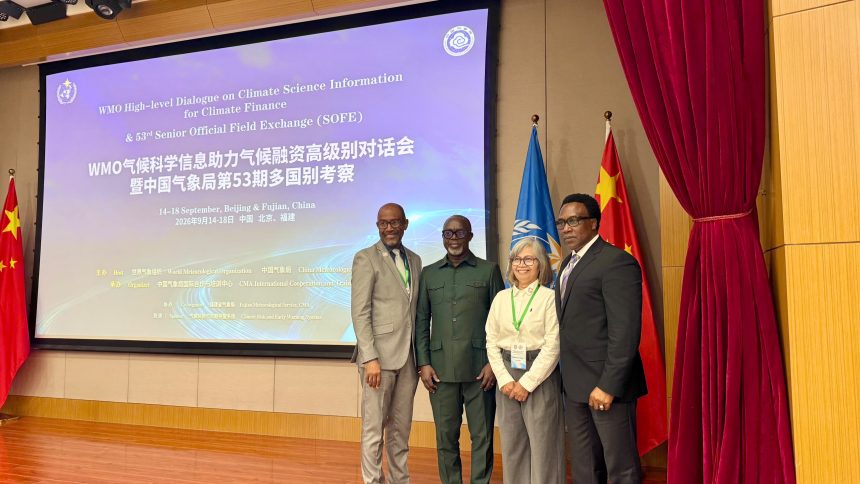
The Director-General and Chief Executive Officer of the Nigerian Meteorological Agency (NiMet), Prof. Charles Anosike, has participated in a high-level international dialogue convened by the World Meteorological Organization (WMO) to strengthen the role of National Meteorological and Hydrological Services (NMHSs) in mobilising climate finance and deploying science-based solutions to climate-related risks.
The WMO High-level Dialogue on Climate Science Information for Climate Finance and the 53rd Senior Official Field Exchange (SOFE) were held in Beijing, China, from September 14 to 18, 2026.
The engagements brought together senior officials and stakeholders in meteorological and hydrological services to deliberate on ways of translating climate science and weather information into practical investments capable of strengthening resilience, protecting lives and livelihoods, and supporting sustainable development.
A major focus of the high-level dialogue was the need to strengthen the leadership capacity of NMHSs and enhance their strategic role in accessing and mobilising climate finance.
Participants examined mechanisms for enabling meteorological and hydrological institutions to better articulate climate risks, develop bankable projects and establish partnerships with multilateral financing institutions.
The discussions also centred on aligning scientific and technical capabilities with risk-informed and people-centred early warning systems, particularly as countries face increasing exposure to extreme weather and climate-related hazards.
The dialogue underscored the importance of moving beyond conventional technical assistance towards sustainable investments that can build institutional capacity, modernise meteorological infrastructure and improve the delivery of climate and weather services.
Participants explored opportunities for expanding practical cooperation between meteorological frameworks and multilateral financing entities, with emphasis on creating sustainable financing pathways for national weather and climate institutions.
Another key area of discussion was leadership development for NMHSs, with participants examining strategies for strengthening strategic thinking, improving institutional effectiveness and fostering productive partnerships among governments, development partners, financial institutions, scientific organisations and other stakeholders.
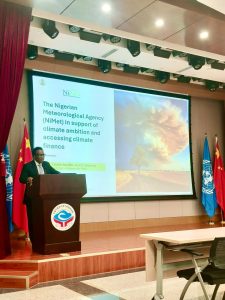
The engagement provided an opportunity for senior meteorological officials to exchange experiences on how national weather services can position themselves more effectively within the global climate-finance architecture.
For Nigeria, the participation of the NiMet Director-General placed the agency within an international platform focused on strengthening the capacity of meteorological institutions to contribute to climate adaptation, disaster-risk reduction and sustainable development.
Held back-to-back with the high-level dialogue was the 53rd Senior Official Field Exchange, which took participants to Fujian Province for first-hand exposure to China’s implementation of its Multi-hazard, Alert, Zero-gap and Universal (MAZU) platform.
The MAZU platform is an AI-driven meteorological early-warning solution designed to support the objectives of the Early Warnings for All (EW4All) initiative and strengthen disaster-risk reduction practices.
The field exchange provided participants with an opportunity to observe the practical application of technology, data and meteorological services in the delivery of early warnings for multiple hazards.
Through technical exchanges, field visits and peer-learning sessions, senior officials examined how China’s experience could provide useful lessons for strengthening early-warning systems in other countries.
The focus on MAZU also highlighted the growing role of artificial intelligence and digital technologies in modern meteorological services, particularly in improving the speed, reach and effectiveness of warnings issued to communities at risk from extreme weather events.
The EW4All initiative seeks to ensure that everyone on Earth is protected by early-warning systems, making the integration of scientific information, technology, institutional coordination and community-level response a critical component of disaster-risk reduction.
The Fujian field exchange therefore provided a practical dimension to the discussions held during the Beijing dialogue, allowing participants to connect policy and financing conversations with real-world applications of meteorological technology and early-warning systems.
The Beijing engagements come at a time when meteorological and hydrological services are increasingly being called upon to provide reliable climate information for decision-making across multiple sectors.
Accurate weather and climate information is critical to sectors including agriculture, water resources, transportation, aviation, energy, public health and disaster management.
The WMO dialogue recognised that strengthening such services requires not only scientific and technical expertise but also sustainable financing, institutional leadership and effective partnerships.
For NMHSs, access to climate finance can provide opportunities to modernise observation networks, improve forecasting capabilities, strengthen data systems and expand early-warning coverage.
The discussions in China also reinforced the importance of ensuring that climate investments are informed by credible scientific information and designed around the needs of vulnerable populations.
By bringing together meteorological leaders, financing stakeholders and technical experts, the WMO initiative sought to promote a more integrated approach in which climate science directly supports investment decisions and resilience-building programmes.
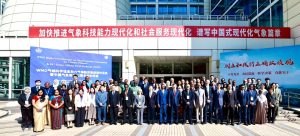
Anosike’s participation also provided an avenue for Nigeria to engage with international counterparts on emerging approaches to meteorological service delivery, artificial intelligence, early-warning systems and climate-risk management.
The combination of the high-level dialogue and the SOFE field exchange offered participating officials both policy-level discussions and practical exposure to technological and institutional approaches being deployed to strengthen early-warning systems.
The engagements ultimately highlighted the growing importance of partnerships among NMHSs, governments, international organisations, development institutions and financing bodies in building climate-resilient societies.
For meteorological agencies such as NiMet, the discussions underscored the need to continually strengthen scientific capabilities while developing strategic partnerships and sustainable financing models capable of supporting modern weather and climate services.
The Beijing and Fujian engagements therefore provided a platform for knowledge sharing, peer learning and exploration of practical solutions aimed at improving early-warning systems and ensuring that climate science is effectively translated into action, investment and greater protection for communities.