

By Julius Peter, Abuja
The Minister of Humanitarian Affairs and Poverty Reduction, Dr. Bernard M. Doro, has reaffirmed the Federal Government’s commitment to strengthening humanitarian coordination, social protection and poverty reduction through a more integrated and nationally owned response system.
Doro stated this when he received the Regional Director of the World Food Programme (WFP) for West and Central Africa, Ms. Kinday Samba, and her delegation during a courtesy visit to the Federal Ministry of Humanitarian Affairs and Poverty Reduction in Abuja.
The meeting focused on deepening the longstanding partnership between Nigeria and WFP, while exploring measures to improve the coordination of humanitarian assistance, food security, nutrition and social protection interventions for vulnerable populations.
The Minister expressed appreciation to WFP for its continued support to Nigeria, particularly in the areas of humanitarian assistance, food and nutrition security and interventions targeted at vulnerable households.
He disclosed that he had recently returned from international engagements, including meetings in the United States with the World Bank and other development partners, where discussions centred on strengthening Nigeria’s social protection architecture and advancing the country’s humanitarian and poverty reduction priorities.
According to him, the Federal Government is seeking to present a new policy direction to the international community through the One Humanitarian – One Poverty Response System (OHOPRS), a flagship initiative of the Ministry designed to strengthen coordination between humanitarian response and poverty reduction interventions.
Doro explained that the initiative was conceived to address the fragmentation and duplication often associated with humanitarian assistance, social protection and poverty reduction programmes.
He said the objective was to establish a coordinated system capable of identifying vulnerabilities, connecting affected households to appropriate interventions and creating sustainable pathways out of poverty.
“The ambition is to move away from fragmented and siloed approaches to humanitarian assistance, social protection and poverty reduction towards a more coordinated system that can effectively identify vulnerabilities, connect interventions and create sustainable pathways for vulnerable households,” the Minister said.
Doro stressed that OHOPRS was not intended to become another short-term government programme, but to be institutionalised as a sustainable national framework capable of surviving changes in political leadership and administration.
He disclosed that the Ministry was finalising a policy memorandum for consideration by the Federal Executive Council, describing the proposed institutionalisation of the system as an important step towards ensuring continuity and long-term implementation.
The Minister expressed the expectation that, if effectively implemented, OHOPRS could position Nigeria as an example of how nationally owned systems can provide more coherent and sustainable responses to humanitarian needs and poverty across Africa and beyond.
He, however, acknowledged that the success of humanitarian interventions depended not only on the availability of resources but also on the ability to deliver assistance to people in need.
Doro identified logistics as one of the practical challenges confronting humanitarian and nutrition interventions, noting that the availability of food and nutritional commodities did not automatically guarantee their timely delivery to vulnerable communities.
He therefore emphasised the need to strengthen systems for the movement and distribution of humanitarian supplies to ensure that assistance reaches intended beneficiaries when required.
On the transition towards greater national ownership of humanitarian response, the Minister said the process must be deliberate, structured and procedural rather than rushed.
He noted that Nigeria needed to strengthen its institutional systems, technical capacity and coordination mechanisms to ensure that greater national ownership translated into a sustainable and effective humanitarian response.
Doro also acknowledged the contributions of development and humanitarian partners to Nigeria’s humanitarian efforts, but stressed that national leadership and ownership remained essential in determining the country’s priorities in humanitarian affairs and social protection.
Earlier, the Director of Humanitarian Affairs in the Ministry, Mrs. Catherina Bulus, welcomed the WFP delegation and expressed appreciation for the organisation’s continued partnership with the Federal Government.
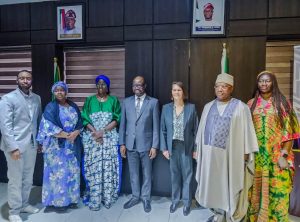
Bulus particularly commended WFP’s support in humanitarian assistance, food security and nutrition interventions, saying the visit provided an opportunity to further strengthen the relationship between both institutions.
She said the engagement would also enable the Ministry and WFP to exchange perspectives on emerging humanitarian priorities and identify additional areas of collaboration in support of vulnerable Nigerians.
In her remarks, WFP Regional Director for West and Central Africa, Ms. Kinday Samba, reaffirmed the organisation’s commitment to supporting Nigeria’s humanitarian and social protection priorities.
Samba said the factors driving food insecurity and poverty were closely interconnected and therefore required integrated responses rather than interventions developed and implemented in isolation.
She noted that social protection programmes could provide an important platform for reaching vulnerable populations who might otherwise remain outside the reach of conventional humanitarian interventions.
According to her, WFP is increasingly shifting its approach towards supporting governments to strengthen their own institutions, systems and capacities instead of establishing parallel structures.
The Regional Director cited Pakistan’s Benazir Income Support Programme as an example of a national social protection system that has survived and evolved through successive administrations.
She encouraged Nigeria to examine lessons from the Pakistani experience, stressing that the objective should not be to replicate the model directly but to identify institutional and implementation approaches that could inform the development of Nigeria’s own social protection framework.
Samba offered WFP’s assistance in facilitating a possible learning engagement between Nigerian authorities and relevant institutions in Pakistan to enable Nigeria to examine the programme’s implementation, institutional arrangements and evolution.
She further assured the Ministry of WFP’s readiness to provide technical expertise and assistance in support of Nigeria’s national objectives, particularly its efforts to strengthen humanitarian coordination and the country’s social protection architecture.
The WFP Regional Director also disclosed that the organisation’s forthcoming Country Strategic Plan for Nigeria would be developed in close consultation with the Federal Government and aligned with national priorities.
She said the Ministry of Humanitarian Affairs and Poverty Reduction would remain an important partner in defining the strategic direction and objectives of WFP’s future engagement in Nigeria.
Samba commended the Federal Government’s efforts towards greater national ownership of humanitarian response and expressed WFP’s willingness to support Nigeria in making the transition effective, sustainable and aligned with the country’s priorities.
The engagement reaffirmed the shared commitment of the Federal Ministry of Humanitarian Affairs and Poverty Reduction and WFP to improving humanitarian coordination, strengthening food and nutrition security, expanding social protection and developing sustainable pathways for vulnerable Nigerians.
The meeting also underscored the importance of stronger government-led systems and closer collaboration between national institutions and development partners in addressing the interconnected challenges of poverty, food insecurity and humanitarian vulnerability in Nigeria.