
By Julius Peter, Abuja
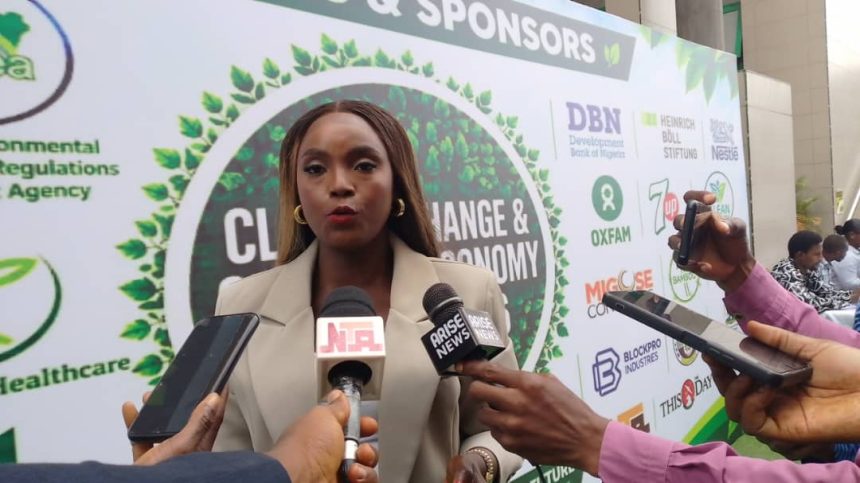
The Founder and Convener of Climate Change and Circular Economy Africa (CCCE Africa), Zigwai A. Fanda, has called for stronger collaboration among governments, businesses, innovators, researchers, communities and development partners to develop practical African solutions to climate change and advance the circular economy across the continent.
Fanda made the call while speaking with journalists at Engineering House, Abuja, on Thursday, during discussions ahead of the CCCE Africa 2026 Conference and Exhibition, scheduled to focus on the theme, “Natural Solutions for a Sustainable Future in the Face of Climate Change.”
She said Africa must move beyond repeated declarations and conversations on climate change and begin translating commitments into practical interventions capable of improving livelihoods, creating jobs, protecting natural resources and strengthening the resilience of communities.
According to her, the continent’s environmental challenges are closely linked to its economic and social development, making it necessary for climate action to be incorporated into national development planning and investment decisions.
Fanda, a chemical engineer and sustainability entrepreneur, said her interest in climate action and the circular economy was driven by the desire to empower people, create economic opportunities and address the environmental and socioeconomic challenges confronting African societies.
She explained that her engineering background had given her an understanding of the relationship between industrial processes, energy consumption, resource utilisation and waste generation.
However, she noted that her experience had also demonstrated that technical solutions alone would not be sufficient to address the continent’s complex environmental challenges.
“Technical solutions alone cannot address Africa’s environmental and socioeconomic challenges.”
She said engineering and technological innovation must therefore be complemented by entrepreneurship, responsible leadership, effective public policies, sound environmental governance and meaningful community participation.
Fanda urged African countries to develop solutions that respond directly to the continent’s peculiar circumstances rather than simply adopting models designed for other parts of the world.
She identified renewable energy, circular economy practices, sustainable agriculture, green manufacturing, climate-smart infrastructure, waste-to-value initiatives and nature-based solutions as areas capable of driving sustainable development across Africa.
She said the continent possessed significant human and natural resources that could be harnessed to build a greener, more resilient and inclusive economy if supported by appropriate policies, investment, technology and skills development.
The CCCE Africa convener also called for stronger environmental governance and effective enforcement of existing environmental regulations.
She argued that policies and regulations would have limited impact if they were not properly implemented, monitored and enforced.
According to her, governments must create an enabling environment in which environmentally responsible businesses and innovations can thrive, while ensuring that environmental standards are respected across industries.
A major component of Fanda’s advocacy is the need to change the perception of waste in Africa.
She argued that waste should not simply be regarded as something to be discarded but as a potential economic resource that can support new businesses, create employment and reduce pressure on the environment.
She said the adoption of circular economy principles could enable African countries to reduce waste, extend the useful life of products and materials, conserve natural resources and create new economic opportunities.
Under a circular economy approach, she explained, resources are kept in use for as long as possible through measures such as reuse, repair, recycling, remanufacturing and resource recovery.
Fanda urged industries to embrace cleaner production methods and improve resource efficiency, while encouraging businesses and entrepreneurs to explore innovative approaches to waste collection, recycling and conversion of waste into useful products.
She said this could simultaneously address environmental problems and create economic value.
The CCCE Africa platform focuses on areas including circular economy and industrial resource optimisation, climate resilience, sustainable energy, green transition and smart infrastructure.
Fanda further emphasised the importance of stronger cooperation between the public and private sectors, stressing that no single institution could tackle Africa’s climate and environmental challenges alone.
She said government had an important role to play through appropriate policies, incentives, standards, infrastructure and regulatory frameworks, while the private sector could contribute investment, technology, innovation and access to markets.
She also identified universities, researchers, environmental organisations, non-governmental organisations, entrepreneurs and young people as important stakeholders in developing and implementing sustainable solutions.
“The key is collaboration rather than working in silos,” she said.
According to her, stronger partnerships would help bridge the gap between research and commercial application by ensuring that viable innovations receive the financing, technical support and policy backing required to move from ideas to implementation.
Fanda maintained that climate change should no longer be treated exclusively as an environmental issue, describing it as a major economic, social and development challenge.
She noted that flooding, erosion, pollution, deforestation, poor waste management, energy insecurity, food insecurity, unemployment and inadequate infrastructure were interconnected challenges that required integrated responses.
She said climate action, when properly designed and implemented, could generate employment, attract investment, improve public health and strengthen the resilience of communities.
According to her, investment in green infrastructure and climate-resilient systems could also help communities and businesses better prepare for environmental shocks and reduce the long-term economic costs associated with climate-related disasters.
The CCCE Africa convener called for greater investment in green skills, climate education and entrepreneurship, particularly among young Africans.
She said young people represented a major resource for Africa’s transition to a sustainable economy and should be equipped with the technical, entrepreneurial and leadership skills required to participate effectively in emerging green industries.
Fanda said the continent needed a new generation of engineers, entrepreneurs, innovators, researchers and environmental professionals capable of developing solutions suited to African realities.
She encouraged governments, educational institutions, development organisations and the private sector to expand training and capacity-building programmes that would prepare young people for opportunities in renewable energy, sustainable agriculture, recycling, waste management, green manufacturing and other emerging sectors.
Fanda explained that the CCCE Africa 2026 Conference and Exhibition was designed to provide a platform for government representatives, industry leaders, investors, development institutions, environmental experts, academics, innovators and young people to discuss practical pathways towards sustainable development.
She said the event would promote strategic industry dialogue, showcase sustainable innovations, provide opportunities for capacity building and facilitate partnerships and investment in green solutions.
According to her, the objective is to create an ecosystem in which ideas can connect with innovation, innovation can connect with industry, and viable solutions can connect with financing and government support.
She said such an ecosystem would help accelerate the transition from discussions about sustainability to actual projects capable of delivering measurable environmental and economic benefits.
Fanda also cautioned against approaching climate change solely from the perspective of Africa’s vulnerability.
While acknowledging the serious environmental and socioeconomic risks posed by climate change, she said the continent should also recognise the opportunities presented by the global transition towards a greener economy.
She said Africa could leverage climate action, circular economy practices and green innovation to create new industries, jobs, investment opportunities and markets while protecting its ecosystems.
According to her, the transition to a sustainable economy should therefore be viewed not merely as an environmental obligation but as an opportunity to strengthen Africa’s industrial and economic base.
Fanda said one of the major mindset changes required across the continent was to stop viewing environmental sustainability as an additional burden on governments and businesses.
Rather, she said, sustainability should be regarded as an investment in economic growth, public health, national resilience, community wellbeing and the future of coming generations.
She called for environmental sustainability to become an integral component of national and sub-national development planning, stressing that climate considerations should be incorporated into infrastructure, energy, agriculture, industrial and economic policies.
She also urged businesses to recognise that efficient use of resources, cleaner production and responsible waste management could improve competitiveness while reducing environmental impact.
Fanda said Africa’s transition to a green and circular economy would require sustained political commitment, private-sector investment, technological innovation, community ownership and strong institutions.
She added that development partners also had an important role to play in providing technical expertise, financing, knowledge transfer and capacity development.
The CCCE Africa initiative, she said, seeks to contribute to positioning Africa as a leader in climate-conscious industrialisation by bringing governments, businesses, innovators and communities together around practical solutions.
She stressed that the continent’s response to climate change must ultimately be measured not only by the number of conferences or policies produced but by the extent to which those commitments translate into cleaner communities, resilient infrastructure, new businesses, jobs, improved livelihoods and a healthier environment.
The message from the Abuja engagement, she said, was therefore clear: Africa must move from rhetoric to implementation and harness its human capital, natural resources, innovation and entrepreneurial energy to build a sustainable future.