

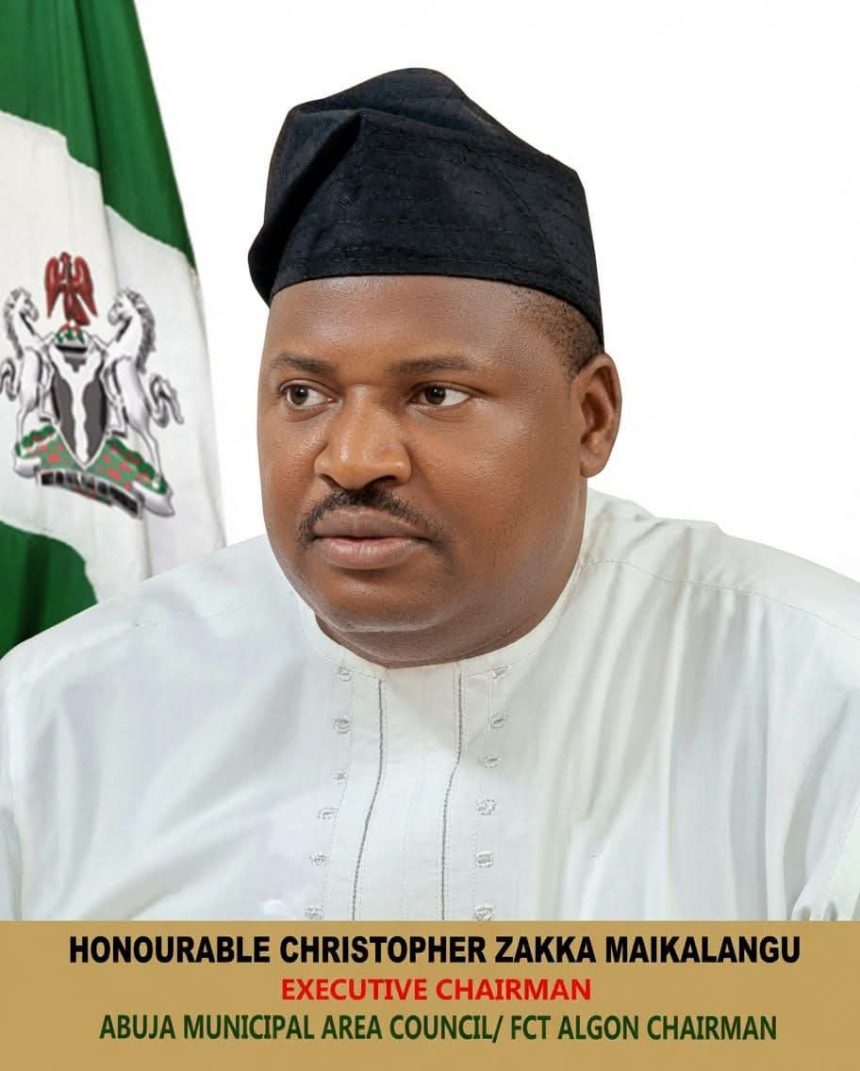
By Kingsley Madaki
Chief Press Secretary to the Executive Chairman, AMAC
The story of Hon. Christopher Zakka Maikalangu, Executive Chairman of the Abuja Municipal Area Council (AMAC) and Chairman of the Association of Local Governments of Nigeria (ALGON), Federal Capital Territory (FCT) Chapter, is one of resilience, grassroots mobilisation, community trust and purposeful leadership.
From humble beginnings in Garki Village to the leadership of Nigeria’s foremost municipal area council, Maikalangu’s journey demonstrates how perseverance, service to the community and the confidence of the people can transform an ordinary beginning into an extraordinary public leadership career.
His rise did not begin in the corridors of political power. It began within the community he grew up in, where he experienced first-hand the challenges confronting ordinary families and developed a deep understanding of the aspirations and struggles of the people.
Humble Beginnings and the Struggle for Education
Christopher Zakka Maikalangu was born on December 23, 1978, into the indigenous family of Zakka Maikalangu in Garki Village, Abuja.
His childhood was marked by financial difficulties, circumstances that made the pursuit of formal education challenging. He commenced his primary education at Garki Primary School, where he began laying the foundation for what would eventually become a remarkable journey into public service.
However, the challenges confronting his family did not extinguish his ambition. Faced with circumstances that delayed his secondary education, the young Maikalangu remained determined to improve himself.
Through night classes and private studies, he continued his education, demonstrating the discipline and perseverance that would later become defining features of his public life.
His experience of hardship also gave him a personal understanding of the difficulties faced by people in underserved communities. Rather than allowing his circumstances to define his future, he turned them into a source of strength and empathy.
“My People Asked Me to Contest”
By 2009, Maikalangu had settled into private business in Garki. He was not seeking political office and, by his own account, was primarily concerned with his business, family and community.
Yet, his involvement in community affairs gradually attracted the attention of residents and community leaders.
His generosity, accessibility and willingness to assist people in need earned him the respect of elders, youths, traders and other community stakeholders. He became known not merely as a businessman but as someone whom people could approach when they had problems.
It was this reputation that eventually drew him into politics.
In 2012, members of his community approached him and urged him to contest for political office, believing that his knowledge of their challenges and his close relationship with the people made him suitable to represent them.
Recalling the moment, Maikalangu said:
“I was just doing my business, keeping to myself and helping where I could. But my people came to me and said, ‘You understand our pain, you live with us, you must contest as our Councillor.'”
The appeal from his community marked a turning point.
Rather than viewing politics as a personal ambition, Maikalangu embraced it as a responsibility entrusted to him by the people.
Entry Into Grassroots Governance
In 2013, Maikalangu contested the election to represent Garki Ward as a Councillor and emerged victorious.
His entry into the Abuja Municipal Area Council legislature provided him with an opportunity to translate his understanding of grassroots challenges into practical governance.
As a Councillor, he became increasingly involved in legislative and administrative responsibilities, while also maintaining close contact with residents.
He subsequently served in positions including Supervisory Councillor and Special Adviser/Senior Special Assistant roles, experiences that broadened his understanding of local government administration and public policy.
The period was significant in shaping his leadership philosophy.
Rather than distancing himself from the grassroots after assuming office, Maikalangu continued to maintain contact with the communities that had produced him.
His political growth was therefore built largely from the bottom up—from ward-level representation to broader responsibilities within local administration.
From Councillor to AMAC Chairman
Years of grassroots political experience eventually prepared Maikalangu for a larger leadership responsibility.
In the February 2022 FCT Area Council elections, he contested the chairmanship of the Abuja Municipal Area Council and secured victory.
He was subsequently sworn in as Executive Chairman of AMAC on June 14, 2022.
His emergence placed him at the helm of one of the most strategically important area councils in the Federal Capital Territory.
AMAC occupies a unique position within the FCT because of its central role in the administration of communities within Nigeria’s capital territory. Its rapidly expanding population, commercial activities, urban development and infrastructure needs present significant governance challenges.
For Maikalangu, however, the responsibility represented an opportunity to apply the lessons he had learned during his years at the grassroots.
In 2026, he was re-elected as Executive Chairman of AMAC, giving him another mandate to continue his administration’s development agenda.
His peers across the six Area Councils of the Federal Capital Territory also elected him Chairman of ALGON, FCT Chapter, further expanding his responsibilities within the local government system.
Looking Beyond Internally Generated Revenue
One of the defining features of Maikalangu’s administration has been the effort to look beyond traditional sources of local government revenue.
With Abuja’s rapid population growth and expanding economic activities placing increasing demands on infrastructure and public services, the AMAC administration recognised the need to explore additional avenues for economic development.
Maikalangu consequently began pursuing international partnerships, investment opportunities and economic engagements aimed at positioning AMAC as a destination for responsible investment.
From late 2022, he participated in international trade, investment and governance engagements, including diplomatic and economic missions and high-level business forums in Europe and Africa.
The objective was to expose AMAC to international investors and development partners while identifying opportunities capable of generating employment, expanding the local economy and improving public services.
Attracting Investment Into Key Sectors
The investment drive under Maikalangu’s leadership has focused on sectors considered critical to the future development of the municipal area.
These include waste recycling and modern waste management technologies, agricultural processing, renewable energy and urban development.
The focus on waste management is particularly significant given Abuja’s continuing urban expansion and the growing volume of waste generated across communities.
By seeking partnerships capable of introducing modern recycling and waste-management technologies, the administration aims to address an environmental challenge while also creating economic opportunities.
Agricultural processing represents another area of interest, particularly because it can help connect rural and peri-urban communities to larger markets, reduce post-harvest losses and create jobs.
Similarly, renewable energy and urban development have been identified as areas where investment can support sustainable growth in the nation’s capital.
Promoting a Better Business Environment
Maikalangu’s investment strategy has also placed emphasis on governance and creating an environment in which investors can operate with confidence.
Through his engagement with the Open Government Partnership framework, the administration has sought to promote transparency, accountability and improved public-sector engagement.
The emphasis on transparent fiscal policies and security is intended to strengthen confidence among prospective investors and development partners.
For Maikalangu, attracting investment is not simply about bringing money into AMAC. It is about creating an economic ecosystem that can generate employment, improve infrastructure, support local businesses and ultimately enhance the quality of life of residents.
A Journey Rooted in Community Trust
Perhaps the most striking feature of Maikalangu’s political journey is that his entry into public service was driven largely by community demand.
He did not begin as a career politician.
He began as a young man from Garki who understood hardship, pursued education despite financial challenges, established himself in business and built relationships within his community.
When his people asked him to represent them, he accepted the responsibility.
That decision eventually took him from the ward level to the leadership of AMAC and the chairmanship of ALGON in the FCT.
His story therefore illustrates the power of grassroots legitimacy in public leadership.
The Road Ahead
As Maikalangu begins his second term as Executive Chairman of AMAC, expectations remain high.
The challenges facing the municipal council are considerable, ranging from population growth and urbanisation to infrastructure, waste management, security, employment, environmental sustainability and the need to expand economic opportunities.
His administration’s emphasis on investment, partnerships and international engagement suggests an ambition to position AMAC not only as an administrative unit but as an increasingly competitive economic and investment destination within the Federal Capital Territory.
For a man whose journey began in the modest surroundings of Garki Village, the trajectory is remarkable.
From overcoming educational and financial difficulties to becoming a councillor, then a senior grassroots administrator, and ultimately Executive Chairman of AMAC, Maikalangu’s story is a testament to perseverance and the confidence of the people.
His journey from grassroots to grace is, ultimately, a story about service.
It is the story of a man who was called by his people, answered that call, and has continued to build his political career around the principle that leadership begins with understanding the people one is called to serve.
As Maikalangu’s journey continues, the central lesson remains clear: public leadership is strongest when it is rooted in the community, sustained by trust and directed towards creating opportunities for the people.