

By Julius Peter
From laboratories to the marketplace, the National Agency for Science and Engineering Infrastructure is attempting to rewrite the story of Nigerian innovation under Khalil Suleiman HaliluFor decades, Nigeria’s science and technology story has been marked by a frustrating contradiction: the country has never been short of brilliant minds, research institutions, engineers, inventors or ambitious technological ideas, yet too many of those ideas have struggled to cross the difficult bridge between the laboratory and the marketplace.
Research papers were produced. Prototypes were developed. Patents were obtained. Conferences were held.
But factories remained scarce, commercial production was limited and Nigeria continued to import many of the technologies and manufactured goods it had the capacity to develop locally.
It is against that long-standing challenge that the three-year tenure of Khalil Suleiman Halilu as Executive Vice Chairman and Chief Executive Officer of the National Agency for Science and Engineering Infrastructure (NASENI) should be examined.
Since taking over the leadership of NASENI in September 2023, Halilu has sought to reposition the agency from an institution predominantly associated with research and development into a more commercially oriented organisation focused on technology transfer, industrialisation and the movement of indigenous innovations from concept to market.
As NASENI marks three years of the Halilu administration, the agency says its transformation is being driven by a simple proposition: Nigeria does not merely need to invent; it needs to manufacture.
And it does not merely need prototypes.It needs products, factories, businesses, skills, jobs and industries.
That philosophy has become the central theme of Halilu’s tenure.At the heart of the transformation is what NASENI describes as the 3Cs — Creation, Collaboration and Commercialisation.
The philosophy is straightforward.Creation involves developing or adapting technologies to solve Nigerian problems.
Collaboration involves working with private companies, foreign technology partners, universities, research institutions, investors and other government agencies.
Commercialisation is the final and perhaps most difficult stage: taking an innovation beyond the laboratory and turning it into a product that can be manufactured, sold, adopted and sustained.
Halilu has repeatedly argued that Nigeria’s greatest weakness has not necessarily been a shortage of ideas.
Rather, it has been the absence of a connected system capable of taking those ideas through development, financing, manufacturing and market penetration.
That diagnosis has shaped NASENI’s strategy since 2023.In a statement marking the agency’s third anniversary, Halilu said the objective was to close the gap between Nigeria’s research capacity and industrial output by connecting innovation, infrastructure, skilled manpower, finance, manufacturing and markets.
It represents an important shift in emphasis.The traditional research model asks: What can we invent?The new NASENI model increasingly asks: What can we invent, manufacture, sell and scale?Before an institution can drive industrial transformation outside itself, it must first be capable of delivering inside.
One of the first priorities of the Halilu administration was therefore institutional reform.
NASENI says it strengthened its project-management and implementation structures, introduced clearer links between budgets and measurable deliverables, strengthened internal audit and reporting, digitised key processes and deployed an Enterprise Resource Planning system.
The reforms were designed to address a familiar problem in public-sector project implementation: initiatives can survive for years on paper without reaching completion or producing measurable outcomes.
Under the new approach, the agency says projects are increasingly being managed around timelines, responsible teams, outputs and measurable national objectives.
This is significant because industrial development is rarely produced by isolated projects.
It requires an institutional system capable of moving consistently from research to design, from design to production and from production to markets.
NASENI’s challenge, therefore, is not simply to produce impressive technologies.It is to build an organisation capable of reproducing success.
One of the most visible aspects of the transformation has been the push to commercialise NASENI technologies.
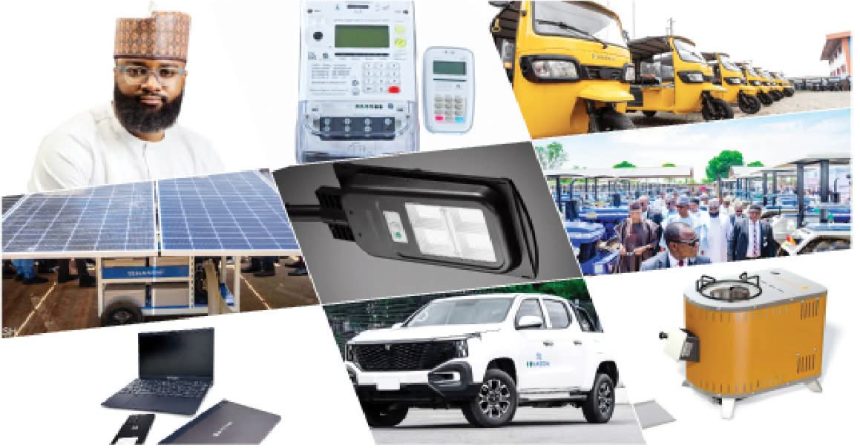
The agency says it has developed and introduced more than 40 products across areas including renewable energy, mobility, agriculture, healthcare, information technology, clean cooking and education.
Earlier NASENI documentation and reporting put the number at more than 44 commercialised or market-ready products.
Among the technologies showcased under Halilu have been locally developed or assembled laptops, Android smartphones, lithium batteries, solar street lights, solar irrigation systems, electric motorcycles, electric tricycles and other clean-energy products.
A country that spends billions of dollars importing technology is vulnerable to foreign exchange pressures, supply-chain disruptions and external technological dependence.
Every locally manufactured product that can compete successfully in the Nigerian market therefore has implications beyond the product itself.
It represents potential savings in foreign exchange, local employment, skills acquisition and the development of supplier networks.
But the ultimate measure will not be the number of products unveiled at exhibitions.It will be how many survive commercially.That is where the real test of NASENI’s strategy begins.
Nigeria’s history is littered with technological prototypes that generated excitement at launch but failed to achieve sustained production.
This is why NASENI’s emphasis on commercialisation is arguably the most consequential part of Halilu’s agenda.
In May 2024, for example, the agency unveiled a NASENI laptop, Android smartphone, lithium battery and 300-watt LED solar street lamp, while also highlighting previously developed solar irrigation systems and electric mobility products. NASENI said some products were already in the market while others had been pre-booked.
The crucial question is what happens after the unveiling.Can the products be manufactured consistently?Can they compete on price and quality?Can they secure large institutional and private-sector buyers?Can local suppliers provide components?Can the technologies generate intellectual property and export opportunities?Can the companies involved survive without permanent government subsidy?
Those questions will ultimately determine whether NASENI is experiencing a genuine industrial transformation or simply a more efficient cycle of prototype development and product launches.
Building the bridge between research and industry
To strengthen that bridge, NASENI has also developed programmes designed to support innovators before they reach the factory floor.
Among them is the NASENI Innovation Hub, established in partnership with AfriLabs to provide infrastructure, mentorship, capacity building and support for Nigerian innovators and startups seeking to commercialise their technologies.
The agency has also introduced InnovateNaija, a national innovation challenge designed to identify promising innovators across the 36 states and the Federal Capital Territory.
The programme announced a total prize pool of N250 million, including N2.5 million for each of the 37 state and FCT winners and a N100 million grand prize for the overall winner.
The significance of such programmes lies in their potential to create a pipeline.
Instead of waiting for researchers to independently find funding, manufacturing partners and markets, NASENI is attempting to create a structured pathway from idea identification to product development and commercialisation.
That is closer to the model used by successful innovation ecosystems around the world.
Another major component is the agency’s Research Commercialisation Grant Programme.In 2025, NASENI said it awarded N229 million to 14 researchers working on projects in agriculture, clean energy, healthcare, mobility and digital security.
The objective is not simply to finance academic research.It is to identify research with commercial potential and provide the support necessary to move it closer to application.
This approach attempts to tackle one of Nigeria’s persistent structural problems: the disconnect between universities, research institutes and industry.
A researcher may develop a promising technology without having the resources to manufacture it.
A manufacturer may have the capacity to produce it without having access to the research.
An investor may have the money but lack the technical expertise to assess it.
NASENI’s emerging role is to occupy the space between all three.
Perhaps the most ambitious element of Halilu’s tenure has been the emphasis on partnerships.
Rather than attempting to develop every technology internally, NASENI has increasingly pursued collaboration with international technology companies, domestic manufacturers, government institutions and research organisations.
The agency has reported major agreements and investment interests involving companies from China and other countries.
In October 2023, shortly after Halilu assumed office, NASENI signed three agreements with Chinese partners with a combined reported value of $2 billion, while ten additional Chinese companies submitted letters of intent relating to projects collectively valued at another $4 billion. The proposed areas included solar energy, natural gas, vehicle manufacturing, training, drone technology and industrial parks.
But there is an important distinction that must be maintained.
A memorandum of understanding is not the same thing as a factory.
An investment commitment is not the same thing as capital deployed.
A letter of intent is not the same thing as a functioning production line.
This distinction is essential when assessing NASENI’s three-year record.
The reported value of partnerships is impressive, but the real industrial impact must be measured by what has actually been built, what is producing, how much is being produced, how many Nigerians are employed and how much technology has genuinely been transferred.
Energy has emerged as one of the major areas of NASENI’s industrial strategy.
The agency has pursued solar technologies, batteries, solar irrigation and other renewable-energy solutions.
One of the larger ambitions is the development of the NASENI Solar Industrial Park in Gora, Nasarawa State, designed to support the local manufacture of solar components.
The objective goes beyond installing solar panels.
It is to develop an industrial ecosystem capable of producing components locally, reducing dependence on imported equipment and eventually supporting exports.
If successfully executed, such a project could have significance far beyond NASENI.
Nigeria’s energy deficit remains one of the country’s most persistent constraints on industrial development.
Local production of solar equipment, batteries and related technologies could therefore support both energy security and manufacturing.
Industrial parks do not create industries simply because infrastructure is announced.
They require reliable power, roads, financing, skilled labour, component suppliers, predictable regulation and, most importantly, customers.
Transport is another sector in which NASENI has attempted to connect technology development with industrial production.
Electric motorcycles, electric tricycles and electric vehicles have featured prominently in the agency’s commercialisation agenda.
This is strategically important as Nigeria confronts the rising cost of petroleum products and searches for alternatives to conventional internal-combustion transport.
Electric mobility could eventually reduce fuel dependence, create new manufacturing opportunities and develop expertise in batteries, electronics, software and vehicle engineering.
But Nigeria’s electric-vehicle ambitions face serious obstacles.Charging infrastructure remains limited.Battery costs remain significant.Electricity supply is unreliable in many areas.Consumer purchasing power is constrained.And the local automotive supply chain remains underdeveloped.
NASENI’s challenge is therefore not simply to build an electric vehicle.It is to help create the ecosystem that makes electric mobility commercially viable.The agency has also entered the compressed natural gas space.
NASENI has established CNG reverse-engineering capacity and training initiatives aimed at developing local expertise in vehicle conversion and natural-gas technology.
This aligns with Nigeria’s broader effort to reduce dependence on petrol and cushion the impact of fuel-price increases.
If Nigerian engineers can develop and manufacture conversion systems, components and related infrastructure locally, CNG can become more than a temporary response to fuel-price pressures.
The country needs standards, safety systems, trained technicians, reliable gas infrastructure and a sufficiently large market to make the technology economically attractive.
Agriculture: technology meeting the rural economy
Agriculture is another area where NASENI’s strategy could have a direct impact on ordinary Nigerians.
The agency has developed and promoted technologies such as solar irrigation systems and agricultural machinery.
Nigeria cannot industrialise sustainably without transforming agricultural productivity.
Solar-powered irrigation, mechanisation and technology-enabled farming can potentially reduce production costs, increase the number of farming seasons and improve food security.
More importantly, agricultural technology can create demand for Nigerian manufacturing.
A solar irrigation system requires panels, pumps, batteries, electronics, control systems and maintenance services.
The real success therefore comes not from selling one machine, but from creating an industry around the machine.
NASENI’s portfolio has also extended into healthcare technology and assistive devices.
The agency has reported work around medical diagnostics and the establishment of manufacturing capacity for assistive technology devices.
This is another area where local production could have strategic value.
Nigeria spends substantial resources importing medical equipment and devices.
Local production could reduce costs, shorten supply chains and create opportunities for engineers, biomedical scientists, technicians and manufacturers.
But medical technology is also a highly regulated field.
Commercial success will require not merely engineering capability but rigorous testing, certification, quality assurance, clinical validation and regulatory approval.
In other words, NASENI’s challenge increasingly extends beyond invention.
It must help build trust in Nigerian-made technology.
The agency has also expanded its focus into areas of strategic national importance, including defence-related technologies, unmanned aerial systems and other engineering capabilities.
NASENI’s milestone documentation lists defence-equipment manufacturing, aircraft recovery and repair initiatives, as well as an unmanned aerial vehicle training school among its industrialisation efforts.
This is potentially significant at a time when Nigeria is spending heavily on national security.
A stronger domestic defence-industrial base could reduce dependence on imported equipment and allow Nigeria to develop technologies adapted specifically to its security challenges.
But defence technology carries an even higher requirement for quality, reliability, testing and institutional coordination.
The ultimate test is whether Nigeria can move from assembling or adapting equipment to developing proprietary technologies and sustainable manufacturing capabilities.
This is why skills development is central to the NASENI strategy.
Technology transfer means little if Nigerian workers do not acquire the technical knowledge required to operate, maintain and eventually improve the technology.
The agency’s programmes have therefore increasingly emphasised training, innovation challenges, engineering development and partnerships with educational and research institutions.
The Innovation Hub and related initiatives are intended to give young Nigerians access to infrastructure, mentorship and commercialisation support.
This is particularly important because industrialisation is ultimately a human-capital project.
And the ability to design, maintain, improve and eventually export technology is what separates genuine technology transfer from simple technology acquisition.
Halilu’s international engagement has also attracted considerable attention.
NASENI has pursued relationships with partners in China, the Czech Republic, the United Arab Emirates, the United Kingdom and elsewhere.
These relationships are potentially valuable because no modern industrial economy develops entirely in isolation.
Manufacturing systems are adapted to local marketsThe danger, however, is that international partnership can become little more than importation under another name.
True technology transfer requires Nigerian engineers and firms to acquire the ability to understand, operate, modify and eventually improve the technology.
The ultimate goal should therefore not be “made in Nigeria using foreign technology” indefinitely.
It should be a progression toward “designed, engineered, manufactured and eventually exported from Nigeria.”
And it is the one by which NASENI’s international partnerships should eventually be judged.Industrial policy ultimately comes back to employment.
NASENI has reported tens of thousands of jobs and significant wider economic impact from projects implemented under the Halilu administration. Previous reporting cited more than 30,000 direct jobs associated with projects during the first two years.
These claims are important, but they deserve careful measurement.
How many are generated by NASENI’s own factories and how many arise indirectly through partner companies?
Such questions should not be interpreted as an attempt to diminish the agency’s achievements.
They are precisely the questions that must be asked if public-sector industrial policy is to be evaluated seriously.
Perhaps the most important change under Halilu is therefore conceptual.
NASENI increasingly presents itself not simply as a research agency but as a platform connecting rese