
By Julius Peter
Nigeria’s Economic Management Team (EMT) has taken steps to strengthen coordination between the country’s fiscal and monetary authorities, approving the establishment of an inter-agency committee to harmonise the economic assumptions underpinning government planning, budgeting and monetary policy.
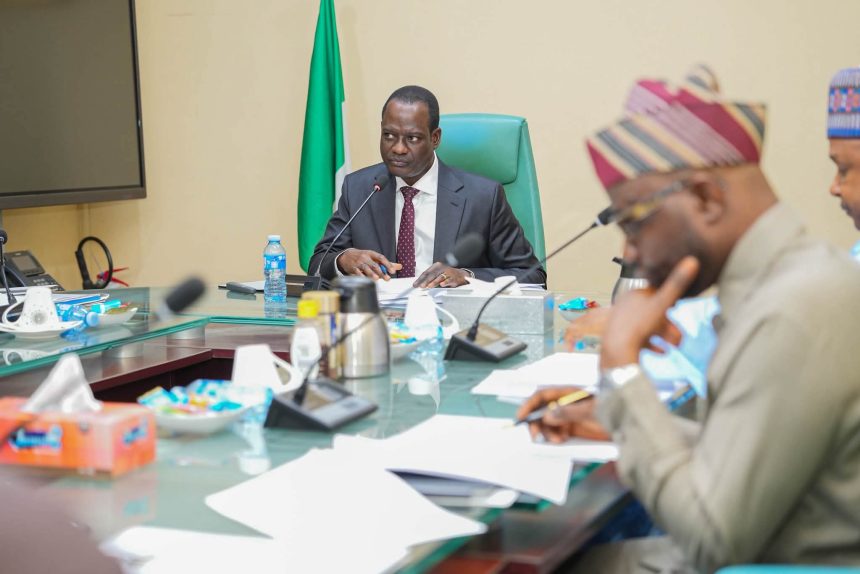
The decision, reached at a recent meeting of the EMT in Abuja, is aimed at reducing discrepancies in economic projections and ensuring that government institutions work with a common set of assumptions on critical indicators such as inflation, exchange rates, oil prices, economic growth and other variables that influence the preparation and implementation of the national budget.
The move comes against the backdrop of improving headline economic indicators, with the Federal Government highlighting stronger economic growth, rising foreign reserves, an improving foreign-exchange position and Nigeria’s return to the FTSE Russell Frontier Market Index as signs of increasing macroeconomic stability.
The National Bureau of Statistics (NBS) reported that Nigeria’s real Gross Domestic Product (GDP) expanded by 4.43 per cent year-on-year in the second quarter of 2026, up from 4.23 per cent in the corresponding quarter of 2025. The latest performance represents the strongest quarterly growth recorded since the third quarter of 2024.
The improvement, according to the government, reflects stronger performances across several parts of the economy, including agriculture, manufacturing, oil and gas and services.
The development has provided fresh momentum to the Federal Government’s argument that recent economic reforms are beginning to translate into stronger macroeconomic fundamentals, although economists and households continue to focus on whether improvements in headline indicators will translate into sustained increases in purchasing power and living standards.
At the centre of the EMT meeting was the need to bring greater consistency to Nigeria’s economic planning.
The committee approved the establishment of a committee responsible for harmonising macroeconomic assumptions across fiscal and monetary institutions. The objective is to ensure that the assumptions used by the Federal Government in preparing budgets are better aligned with those used by monetary authorities and other key economic institutions.
For years, differences in assumptions and projections have complicated economic planning, particularly when actual economic outcomes diverge significantly from the parameters used to prepare annual budgets.
Issues such as oil prices, production levels, inflation, exchange rates, interest rates and economic growth have direct implications for government revenue, expenditure, borrowing requirements and debt sustainability.
The EMT’s latest decision is therefore designed to tighten the relationship between economic forecasts and actual outcomes.
Recent reports indicate that the committee will also examine inconsistencies in how important economic indicators are reported within government and to external stakeholders.
The Ministry of Finance is expected to play a coordinating role in ensuring greater consistency in national economic data, while relevant agencies will continue to provide information within their respective mandates.
Finance Minister and Coordinating Minister of the Economy, Wale Edun, said the approach was intended to ensure that the numbers used for planning more closely reflect economic realities.
A harmonised framework could also provide investors with greater clarity, particularly at a time when Nigeria is seeking to attract long-term domestic and foreign investment.
The EMT’s revised framework reportedly envisages more regular economic reviews, stronger fiscal and monetary policy coordination and closer monitoring of government priorities and financing requirements.
The decision to improve economic coordination comes as Nigeria records stronger growth.
According to the NBS, real GDP expanded by 4.43 per cent in Q2 2026, compared with 4.23 per cent in Q2 2025.
The State House said the latest figures showed growth in agriculture, manufacturing, oil and gas and services, with the services sector continuing to account for the largest share of aggregate economic output. Nominal GDP stood at N119.27 trillion in the second quarter, representing an 18.43 per cent increase from N100.7 trillion recorded in Q2 2025.
The EMT also noted that the economy grew by approximately 17 per cent in US-dollar terms during the first half of 2026, a development that reflects both economic expansion and improvements in the exchange-rate environment.
The figures are significant because Nigeria’s economic performance is increasingly being assessed not only in naira terms but also in relation to the country’s capacity to generate foreign exchange, attract investment and strengthen its position in international markets.
However, the latest growth figures do not eliminate the challenges facing the economy.
The International Monetary Fund, in its 2026 Article IV assessment, projected Nigeria’s full-year real GDP growth at 4.1 per cent and noted that reforms had improved macroeconomic outcomes and resilience, while also warning that higher food and transport costs, inflationary pressures, poverty and food insecurity remained significant challenges.
This means that the government faces the dual task of sustaining growth while ensuring that the benefits of expansion are increasingly felt by households and businesses.
Another major development highlighted by the EMT is the increase in Nigeria’s external reserves.
The country’s reserves have risen above $54 billion, representing the highest level in almost 18 years, according to recent government and media reports citing Central Bank of Nigeria data.
The increase strengthens Nigeria’s external position and provides an additional buffer against external shocks.
Higher reserves can also support confidence in the foreign-exchange market by improving the country’s capacity to meet external obligations and manage periods of pressure on the naira.
The naira has also strengthened into the N1,300 range against the US dollar in early September, its strongest level in about two years, according to reports on the EMT meeting.
The improved external position marks a notable shift from the severe foreign-exchange pressures that have characterised parts of Nigeria’s recent economic experience.
Nevertheless, maintaining the gains will depend on the sustainability of foreign-exchange inflows, oil and non-oil exports, portfolio and direct investment, as well as continued confidence in the country’s economic policies.
The EMT also welcomed Nigeria’s reclassification by global index provider FTSE Russell from “Unclassified” to Frontier Market status.
The reclassification is scheduled to take effect on September 21, 2026, marking Nigeria’s return to the FTSE Russell Frontier Market Index after about three years.
The development is important for Nigeria’s capital market because index classifications influence how international institutional investors assess and allocate funds to markets.
A return to the Frontier Market classification could increase the visibility of Nigerian equities among global investors and potentially support greater foreign participation in the Nigerian capital market.
It also provides another indication of the broader effort to restore confidence in Nigeria’s financial markets.
The government has linked recent improvements in economic and financial indicators to reforms aimed at creating a more stable and investment-friendly environment.
Beyond short-term macroeconomic indicators, the EMT is also looking at sectors capable of driving sustained long-term growth.
Agriculture featured prominently in the meeting as the government considers how to achieve its ambition of building a $1 trillion economy by 2030.
Nigeria’s agricultural sector remains central to the country’s economic prospects because of its importance to food production, employment, rural livelihoods, manufacturing inputs and exports.
But the sector continues to face structural constraints, including inadequate mechanisation, limited access to affordable credit, poor storage facilities, post-harvest losses, insufficient processing capacity, infrastructure gaps and difficulties accessing export markets.
The government’s strategy includes efforts to reduce post-harvest losses, expand mechanisation and agro-processing, strengthen agricultural financing, recapitalise the Bank of Agriculture and establish new credit opportunities for smallholder farmers.
The government is also targeting an increase in agriculture’s share of private-sector credit to 10 per cent by 2030.
The emphasis on agro-processing is particularly significant.
Rather than relying solely on the export of raw agricultural commodities, increased processing could allow Nigeria to capture more value within the domestic economy, create industrial jobs and increase non-oil export earnings.
For the $1 trillion ambition to become sustainable, therefore, agriculture will need to evolve from predominantly primary production towards a more integrated value chain involving production, storage, processing, logistics, manufacturing and exports.
The EMT also reviewed preparations for Nigeria to host two major continental trade and investment events — the Creative Africa Nexus (CANEX) 2026 and the Intra-African Trade Fair (IATF) 2027 in Lagos.
The events are expected to provide opportunities for Nigerian businesses to connect with investors, buyers and companies from across Africa and beyond.
For the Federal Government, their significance extends beyond hosting international gatherings.
Nigeria is seeking to use its position as Africa’s largest economy and one of the continent’s biggest consumer markets to strengthen regional trade, promote Nigerian products and services and attract investment.
Preparations for the events are therefore being linked to broader efforts to improve customs facilitation, financing and the operating environment for businesses.
The Ministry of Finance has been directed to coordinate funding and customs facilitation for the events in collaboration with the Ministry of Industry, Trade and Investment.
The events could also provide a platform for Nigerian creative industries, manufacturers, agricultural businesses and exporters to gain greater access to African markets.
While the latest indicators provide grounds for optimism, the government’s economic agenda continues to face a critical test: translating macroeconomic improvements into tangible improvements in the lives of Nigerians.
Economic growth, higher reserves and stronger investor sentiment are important indicators of stability, but households and businesses also judge the economy by the cost of food, transportation, housing, energy, credit and other necessities.
The IMF has similarly acknowledged improvements in Nigeria’s macroeconomic resilience while stressing that living conditions remain difficult for many Nigerians, with poverty and food insecurity continuing to pose serious challenges.
For policymakers, this makes the next phase of economic management particularly important.
A stronger economy must not only produce better headline numbers; it must also generate jobs, expand productive capacity, improve household incomes and increase access to affordable goods and services.
The EMT’s latest decisions suggest that the Federal Government is attempting to move Nigeria’s economic management towards a more coordinated and data-driven framework.
The proposed harmonisation of fiscal and monetary assumptions could reduce policy inconsistencies, improve the credibility of budget projections and provide businesses and investors with greater certainty.
At the same time, the government is positioning stronger GDP growth, rising reserves, exchange-rate stability, improved investor visibility and sectoral reforms as building blocks for a larger and more diversified economy.
Nigeria’s $1 trillion economic ambition will require sustained investment, policy consistency, productivity improvements and stronger institutions. It will also require continued reforms in agriculture, manufacturing, infrastructure, energy, finance and trade.
For the EMT, the task is therefore no longer simply to respond to economic pressures as they emerge. It is increasingly about building a coordinated framework capable of anticipating those pressures, aligning government institutions and ensuring that economic policy translates into measurable improvements in national productivity and living standards.
The latest meeting signals an effort to do precisely that: establish a common economic direction, strengthen coordination among the institutions responsible for managing the economy and use emerging improvements in Nigeria’s economic fundamentals as a foundation for longer-term growth.
Whether those gains can be sustained — and ultimately translated into broader prosperity — will depend on how effectively the decisions taken in Abuja are implemented across the economy.