

By Julius Peter, Abuja
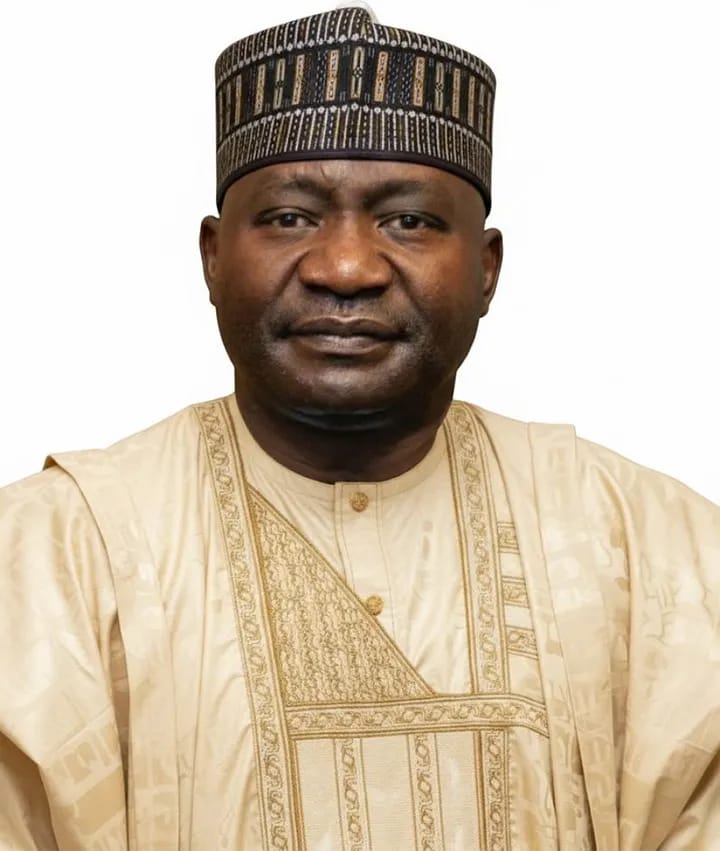
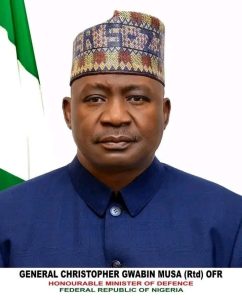
For General Christopher Gwabin Musa (Rtd), OFR, the journey from the command of Nigeria’s Armed Forces to the nation’s defence policy establishment has been one marked by operational responsibility, institutional reform and an expanding focus on technology, local defence production and military welfare.
His tenure as Chief of Defence Staff (CDS), which began in 2023, placed him at the centre of Nigeria’s military response to terrorism, banditry, kidnapping and other security threats confronting the country.
His subsequent emergence as Minister of Defence in December 2025 broadened that responsibility. From the battlefield and military command structure, he moved into the wider policy arena, where defence planning, border security, veterans’ welfare, defence technology, international partnerships and indigenous military production became central components of his mandate.
The two assignments are different in scope, but together they provide an insight into the direction of Nigeria’s defence architecture under his leadership.
When General Musa became Chief of Defence Staff, one of the major issues confronting the Armed Forces was how to strengthen coordination among the services while responding to increasingly complex security threats.
Under his leadership, Defence Headquarters established the Joint Doctrine and Warfare Centre in Abuja and a dedicated Department of Training.
The initiatives were designed to improve joint military operations, strengthen doctrine and enhance the preparedness of personnel across the Army, Navy and Air Force.
The emphasis on jointness reflected the changing character of Nigeria’s security environment. Terrorism, banditry, kidnapping, arms trafficking and other threats often operate across geographical and operational boundaries, requiring military services to share intelligence and coordinate their capabilities.
The institutional reforms were therefore aimed at creating a more integrated Armed Forces capable of responding collectively to national security challenges.
Another important component of Musa’s tenure as CDS was the strengthening of Special Forces capabilities.
Defence Headquarters reported that more than 800 Special Forces personnel graduated during the period, while additional personnel underwent specialised training at Jaji and Nasarawa.
The objective was to strengthen the capacity of the Armed Forces to respond to asymmetric threats, including terrorism, banditry and other unconventional forms of warfare.
Specialised military units have become increasingly important in an environment where armed groups operate in difficult terrain, use unconventional tactics and frequently move between communities and states.
The investment in specialised training therefore formed part of the broader effort to improve the military’s ability to respond rapidly and effectively to emerging threats.
The North-West remained one of the major theatres of insecurity during Musa’s tenure as CDS.
To strengthen military coordination in the region, the Armed Forces restructured operations and established Operation FANSAN YAMMA as a unified joint task force.
Defence Headquarters also cited the establishment of Defence Special Forces Brigades in Kaduna and Niger States, additional operational sectors and the expansion of Forward Operating Bases.
The changes were designed to increase military presence, improve coordination and strengthen the Armed Forces’ ability to respond to terrorist and bandit activities across the region.
The restructuring also demonstrated an attempt to move beyond fragmented responses towards a more coordinated regional security architecture.
Operational effectiveness remained one of the most visible components of Musa’s record as CDS.
In July 2025, Defence Headquarters reported that, during the preceding two years, the Armed Forces had neutralised more than 3,000 terrorists and bandits, secured the surrender of more than 120,000 insurgents and rescued more than 2,000 kidnapped victims.
The military also reported recovering more than 2,300 arms and 72,000 rounds of ammunition across theatres in Northern Nigeria.
These figures were presented by Defence Headquarters as official operational statistics and therefore represent the military’s own assessment of its activities during the period.
Beyond the statistics, the operations involved a combination of ground troops, air assets, intelligence gathering, Special Forces and joint operations aimed at degrading the capabilities of terrorist and bandit groups.
Musa’s CDS tenure also placed emphasis on the relationship between military operations and local communities.
Defence Headquarters highlighted engagement with traditional rulers, state governors, civil society organisations and community leaders.
Community sports, reorientation programmes and stakeholder engagements were deployed as part of efforts to improve confidence in the military and support stabilisation in areas affected by insecurity.
The approach reflected the recognition that military operations alone cannot permanently resolve insecurity.
Where communities have been displaced by terrorism or banditry, rebuilding confidence, restoring livelihoods and creating conditions for the return of displaced populations are also important elements of stabilisation.
During Musa’s tenure, the Armed Forces also supported initiatives involving ranches, schools and ICT-based training centres, particularly in parts of the North-East and North-West.
The initiatives were presented as components of broader efforts to support economic empowerment and stabilisation in conflict-affected communities.
Communities struggling with poverty, displacement and limited economic opportunities can remain vulnerable to criminal recruitment and other destabilising influences. Consequently, initiatives designed to strengthen livelihoods can complement military efforts to restore security.
Another theme associated with Musa’s leadership has been the strengthening of Nigeria’s indigenous defence capacity.
As CDS, he promoted greater utilisation of institutions such as the Defence Industries Corporation of Nigeria (DICON) and the Air Force Institute of Technology (AFIT).
The objective was to strengthen local research, manufacturing and technological capabilities and reduce excessive dependence on imported defence equipment.
That philosophy has subsequently become even more prominent during his tenure as Minister of Defence.
Nigeria’s security challenges do not stop at its borders, and Musa’s tenure as CDS included engagements with neighbouring countries and regional military institutions.
He participated in discussions on cross-border security challenges, including a 2024 engagement with Niger Republic.
Nigeria also hosted the African Chiefs of Defence Conference in Abuja in August 2025, bringing together African military leaders to discuss security cooperation and common threats.
Such engagements reinforced the importance of intelligence sharing and coordinated regional responses to terrorism, organised crime and other transnational threats.
In December 2025, General Musa moved into a new phase of his career when he was appointed Minister of Defence.
The transition from CDS to Minister represented more than a change of office.
As CDS, his principal responsibility was the operational coordination of the Armed Forces.
As Minister, his mandate expanded to include defence policy, strategic planning, military modernisation, international defence cooperation, veterans’ welfare, defence procurement and the development of Nigeria’s defence-industrial base.
His ministerial agenda has consequently focused on building the structures that support military capability over the long term.
One of Musa’s priorities as Minister has been the need to update Nigeria’s defence policy framework.
He has advocated a review of the National Defence Policy 2017 and its 2019 Implementation Guidelines, arguing that Nigeria’s security architecture must respond to changing threats.
The contemporary security environment extends beyond conventional warfare.
Terrorism, cyber threats, drones, artificial intelligence, transnational organised crime, maritime insecurity and cross-border criminal networks increasingly require new approaches to defence planning.
The proposed policy review is therefore intended to align national defence strategy with the realities of contemporary and emerging security threats.
Border security has also emerged as a major component of Musa’s ministerial agenda.
In April 2026, the Ministry inaugurated a Technical Committee on Integrated Border Security System.
The committee was tasked with developing a more coordinated, intelligence-driven and technology-enabled approach to securing Nigeria’s land and maritime borders.
A major objective is improved information sharing among relevant security agencies.
For a country with extensive land and maritime borders, effective coordination is essential in combating arms trafficking, terrorism, human trafficking, smuggling and other forms of transnational crime.
Another committee established under Musa’s leadership was the Defence Sector Capital Requirements Plan Committee.
The committee was tasked with developing a prioritised and costed five-to-10-year capital investment framework for the defence sector.
The significance of such long-term planning is that military modernisation requires more than the acquisition of individual platforms.
It requires sustained investment in infrastructure, training, maintenance, logistics, communications, intelligence systems and human resources.
A long-term capital framework is intended to identify capability gaps and establish priorities for future defence investment.
Military welfare has not been limited to serving personnel.
Under Musa, the Ministry has also increased attention to the welfare of retired members of the Armed Forces.
In 2026, the Ministry established a Committee on Veterans Welfare and Institutional Reform to examine ways of improving support services and strengthening the institutional recognition of veterans.
The Ministry has also pursued efforts to reposition the Nigerian Legion Corps of Commissionaires and Veterans, including proposals to utilise the skills and experience of veterans in security and national development initiatives.
The philosophy is that military service should continue to have value beyond active duty, with retired personnel remaining contributors to national development.
Perhaps the most significant evolution in Musa’s ministerial agenda is the growing emphasis on technology.
The Ministry of Defence has increasingly focused on artificial intelligence, drones, counter-drone systems, surveillance, cybersecurity, secure communications and integrated command-and-control systems.
During a 2026 working visit to Monaco, Nigerian officials examined technologies involving radar detection, artificial intelligence-enabled threat identification, drone interception and integrated command-and-control systems under discussions around the proposed Multi-domain Hybrid Intelligence Shield initiative.
The growing emphasis on technology reflects a changing battlefield.
Modern conflicts increasingly involve unmanned aerial systems, electronic warfare, cyber operations, artificial intelligence and real-time intelligence.
Nigeria’s security institutions therefore face the challenge of developing capabilities that can detect threats early and respond before they escalate.
Musa has also repeatedly emphasised the need for Nigeria to move from being largely a consumer of defence equipment to becoming a producer of defence technology.
The Ministry has promoted closer cooperation involving DICON, technology companies, universities, research institutions and innovators.
Areas of interest include drones, robotics, unmanned systems, surveillance technologies and other military equipment.
The Minister has disclosed that technologically skilled Nigerians are being integrated with DICON to develop defence equipment, including drones.
The broader objective is to build an indigenous ecosystem capable of supporting Nigeria’s Armed Forces while creating opportunities for technology development and skilled employment.
For a country with a large population of young engineers, scientists and technology entrepreneurs, the development of a domestic defence-industrial ecosystem could provide an important bridge between national security and technological innovation.
In June 2026, Musa launched the Defence Futures Lab Pathway, an initiative designed to encourage collaboration between the military, Nigerian technology companies, innovators and researchers.
The initiative is built around a forward-looking concept: security institutions must anticipate future threats instead of waiting for them to become immediate crises.
The initiative therefore places emphasis on research, innovation and the development of indigenous solutions.
It also reflects the increasing importance of partnerships between the military and Nigeria’s technology ecosystem.
The future of defence is unlikely to be determined by military hardware alone. Artificial intelligence, data, cybersecurity, robotics, satellite technology and autonomous systems are becoming increasingly important components of national security.
Musa’s tenure as Minister has also witnessed efforts to deepen Nigeria’s international defence relationships.
In April 2026, he led a Nigerian delegation to discussions with Türkiye’s Defence Ministry.
The proposed areas of cooperation included military training, counter-terrorism, intelligence integration, counter-drone and counter-IED capabilities, technology transfer, surveillance, maritime security and defence-industrial cooperation.
The emphasis on technology transfer and industrial cooperation is particularly significant because it aligns with Nigeria’s wider ambition of developing domestic defence manufacturing capacity.
International partnerships can provide access to expertise and technology while also creating opportunities for Nigerian institutions to develop their own capabilities.
For any military organisation, personnel remain its most important asset.
Musa’s current tenure has therefore also included emphasis on the welfare of serving personnel.
In August 2026, the Minister welcomed President Bola Ahmed Tinubu’s approval of a 30 to 80 per cent salary increase for Armed Forces personnel, effective from September 1, 2026.
The announced structure provided larger increases for junior ranks than for senior military leadership.
The development represents a significant Federal Government decision concerning military personnel welfare.
However, the salary increase was approved by President Tinubu and should therefore be accurately described as a Federal Government/Presidential decision, rather than solely as a personal achievement of the Defence Minister.
For Musa, the development nevertheless forms part of the broader defence agenda centred on improving conditions of service, morale and the welfare of those serving the country.
The story of General Christopher Musa’s career in Nigeria’s defence leadership can therefore be viewed through two complementary phases.
As Chief of Defence Staff, his emphasis was largely on the operational side of national security: strengthening joint operations, restructuring military theatres, expanding Special Forces capabilities, combating terrorism and banditry, improving community engagement and strengthening regional security cooperation.
As Minister of Defence, his responsibilities have broadened to the institutional side of national defence: policy reform, long-term military investment, border security, veterans’ welfare, technology, indigenous manufacturing and international partnerships.
The transition has effectively moved his focus from commanding the military instrument to helping shape the system that equips, supports and directs that instrument.
The initiatives under Musa’s leadership have established an ambitious agenda, but their long-term impact will depend on implementation.
The effectiveness of new defence structures will ultimately be measured by their ability to improve coordination and operational readiness.

The success of defence technology initiatives will depend on whether research and innovation translate into reliable equipment and systems for military personnel.
The indigenous manufacturing drive will depend on sustained investment, technology transfer, skilled manpower and the ability of Nigerian institutions and companies to produce equipment that meets operational requirements.
Similarly, border-security reforms will require effective coordination among the military and other security agencies.
For veterans and serving personnel, the durability of welfare reforms will be determined by the quality and consistency of implementation.
General Christopher Musa’s movement from Chief of Defence Staff to Minister of Defence represents a transition from military command to strategic defence administration.
His CDS years were characterised by efforts to strengthen joint military operations, expand specialised capabilities, restructure operations and sustain counter-terrorism and counter-banditry campaigns.
His ministerial tenure has increasingly focused on building the institutional foundations for the future: defence policy reform, integrated border security, long-term capital planning, veterans’ welfare, technological modernisation, indigenous defence production and international military partnerships.
At the heart of this evolving agenda is the proposition that Nigeria’s future security cannot depend solely on the number of troops deployed or weapons acquired. It will also depend on intelligence, technology, training, domestic manufacturing, strong institutions, regional cooperation and the welfare of the men and women entrusted with defending the country.
For General Musa, the journey from the operational command of the Armed Forces to the leadership of the Ministry of Defence has therefore broadened the scope of his responsibility—from confronting today’s security threats to helping prepare Nigeria’s defence establishment for the challenges of tomorrow.