
By Julius Peter, Abuja
The Nigeria Customs Service (NCS) has commenced efforts to combat the growing spread of fake news, online scams and misleading information capable of undermining public confidence in the Service through the deployment of artificial intelligence (AI) and advanced digital data-tracking intelligence tools.
The initiative is aimed at strengthening the Service’s capacity to monitor online activities, identify misleading narratives, establish facts and track individuals or groups involved in spreading fraudulent information and impersonating the Customs Service.
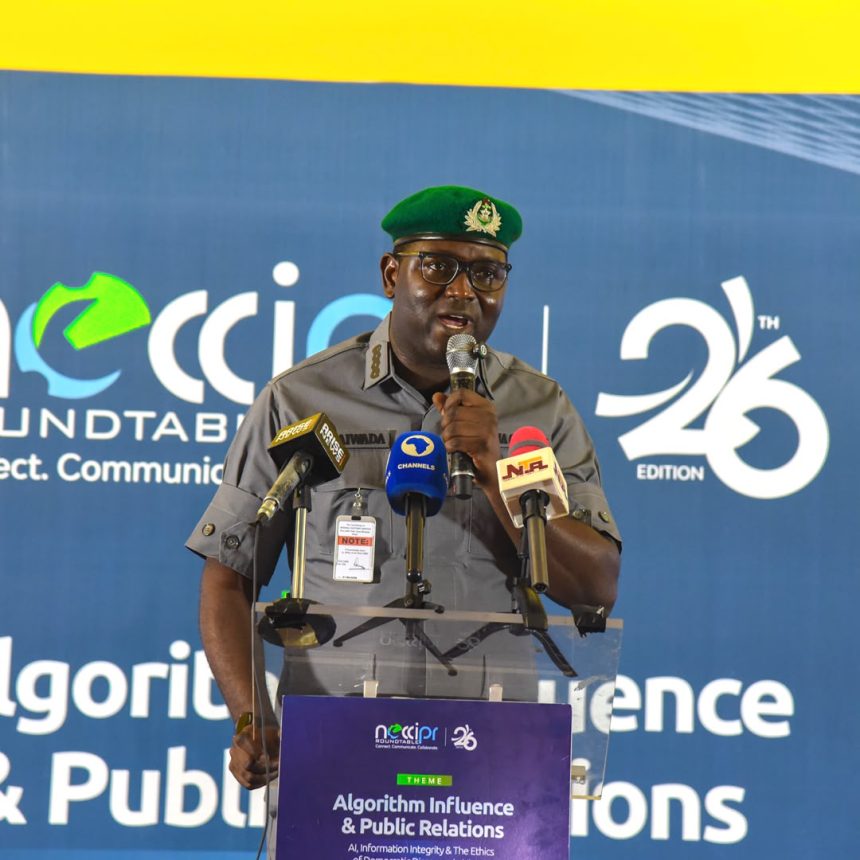
The Comptroller-General of Customs, Adewale Adeniyi, disclosed this on Friday, October 30, 2026, through the National Public Relations Officer of the Service, Deputy Comptroller of Customs Abdullahi Maiwada, at the 2026 edition of the Nigerian Council of Public Relations and Communications (NECCIPR) Roundtable held in Lagos.
The roundtable, which focused on the theme, “Algorithm Influence and Public Relations,” brought together public relations practitioners, communication experts and other stakeholders to examine the growing influence of artificial intelligence and digital platforms on public perception, information management and national discourse.
Speaking on behalf of the Comptroller-General, Maiwada emphasised the growing importance of artificial intelligence in modern Customs operations, particularly in strengthening strategic communication, improving operational efficiency and addressing the challenges posed by misinformation in the digital space.
He noted that effective communication remained essential to the Service’s relationship with the public, stressing that beyond carrying out enforcement and revenue collection responsibilities, the NCS must ensure that Nigerians understand the rationale behind its activities and appreciate the importance of its statutory duties.
According to him, the adoption of artificial intelligence has become increasingly relevant in both the operational and communication activities of the Service.
“The role of AI cannot be over emphasised, especially within our operations. Over the years, AI has been deployed in our core operational duties as well as strategic communication,” he said.
Maiwada explained that artificial intelligence had also been integrated into Customs risk management processes, particularly in assessing imported goods and categorising them according to their respective risk levels to facilitate appropriate interventions by officers.
He said the technology enables the Service to improve its ability to identify potential threats, strengthen compliance monitoring and make informed operational decisions.

The Customs spokesman further highlighted the application of AI in analysing public sentiment and understanding how Nigerians perceive the activities, policies and enforcement operations of the Service.
He explained that monitoring public perception through digital intelligence would enable the NCS to identify emerging concerns, respond appropriately to misleading narratives and strengthen its engagement with citizens.
Maiwada added that the Service was making use of available digital platforms and intelligence-gathering mechanisms to establish facts surrounding information circulating online, particularly reports capable of misleading the public or damaging the institution’s reputation.
He also disclosed that the NCS was collaborating with relevant government agencies to track down and apprehend individuals responsible for disseminating fraudulent information and misleading content.
The initiative is expected to strengthen the Service’s response to online impersonation, fraudulent Customs-related announcements and other forms of digital deception that exploit the institution’s name and public standing.
He stressed that the effective use of technology would not only improve the Service’s internal communication strategies but also promote transparency, accountability and public understanding of Customs operations.
Earlier, the convener of the NECCIPR Roundtable 2026, Nkechi Ali-Balogun, said the initiative was established out of the conviction that public relations professionals must go beyond managing institutional messages to actively shape national conversations and contribute to informed public discourse.
Ali-Balogun observed that the increasing influence of artificial intelligence and digital algorithms had fundamentally changed how information was produced, distributed and consumed, raising important questions about the control of public narratives.
She said the theme of the 2026 edition was particularly relevant at a time when algorithms increasingly determine the information people encounter, the issues they discuss and, in some cases, the opinions they form about individuals, institutions and government policies.
“This year, we confront a question that touches every one of us. When machines decide what we see, who is really shaping the Nigerian mind? Who now controls the flow of information that shapes what Nigerians believe?” she asked.
According to her, the world is experiencing rapid technological transformation driven by artificial intelligence, with a single algorithm capable of influencing political narratives, amplifying conspiracy theories and determining the information consumed and shared by millions of people.
She warned that the growing power of digital platforms had created new responsibilities for public relations practitioners, who must now understand the dynamics of algorithm-driven communication and develop strategies to ensure that credible information remains relevant and accessible.

Ali-Balogun maintained that public relations professionals must position themselves to respond effectively to the challenges associated with digital misinformation while preserving the integrity and credibility of the profession.
The roundtable also featured keynote addresses by the President and Chairman of the Governing Council of the Nigerian Institute of Public Relations (NIPR), Ike Neliaku, and former Minister of Education, Obiageli Ezekwesili, alongside other invited dignitaries and industry stakeholders.
Their participation underscored the importance of strengthening professional capacity and promoting responsible communication practices in an increasingly technology-driven information environment.
The discussions highlighted the need for public relations practitioners, government institutions and other stakeholders to adapt to the changing communication landscape by embracing innovation while maintaining professional ethics, accuracy and accountability.
For the Nigeria Customs Service, the adoption of AI-powered intelligence and digital tracking tools represents an important step towards addressing the reputational risks associated with online misinformation and fraudulent activities.
As government institutions increasingly rely on digital platforms to communicate with citizens, the ability to distinguish credible information from fabricated content has become critical to maintaining public confidence.
The NCS initiative is therefore expected to strengthen its communication framework, improve its capacity to respond to emerging online threats and reinforce its commitment to providing Nigerians with accurate and verifiable information about its activities.
The development also reflects the growing recognition that effective public relations in the digital age requires more than conventional media engagement, as institutions must increasingly combine technology, intelligence gathering and strategic communication to protect their credibility and sustain public trust.