


By Julius Peter,
The Minister of Defence, General Christopher Gwabin Musa (Rtd), OFR, has called for stronger collaboration between Nigerian universities, security agencies and other relevant stakeholders to address the country’s evolving security challenges through research, innovation and evidence-based solutions.
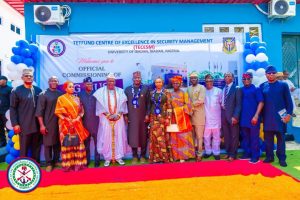
The minister made the call on Friday, October 30, 2026, while commissioning the CG Musa Security Management Hub at the Tertiary Education Trust Fund (TETFund) Centre of Excellence in Security Management, University of Ibadan, Oyo State.
General Musa said Nigeria’s security challenges had become increasingly complex, requiring a comprehensive approach that goes beyond military operations to include academic research, strategic planning, intelligence development, technology and community participation.
He stressed that although the military remained central to protecting the country’s territorial integrity and maintaining national security, sustainable solutions could only emerge through the collective contributions of academic institutions, security agencies, policymakers and citizens.
Reflecting on the origin of the project, the minister disclosed that the idea was conceived following his lecture on Global Fragility and Security Management in Nigeria at the University of Ibadan in July 2025.
According to him, the initiative was informed by the need to bridge the gap between military operations and academic research, particularly in understanding the underlying causes of insecurity and developing long-term strategies to prevent conflicts.
“The battlefield may reveal the immediate manifestations of insecurity, but the university provides the intellectual environment to interrogate its causes, evaluate responses, and develop sustainable solutions,” he said.
The former Chief of Defence Staff explained that his decades of experience in military service had strengthened his conviction that effective security management must begin with anticipation, prevention and strategic preparedness rather than waiting until threats develop into full-blown crises.
“Having spent decades in military service, I have come to appreciate that effective security management begins long before the first shot is fired. We must anticipate threats long before they escalate into crises,” he stated.
The minister further reaffirmed the Federal Government’s commitment to strengthening national security under President Bola Ahmed Tinubu’s Renewed Hope Agenda, noting that the administration was pursuing institutional reforms, improved operational capabilities, strategic partnerships and evidence-based policy development.
He observed that the Ministry of Defence had continued to provide policy direction and strategic guidance to the Armed Forces while efforts were being intensified to improve operational effectiveness across the country’s security theatres.
Musa expressed optimism that ongoing military operations and other government interventions would continue to yield positive results, although he acknowledged that security management required the active participation of every Nigerian.
“We have stepped up our game in the field and are gradually improving the security situation. However, it is essential that every citizen plays a role through a whole-of-nation approach,” he said.
He urged Nigerians to remain vigilant and promptly report suspicious activities to the appropriate security authorities, emphasising the importance of collective responsibility in preventing security threats.
“As the saying goes, ‘if you see something, say something’,” he added.
Speaking on the expected contributions of the newly commissioned facility, the Defence Minister expressed confidence that the CG Musa Security Management Hub would develop into a leading centre for security research, strategic dialogue, professional development and practical innovation.
He charged the university management to ensure that the facility was effectively utilised to generate research findings and policy recommendations capable of addressing Nigeria’s security concerns.
He particularly advocated collaborative programmes involving university scholars, military professionals, law enforcement agencies, policymakers and technology experts to strengthen knowledge-sharing and institutional cooperation.
Among the priority areas he identified for research and professional development were intelligence analysis, cybersecurity, artificial intelligence, conflict prevention, crisis management and community engagement.
According to him, the integration of academic knowledge with operational security experience would provide opportunities for developing innovative strategies, strengthening institutional capacity and preparing security professionals to respond effectively to emerging threats.
The minister also expressed appreciation to individuals and institutions that contributed to the successful execution of the project.
He specifically acknowledged Professor B.A. Aluko, Professor Ayo Albert, the General Officer Commanding (GOC), 2 Division of the Nigerian Army, personnel of the 2 Division Engineers and various departments of the University of Ibadan for their contributions and commitment to bringing the initiative to fruition.
Musa also paid tribute to the outgoing Vice-Chancellor of the University of Ibadan, Professor K.O. Adebowale, congratulating him on the successful completion of his distinguished tenure.
He commended the vice-chancellor’s leadership and wished him success in his future endeavours, while reaffirming his commitment to supporting the university in its pursuit of academic excellence and the development of practical solutions to Nigeria’s national security challenges.

Earlier, Professor Adebowale expressed appreciation to the Minister of Defence for honouring the university’s invitation and ensuring the delivery of the project within the timeframe promised.
The outgoing vice-chancellor described the minister’s support as a significant contribution to the university’s efforts to strengthen its capacity for research, knowledge development and institutional engagement in security management.
The commissioning of the CG Musa Security Management Hub is expected to strengthen the University of Ibadan’s position as an important centre for research and intellectual engagement on security issues, while providing an institutional platform for closer interaction between academia and security practitioners.
The initiative also underscores the growing recognition that Nigeria’s security challenges require coordinated responses involving military and civilian institutions, technological advancement, sound public policies and sustained investment in research.
With the establishment of the hub, stakeholders are expected to have a platform for examining the changing nature of insecurity, developing preventive strategies and contributing to policies that promote peace, stability and sustainable national development.