
By Julius Peter, Abuja
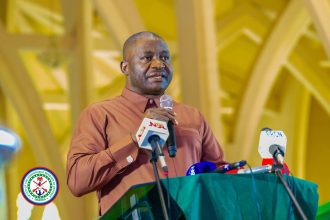
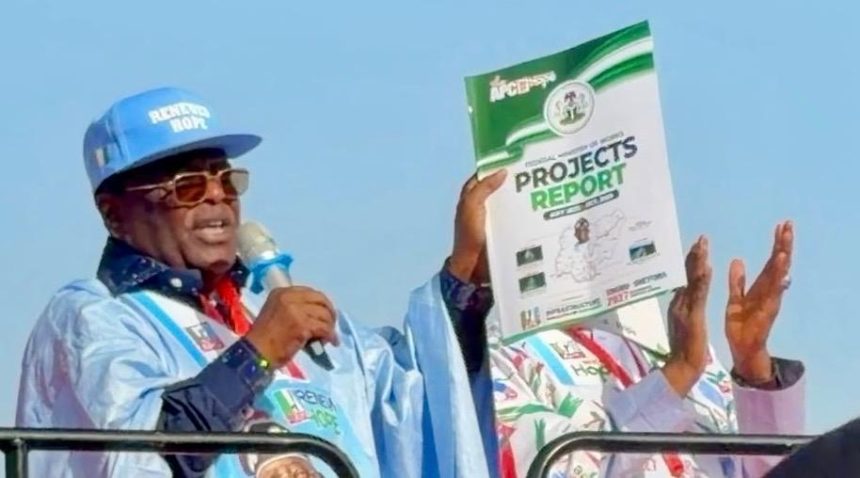
Governor of Bayelsa State, Senator Douye Diri, has disclosed that he disagreed with the Minister of Works, Senator David Umahi, over the proposed realignment of the Lagos-Calabar Coastal Highway with the East-West Road, insisting that both projects must be executed independently.
Diri said the governors of the South-South geopolitical zone were united in their support for the coastal highway project and opposed any arrangement that would see it merged with the East-West Road.
The governor also launched a scathing criticism of former Cross River State governor, Mr. Donald Duke, over comments questioning the feasibility of constructing the coastal highway through Bayelsa State, describing him as a pretender and a politician without a solid political base.
Diri’s position was contained in a statement issued by his Chief Press Secretary, Mr. Daniel Alabrah, following the 200th session of the Bayelsa State Executive Council at Government House, Yenagoa, where the governor addressed the controversy surrounding the proposed highway alignment.
The Lagos-Calabar Coastal Highway is a major federal infrastructure project intended to improve connectivity along Nigeria’s coastline. Its development has attracted considerable interest from coastal communities and state governments, particularly in the South-South, where difficult terrain has historically presented challenges to road construction and other infrastructure projects.
Explaining the disagreement with Umahi, Diri said he had privately contacted the Minister of Works after reports emerged that the coastal highway could be realigned with the East-West Road.
According to the governor, he made it clear that the two roads served different purposes and that reconstructing the existing East-West Road should not be used as a substitute for the proposed coastal highway.
“I read, like everyone else, that there would be a realignment and that the coastal road would be merged with the East-West Road, which I do not believe is the same project. That should be a South-South road,” he said.
Diri disclosed that he personally informed Umahi that the proposed arrangement was unacceptable to him and his state, stressing that both projects were important to the development of the region.
“I privately called the Minister of Works and said, ‘Honourable Minister, that is a no, no, no for us. These are two different projects.’
“I agree with you that the East-West Road should be reconstructed. It is called the East-West Road, but its reconstruction should not take the place of the coastal road.
“While you reconstruct the East-West Road, the coastal road must continue because you have already won the hearts of all the coastal states,” the governor stated.
He said the discussion eventually resulted in a disagreement, as he maintained that the coastal highway must proceed regardless of plans to rehabilitate the East-West Road.
Diri explained that Umahi had repeatedly referred to President Bola Tinubu during their conversation, but he insisted that the minister, as the official responsible for implementing the project and communicating its details to the public, should convey the concerns of the South-South governors to the President.
“I told him that, for me and my state, the coastal road must continue. He kept mentioning Mr President’s name, and I felt that he was the implementer, and was the one who addressed the media.
“So, go back and tell Mr President that this is the position of the governors of the South-South, because I also speak as chairman of the South-South Governors’ Forum,” he said.
The governor’s remarks underscored his determination to ensure that the coastal highway remains a distinct infrastructure project rather than being subsumed into the reconstruction of the East-West Road.
The Bayelsa governor’s disagreement with Duke centred on the former Cross River governor’s reported assessment that constructing the coastal highway through Bayelsa would be difficult because of the state’s swampy terrain.
Diri said he was particularly disappointed that a former governor from the Niger Delta would use Bayelsa as an example of an area where the coastal road could not be constructed.
According to him, Duke had argued in a television programme that the project was not feasible because Bayelsa’s capital, Yenagoa, was located in a swampy environment.
Diri recalled that Duke suggested that constructing the road through Bayelsa could require between 100 and 200 bridges.
“When I watched the video and listened to everything he said about the coastal road, what actually made me respond was the example he gave using my state, Bayelsa.
“He said the coastal road was not feasible, and his reason was that even the state capital of Bayelsa is a swamp. According to him, for the coastal road to pass through Bayelsa, 100 to 200 bridges would have to be constructed,” Diri said.
The governor argued that such a characterisation overlooked the possibility of engineering solutions to the challenges posed by the state’s geography.
He maintained that the swampy nature of Bayelsa should not be presented as a reason to deny the state and its people access to critical infrastructure, particularly when the government was already constructing roads and bridges in similar terrain.
Diri said his administration had continued to invest in road and bridge projects despite the state’s limited financial resources, adding that Bayelsa’s physical environment should not be treated as an insurmountable obstacle to development.
“With our limited resources as a state government, we are building bridges and roads in the same swamp that he says cannot be developed. We are inviting him to come to Bayelsa since he has used our state as an example,” he said.
He further argued that the natural environment that had historically complicated infrastructure development in the state was also part of the region that had contributed significantly to Nigeria’s oil and gas wealth.
The governor insisted that the people of Bayelsa deserved to benefit from the country’s infrastructure development agenda, rather than continue to be portrayed as living in an environment where modern roads and other facilities were impracticable.
Diri did not spare Duke in his response, questioning the former governor’s political standing and his emergence as the presidential candidate of the Peoples Redemption Party (PRP).
He described Duke as a pretender who, in his view, had assumed the status of a national political figure without a substantial political structure at the grassroots.
“You pretend to be a presidential candidate of PRP. There is not even a councillor from PRP in Cross River. Not even in your own ward. Yet, you pretend to be a presidential candidate so that at the end of the day you can be rehabilitated,” the Bayelsa governor said.
He added that Duke could continue to present himself as a national and international champion despite what he described as the absence of a strong political base.
Diri also challenged the former governor to address the financial liabilities he alleged were incurred during Duke’s administration in Cross River State, arguing that such debts had continued to affect successive governments and generations of residents.
“I advise you to go back and settle the huge debts hanging over the heads of generations yet unborn, debts that you incurred and passed on to successive governments in your state,” he said.
The governor further criticised Duke over the Tinapa business and leisure resort project in Cross River State, describing it as a white-elephant project and accusing the former governor of placing an excessive financial burden on the state.
Diri also questioned Duke’s response to the ceding of the Bakassi Peninsula from Nigeria to Cameroon during his tenure as governor of Cross River State.
“You were in office when Bakassi was ceded out of Nigeria. But because you were not a local champion, you did nothing about it,” he said.
The governor’s remarks reflected a broader dispute over the responsibility of political leaders to defend the interests of their communities and ensure that regional development concerns receive adequate attention at the national level.
However, the allegations concerning the state’s debts, the Tinapa project and Duke’s handling of the Bakassi issue were Diri’s own criticisms and were not independently established in the governor’s statement.
Explaining why he chose to respond publicly to Duke, Diri said he was not ordinarily inclined to engage in personal exchanges or trade insults with political leaders.
He, however, maintained that the former governor’s comments went beyond a personal disagreement because they touched on the development prospects and dignity of Bayelsa State and its people.
The governor said he was particularly offended by Duke’s reported reference to him as “that fellow”, insisting that his position as an elected governor deserved respect, irrespective of whether the two men had a personal relationship.
“He also said, ‘I don’t even know that fellow.’ But I do not want you to know me from Adam, and I don’t know you, just as you do not know me,” he said.
Diri stressed that public office holders should recognise the responsibilities attached to their positions and avoid language that could be interpreted as disrespectful to the offices occupied by other elected leaders.
“Hear me well: I am not that fellow. I am an elected, sitting governor of Bayelsa State, and I am very surprised that this is coming from a son of the Niger Delta and, more importantly, a former governor who should respect the office of a governor at all times,” he stated.
He said Duke had also described himself as a local champion in response to the controversy.
The Bayelsa governor said he had no difficulty identifying with that description because his political career was rooted in representing and defending the interests of his people.
“Yes, I am a local champion because that is where I was raised. I was elected to defend the local people. I was elected to champion their cause. I was elected to see possibilities where there seem to be impossibilities,” Diri said.
He maintained that defending the interests of Bayelsa and its people was a fundamental responsibility of his office and not an attempt to engage in unnecessary political controversy.
The governor said the controversy had exposed what he considered a persistent and damaging narrative that Bayelsa’s swampy terrain made large-scale infrastructure development impracticable.
He rejected that perception, arguing that the state’s natural resources and difficult geography should not be used to justify its exclusion from major infrastructure projects.
“Enough of this narrative that the Bayelsa environment cannot be developed. Oil and gas resources can be taken away from our land, but the land itself cannot be developed? That is a fat lie from the pit of hell, and we reject it,” he declared.
Diri argued that the state had demonstrated that roads, bridges and other infrastructure could be constructed in difficult terrain when governments were committed to development and prepared to deploy the necessary engineering expertise and resources.
He said the federal government’s coastal highway initiative offered an opportunity to address some of the long-standing connectivity challenges facing communities along the country’s coastline.
For Bayelsa, where rivers, creeks, wetlands and swampy areas shape settlement patterns and transportation networks, the governor maintained that improved road connectivity would be important for economic activity, social development and the movement of people and goods.
He also called for an end to what he regarded as the tendency to treat the state’s geography as a permanent barrier to progress.
Beyond the disagreement with Umahi and the exchange with Duke, Diri reiterated his support for Tinubu’s decision to pursue the coastal highway project, describing it as a significant development initiative for the Niger Delta and the Ijaw nation.
He said the road was not merely a new infrastructure proposal but also a long-standing demand of the Ijaw people, dating back to the military era.
According to him, the construction of a coastal road had featured among the demands presented by the Ijaw National Congress (INC), which he said he had personally highlighted during the political realignment involving himself and other political actors who moved from the Peoples Democratic Party (PDP) to the All Progressives Congress (APC).
Diri said the coastal highway was among the issues that informed their decision to support the new political direction, expressing appreciation to Tinubu for the initiative.
“If you recall, on the day we were all crossing over from PDP to APC, I brought out a document containing the demands of the Ijaw National Congress (INC). One of the major demands, dating back to the military era, was the construction of the coastal road,” he said.
He described the project as an opportunity to address the developmental concerns of coastal communities that, in his view, had not received adequate infrastructure investment over the years.
The governor argued that communities in the South-South should enjoy infrastructure opportunities comparable to those available in other parts of the country.

“I like to seize this opportunity to thank Mr President. The very thought of it alone—that these coastal people should not continue to wallow in poverty and be dehumanised, and that they should not be seen as second-class citizens of this country—is commendable,” he said.
Diri maintained that the proposed highway could contribute to reducing the sense of marginalisation among coastal communities if the project was implemented in a manner that adequately addressed their transportation and development needs.
“If we can have roads in the North and other parts of the country, then the coastal road should also be built. The very idea of it is a big plus for Mr President and his administration. I welcome it with both hands,” he added.
Diri’s intervention has brought renewed attention to the competing infrastructure considerations surrounding the coastal highway and the East-West Road, two projects he insists should be treated separately.
While he acknowledged the need to reconstruct the East-West Road, the governor maintained that doing so should not undermine the implementation of the coastal highway.
His position also reflects the concerns of coastal communities that see improved road access as an important component of economic development, regional integration and greater participation in Nigeria’s national economy.
The dispute with Duke, meanwhile, has highlighted differing views on the technical and economic feasibility of extending major road infrastructure through the challenging terrain of the Niger Delta.
For Diri, the central issue is not whether Bayelsa’s terrain presents engineering challenges, but whether those challenges should be allowed to determine the state’s access to development projects.
He insisted that the people of Bayelsa should not be made to believe that their environment places a permanent limit on their development prospects.
As discussions over the highway’s alignment and implementation continue, the governor’s message to the Federal Government remains that the coastal road must be delivered as a distinct project, with the interests of the South-South and other coastal communities taken into consideration.
He also urged Nigerians to recognise the development potential of Bayelsa and the wider Niger Delta, arguing that the region’s difficult terrain should be a challenge to overcome through engineering and investment rather than a reason to abandon critical infrastructure projects.