

By Julius Peter, Abuja
President Bola Ahmed Tinubu has called on Nigerians to support the All Progressives Congress (APC) at all levels in the 2027 general elections, reaffirming his administration’s commitment to infrastructure development and economic growth as the party launched its North-West zonal presidential campaign in Kaduna.
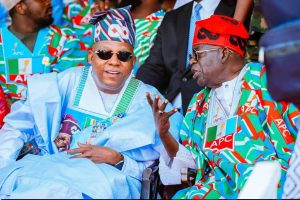
The rally, held on Saturday, October 24, 2026, at the Kaduna Township Stadium, brought together APC leaders, governors, lawmakers, traditional rulers, youths, women’s groups and supporters from across the country to mobilise support for Tinubu’s re-election bid and showcase the administration’s infrastructure initiatives under the Renewed Hope Agenda.
A major highlight of the event was the presentation of APC flags to seven governors from the North-West seeking re-election, alongside the presentation of the Federal Government’s road infrastructure achievements by the Minister of Works, Senator David Umahi.
The rally provided a platform for the ruling party to project its development agenda, particularly road construction and rehabilitation, as a key component of its campaign message ahead of the 2027 general elections.
Addressing the gathering, Tinubu urged eligible Nigerians to obtain their Permanent Voter Cards (PVCs) and participate actively in the electoral process, while calling on voters to support the APC across all elective positions.
“Vote APC from top to bottom, APC everywhere,” the President declared.
He reaffirmed his administration’s determination to sustain infrastructure development and other programmes aimed at improving the welfare and prosperity of Nigerians.
Tinubu also commended governors, traditional rulers, youths and other stakeholders for their contributions to national development, expressing confidence in the administration’s ability to advance its policy objectives.
Presenting the administration’s infrastructure scorecard, Umahi, who also serves as Deputy Director-General for Infrastructure, Mobilisation and Sensitisation of the 2027 APC Presidential Campaign Council, disclosed that the Federal Government had completed 348 kilometres of inherited and newly initiated road projects.
He said ongoing road projects accounted for 4,084 kilometres, while partially completed projects covered another 1,811 kilometres.
The figures, according to the Ministry of Works, demonstrate the scale of the government’s road infrastructure programme and the extent of work required to improve connectivity across the country.
While the reported 348 kilometres of completed projects represent progress in the delivery of road infrastructure, the substantial length of ongoing and partially completed projects underscores the importance of sustained funding, effective supervision and timely execution.
The minister said continued investment in roads remained critical to economic development, particularly in the North-West, where agriculture, commerce and inter-state transportation depend heavily on reliable road networks.
He explained that improved roads would reduce transportation difficulties, facilitate trade, strengthen agricultural supply chains, create employment opportunities and improve access to essential services.

According to him, better road connectivity would also enable farmers to transport produce to markets more efficiently, help traders move goods at lower costs and connect rural communities to major commercial centres.
The minister’s presentation placed infrastructure development at the centre of the administration’s campaign message, with the government seeking to demonstrate how road construction and rehabilitation could support economic activities across the region.
Among the major projects highlighted by Umahi was the outstanding sections of the Abuja-Kaduna-Zaria-Kano Expressway, a strategic transport corridor connecting the Federal Capital Territory with Kaduna and Kano, two of the North-West’s major commercial and industrial centres.
The minister identified the 118-kilometre Lot 1 of the expressway among the key completed project interventions. He also cited the 30-kilometre section in Kano and the 81-kilometre Tungan Maje-Jere alignment as part of the road infrastructure projects commissioned.
The Abuja-Kaduna-Zaria-Kano corridor plays a significant role in the movement of passengers, agricultural produce, manufactured goods and other commodities between the North-West and the Federal Capital Territory.
Improved road conditions along the route are expected to ease travel, reduce vehicle operating costs, strengthen commercial relationships and improve the movement of goods between production centres and major markets.
For businesses operating across Kaduna, Kano and neighbouring states, the condition of the expressway has implications for transportation expenses, delivery times and the overall cost of commercial activities.
The road is also important to commuters, traders, transport operators and residents who depend on the corridor for access to economic opportunities and essential services.
Umahi maintained that sustained attention to strategic road corridors would strengthen regional integration and support economic growth.
The minister also highlighted several road projects in Kano State, including the Northern Bypass, the dualisation of the Kano-Maiduguri Road, Section I, covering the Kano-Shuwarin axis, and the Yakasai-Badume-Damargu-Marken Jalli Road.
These projects are expected to improve access within communities, facilitate movement between settlements and commercial centres, and support economic activities in areas affected by poor road connectivity.
The Kano Northern Bypass, in particular, is strategically important for traffic management and movement around the city, while the Kano-Maiduguri corridor supports transportation between major population centres in the North-East and North-West.
The minister said road infrastructure development remained important to improving the movement of people and goods and creating an enabling environment for businesses.
Across the North-West, improved road networks could strengthen links among Kano, Jigawa, Kaduna, Katsina, Zamfara, Sokoto and Kebbi states, enabling farmers, traders and manufacturers to reach broader markets.
Reliable transportation infrastructure also has the potential to improve the distribution of essential commodities, encourage investment in underserved communities and reduce logistical challenges confronting businesses.
The Federal Government’s road infrastructure programme, as presented at the rally, was linked to the broader objective of improving economic productivity and strengthening regional connectivity.
The North-West is a major agricultural and commercial region, with farmers and traders relying on road networks to transport food, livestock, industrial inputs and other commodities.
Poor road conditions can increase transportation costs, delay deliveries, contribute to post-harvest losses and limit farmers’ access to profitable markets.
Improved roads can help address some of these challenges by reducing travel time, improving access to storage and processing facilities, and making it easier for producers to reach urban markets.
The minister noted that infrastructure investment could also create employment opportunities for engineers, technicians, construction workers and other professionals directly involved in road construction.
Indirect benefits could extend to transport operators, suppliers of construction materials, traders and small businesses operating along road corridors.
However, the long-term benefits of the projects will depend on their timely completion, adherence to engineering standards, transparent management of public resources and regular maintenance.
These measures are essential to ensuring that completed roads remain serviceable and that ongoing projects translate into lasting economic and social benefits for the communities they are designed to serve.
Vice-President Kashim Shettima also highlighted the administration’s development initiatives across Northern Nigeria, drawing attention to road infrastructure, agriculture, regional connectivity and the expansion of economic opportunities.
Shettima commended Tinubu for recognising the infrastructure challenges confronting the North and prioritising interventions intended to address them.
He said improved road networks were essential to connecting farmers to markets, facilitating commercial activities and promoting inclusive development.
The Vice-President expressed confidence in the continued political support of Northern Nigeria, assuring the President of the region’s solidarity ahead of the 2027 elections.
His remarks reinforced the administration’s argument that infrastructure development should be viewed not only as a construction programme but also as an instrument for expanding economic opportunities and improving livelihoods.
The North-West’s agricultural output, commercial activities and population make road infrastructure particularly important to the region’s economic prospects.
Kaduna State Governor, Senator Uba Sani, urged Nigerians to assess the performance of governments through verifiable achievements and tangible development outcomes rather than relying solely on narratives circulating on social media.
He encouraged voters to examine completed projects, ongoing interventions and fulfilled commitments in evaluating the administration’s performance.
The governor’s remarks formed part of the APC’s broader effort to make infrastructure delivery and government performance central to its campaign message.
Similarly, the Director-General of the 2027 APC Presidential Campaign Council, Senator Abdulaziz Yari, urged political stakeholders and supporters, particularly in Northern Nigeria, to reject misinformation and promote constructive political engagement.
Yari maintained that leadership should be assessed through commitments, performance and delivery, with infrastructure and public welfare remaining central to political discourse.
The two party leaders urged supporters to focus on the administration’s record and communicate its development priorities to the electorate.
Their remarks came as political parties prepare to intensify mobilisation and campaign activities ahead of the 2027 general elections.
Another major highlight of the Kaduna rally was the presentation of APC flags to seven governors from the North-West seeking re-election.
The flags were presented by the APC National Chairman, Professor Nentawe Yilwatda, symbolising the party’s preparations for the forthcoming elections and its efforts to consolidate its political structures across the region.
The ceremony attracted APC governors from other parts of the country, lawmakers, traditional and opinion leaders, and other party stakeholders.
The presentation was intended to strengthen party unity and demonstrate the APC’s readiness to mobilise support for its candidates ahead of the elections.
The North-West remains politically significant because of its population, electoral strength and influence in national politics.
By holding its zonal campaign flag-off in Kaduna, the APC sought to consolidate its support base in the region while projecting the Tinubu administration’s infrastructure and development agenda.
The rally also provided an opportunity for the party to bring together its political structures and reinforce coordination among governors, lawmakers, campaign officials and grassroots mobilisers.
The Kaduna rally highlighted the growing importance of infrastructure delivery in the political contest ahead of the 2027 general elections.
For the Tinubu administration, road construction and rehabilitation provide an opportunity to demonstrate progress in addressing longstanding transportation challenges and connecting communities to economic opportunities.
The figures presented by Umahi—348 kilometres of completed road projects, 4,084 kilometres of ongoing projects and 1,811 kilometres of partially completed projects—also illustrate the scale of the government’s infrastructure commitments.
However, the political and economic value of the programme will ultimately depend on the quality of the roads delivered, the pace of construction, the completion of outstanding sections and the durability of the infrastructure.
For road users, the practical test will be whether journeys become safer and faster, transportation costs decline, agricultural produce reaches markets more efficiently and communities gain better access to schools, healthcare facilities and commercial centres.
The completion of ongoing projects will also be important in ensuring that public resources committed to road construction translate into usable infrastructure and measurable economic benefits.
As the APC advances its campaign ahead of the 2027 elections, the administration’s infrastructure record is expected to remain a major part of its argument for continuity.
The Kaduna rally therefore served a dual purpose: mobilising political support for Tinubu’s re-election bid and presenting the government’s road infrastructure priorities to the electorate.
Ultimately, the success of the Renewed Hope infrastructure agenda will be judged not only by the kilometres of roads announced or under construction, but also by the projects completed, the communities connected and the improvements experienced by Nigerians who depend on the country’s road network.
The President was accompanied by his wife, Senator Oluremi Tinubu; Vice-President Shettima and his wife, Hajiya Nana Kashim Shettima; governors, lawmakers and other senior APC officials.
The Federal Ministry of Works said the administration would continue to prioritise infrastructure delivery, with effective implementation, adequate funding and sustainable maintenance remaining essential to ensuring that road investments provide lasting value to Nigerians.