
By Julius Peter, Abuja
The Federal Government has intensified efforts to improve access to essential public services for internally displaced persons (IDPs) and other vulnerable Nigerians with the launch of Mobile One-Stop Shops and the handover of 10 specially equipped vehicles to participating state governments.
The initiative, spearheaded by the Federal Ministry of Humanitarian Affairs and Poverty Reduction in partnership with the United Nations High Commissioner for Refugees (UNHCR) and supported by the Government of Germany, is aimed at taking critical government services closer to displaced persons and underserved communities across the country.
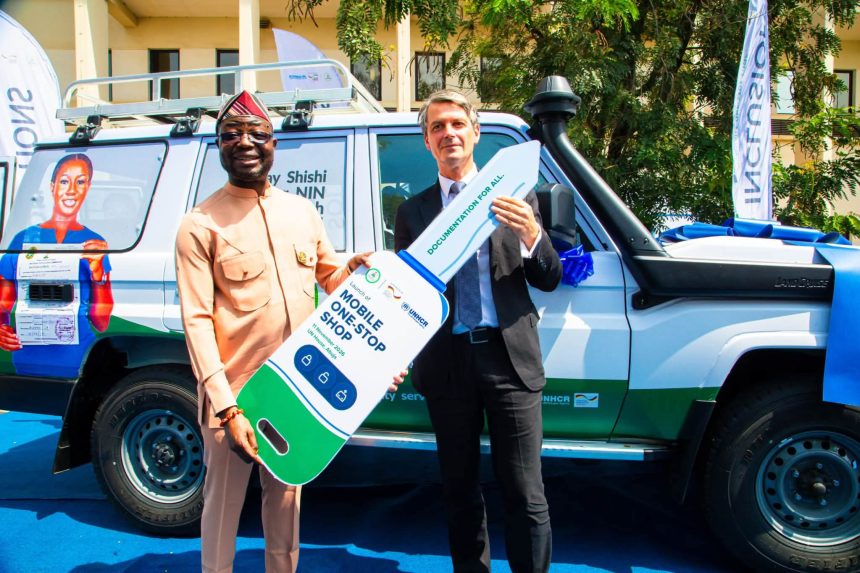
The Minister of Humanitarian Affairs and Poverty Reduction, Dr. Bernard M. Doro, performed the launch and formal handover of the vehicles on Wednesday at the United Nations House in Abuja.
Speaking at the ceremony, Doro reaffirmed the Federal Government’s commitment to ensuring that internally displaced persons and other vulnerable Nigerians are not denied access to essential government services because of their locations or circumstances.
He stressed that no Nigerian should be left behind, particularly those forced to flee their communities because of insecurity, displacement and other humanitarian challenges.
According to the Minister, the Mobile One-Stop Shop initiative is a practical intervention designed to remove barriers that prevent vulnerable populations from accessing government services, especially those who live in remote locations or lack the resources to travel to designated government offices.
He explained that the mobile units would provide several essential services, including birth registration, National Identification Number (NIN) enrolment, SIM card registration, Bank Verification Number (BVN) registration, bank account opening and enrolment into the National Social Register.

Doro noted that access to these services would enable displaced persons and vulnerable households to obtain the necessary documentation required to benefit from government programmes, financial services and social protection interventions.
He described identity documentation as a fundamental requirement for social and economic inclusion, observing that individuals without recognised identification or registration are often excluded from government support programmes and other essential opportunities.
The Minister said the initiative was consistent with the Ministry’s One Humanitarian, One Poverty Response System, which seeks to move Nigerians from dependence on palliatives to sustainable pathways out of poverty through improved access to identity documentation, financial inclusion and social protection.
He added that the intervention aligns with the Renewed Hope Agenda of President Bola Ahmed Tinubu, which prioritises inclusive development and improved living conditions for vulnerable citizens.
Doro expressed profound appreciation to the Government and people of Germany, particularly through its Embassy in Nigeria, for providing the support that made the procurement and deployment of the 10 mobile service vehicles possible.
He described Germany’s contribution as a demonstration of international solidarity and a significant investment in strengthening Nigeria’s humanitarian response and expanding access to essential public services.
The Minister also commended UNHCR for its sustained commitment to supporting displaced persons in Nigeria, noting that collaboration among government institutions, international organisations and development partners remained critical to addressing the country’s humanitarian challenges.
He urged the 10 beneficiary states to ensure that the vehicles were effectively deployed, properly maintained and consistently used to reach displaced communities, remote settlements and vulnerable households.
Doro expressed optimism that the initiative would be expanded beyond the initial 10 beneficiary states to cover all 36 states of the federation and the Federal Capital Territory, thereby extending its benefits to more Nigerians in need.
Earlier, the Permanent Secretary of the Ministry, Mr. Olubunmi Olusanya, described the handover as an important milestone in efforts to address the difficulties faced by internally displaced persons and vulnerable communities in obtaining civil documentation, identity-related services and other essential public services.
Olusanya acknowledged the contributions of UNHCR and the Government of Germany, describing their partnership as invaluable to the successful implementation of the initiative.
He urged the participating state governments to demonstrate ownership of the programme by ensuring the effective deployment, proper maintenance and security of the vehicles to guarantee their long-term usefulness.
In his remarks, the German Ambassador to Nigeria and the Economic Community of West African States (ECOWAS), Mr. Stefan Rößel, reaffirmed Germany’s commitment to strengthening its partnership with Nigeria, particularly in areas of humanitarian assistance and improved access to essential services for vulnerable populations.
Rößel said Germany remained committed to supporting initiatives that would strengthen humanitarian interventions and ensure that displaced persons and underserved communities were not excluded from opportunities available to other citizens.
Similarly, the Interim United Nations Resident and Humanitarian Coordinator in Nigeria, Ms. Vanessa Pala, emphasised the importance of sustained collaboration between the Federal Government, United Nations agencies and development partners in addressing the needs of displaced persons and vulnerable communities.
She noted that coordinated service delivery was essential to ensuring that vulnerable populations gained access to documentation, financial inclusion opportunities and social protection programmes.
Pala stressed that effective partnerships among relevant stakeholders would help address existing service delivery gaps and strengthen the inclusion of people affected by displacement and other humanitarian emergencies.
A major highlight of the ceremony was the formal presentation of the keys to the 10 vehicles by the German Ambassador, Rößel, to the Minister, Doro, who subsequently handed them over to the participating state governments through the Dean of the Forum of Commissioners of Humanitarian Affairs of the 36 states and the FCT, Dr. Helen Isamoh, who also serves as the Akwa Ibom State Commissioner for Humanitarian Affairs.
Receiving the vehicles on behalf of the participating states, Isamoh appreciated the Federal Government, UNHCR and the Government of Germany for the intervention, describing it as significant support for strengthening humanitarian service delivery at the state level.
She expressed optimism that the programme would be extended to all 36 states and the Federal Capital Territory to enable more displaced persons and vulnerable communities to benefit from the initiative.
The ceremony was attended by the UNHCR Representative in Nigeria, Mr. Arjun Jain; the Dean of the Forum of Commissioners of Humanitarian Affairs, Dr. Helen Isamoh; commissioners of humanitarian affairs from participating states; directors and representatives of relevant Ministries, Departments and Agencies; heads of United Nations agencies; representatives of development partners and other stakeholders.
The Mobile One-Stop Shop initiative is expected to strengthen grassroots access to government services by reducing the distance and administrative difficulties associated with obtaining essential identification and civil registration documents.
Beyond addressing documentation challenges, the programme is also expected to promote financial inclusion, improve access to social protection and support the integration of displaced persons into national development programmes.
The intervention further reinforces the Federal Government’s commitment to ensuring that humanitarian assistance goes beyond immediate relief to create sustainable opportunities for vulnerable Nigerians to rebuild their lives and participate meaningfully in the country’s economy.
Bringing services closer and leaving no one behind remains the central objective of the initiative.