

By Julius Peter
The Independent Corrupt Practices and Other Related Offences Commission (ICPC) has called for a stronger institutional partnership with the Nigeria Customs Service (NCS) to safeguard public revenue, strengthen accountability and restore confidence in government institutions.
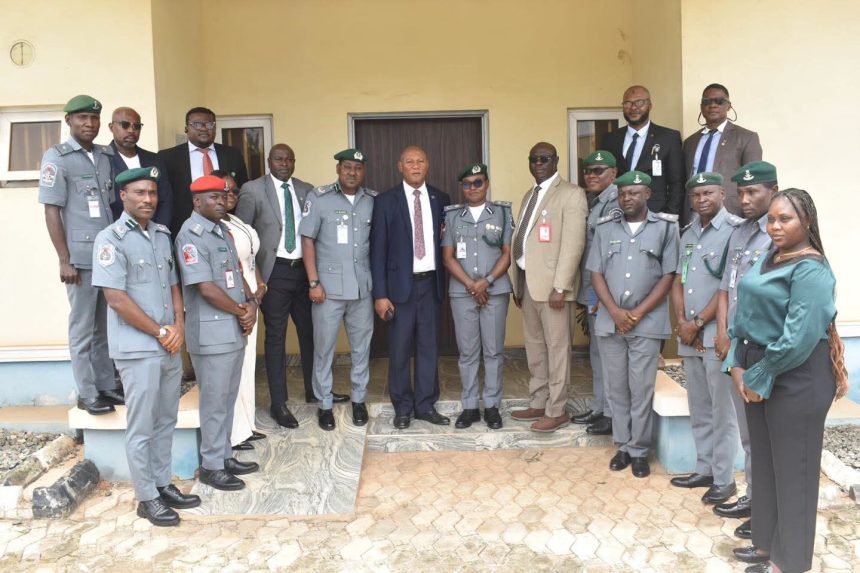
The Commission made the call when the newly appointed Customs Area Controller of the Ondo/Ekiti Command, Deputy Comptroller Patience O. Ita, paid a courtesy visit to the ICPC Ondo State headquarters in Akure.
The engagement, which focused on strengthening inter-agency cooperation, underscored the importance of integrity, transparency and effective internal controls in Customs administration, particularly given the Service’s strategic responsibilities in border management, revenue collection, enforcement and trade facilitation.
Speaking during the meeting, the Resident Anti-Corruption Commissioner (RACC) for Ondo and Ekiti States, Mr. Tiku Andrew Menge, said maintaining high ethical standards within the Customs Service was essential to protecting national revenue and strengthening public trust in state institutions.
Menge noted that the NCS occupies a critical position in the nation’s economic architecture because of its responsibilities at the country’s borders and its role in facilitating legitimate trade while enforcing relevant laws and regulations.
He warned that revenue leakages, abuse of regulatory powers and other systemic weaknesses could undermine these responsibilities, weaken institutional effectiveness and create opportunities for corrupt practices to thrive.
According to him, corruption prevention should not be viewed solely from the perspective of investigating and prosecuting individuals after an offence has occurred. Rather, he said, institutions must proactively identify weaknesses within their systems and put measures in place to prevent corrupt practices from occurring in the first place.
The RACC explained that the ICPC’s mandate extends beyond the investigation and prosecution of corruption cases to include preventive measures aimed at identifying systemic vulnerabilities and strengthening institutional controls.
He said the Commission was committed to working with institutions to examine processes that could expose them to corruption risks and develop mechanisms capable of reducing such vulnerabilities.
Menge maintained that a strong preventive framework would make it considerably more difficult for corrupt practices to be initiated or sustained within public institutions.
The ICPC official also highlighted the role of technology and automation in strengthening Customs administration and reducing opportunities for corruption.
He advocated greater reliance on automated and data-driven processes, arguing that modern technology could improve traceability, accountability and transparency by reducing unnecessary discretionary human intervention in Customs operations.
According to him, automation could help limit the opportunities for manipulation of processes while providing stronger mechanisms for monitoring transactions and identifying irregularities.
However, he stressed that technology alone could not guarantee integrity, noting that digital systems must be supported by ethical leadership, effective supervision and strong internal control mechanisms.
Menge emphasised that the successful deployment of technology must therefore be accompanied by a culture of accountability in which officers and stakeholders understand that established procedures must be followed and that breaches will attract appropriate scrutiny.
The RACC further rejected the perception that anti-corruption measures and trade facilitation are competing objectives.
He argued that the two goals were complementary, stressing that transparent, predictable and efficient Customs procedures could actually reduce the incentives for businesses and individuals to resort to informal channels.
According to him, when legitimate traders are provided with clear procedures, predictable timelines and accountable processes, the attraction of shortcuts and informal arrangements is significantly reduced.
He said an efficient and transparent Customs environment would not only protect government revenue but also contribute to a more secure and reliable business climate for legitimate commercial activities.
The approach, he suggested, would ultimately benefit government, businesses and the wider public by improving compliance while reducing opportunities for corruption.
Menge proposed a strategic framework through which the ICPC and the NCS could deepen their cooperation in the interest of the public.
He identified corruption-risk assessment, integrity sensitisation and stakeholder engagement as some of the practical areas in which both institutions could collaborate.
He explained that regular engagements could enable the agencies to identify emerging vulnerabilities, sensitise personnel on ethical standards and engage stakeholders on challenges affecting compliance and service delivery.
Such collaboration, he stressed, should be based on mutual respect and the shared objective of protecting the public interest.
Menge cautioned against creating a relationship in which one institution would be perceived as supervising or controlling the other.
Rather, he said, the agencies should leverage their respective statutory mandates and institutional strengths to achieve common objectives.
Responding, the newly appointed Customs Area Controller for the Ondo/Ekiti Command, Deputy Comptroller Patience O. Ita, said her visit was intended primarily to establish a constructive working relationship with the ICPC following her recent deployment to the command.
It expressed the readiness of her command to maintain sustained engagement with the Commission on matters of mutual interest.
She identified compliance, enforcement and effective public service administration as areas where both institutions could benefit from continued interaction and cooperation.
Her position signalled the command’s willingness to strengthen institutional relationships aimed at improving operational effectiveness while maintaining the integrity of Customs processes.
The engagement therefore provided an opportunity for both agencies to reaffirm the importance of cooperation in addressing institutional vulnerabilities and promoting accountability.
While advocating closer cooperation, Menge stressed that collaboration must not compromise the statutory independence of either institution.
He noted that effective partnership should be built around clearly defined mandates, mutual respect and commitment to public interest.
The caution is particularly significant given the distinct responsibilities of the two agencies. While the Customs Service is responsible for revenue collection, border control, enforcement and trade facilitation within its statutory mandate, the ICPC has a broader anti-corruption and preventive mandate.
Menge’s position was that cooperation between the agencies should strengthen, rather than blur, these institutional responsibilities.
He concluded with a succinct reminder of the principle that should underpin any future collaboration between the two organisations:
The statement captures the central message of the engagement: inter-agency cooperation can strengthen public institutions, improve revenue protection and enhance public confidence, but such cooperation must remain firmly anchored in accountability, transparency and respect for the law.
As Nigeria continues to seek more effective ways of protecting public resources and improving the efficiency of government institutions, the proposed collaboration between the ICPC and the NCS could provide an important platform for identifying corruption risks before they become entrenched.
For Customs administration in particular, the combination of technology, transparent procedures, effective supervision and ethical leadership could help close revenue leakages while simultaneously making legitimate trade easier and more predictable.
The engagement in Akure consequently went beyond a courtesy visit, highlighting the need for public institutions to work together without compromising their statutory responsibilities, and to place the protection of public resources and the broader public interest at the centre of their operations.