


By Julius Peter, Abuja
The Chairman of the Code of Conduct Tribunal (CCT), Justice (Dr.) Mainasara Umar Kogo, has called on Ministries, Departments and Agencies (MDAs) of government to make integrity, accountability, transparency and ethical conduct enduring principles of public service.
Kogo made the call in a goodwill message delivered on his behalf by the Director of Administration of the Code of Conduct Tribunal, Mrs. Onye Chinelo, at the MDA 100 Pillars of Integrity in Public Service Awards, held at the Musa Yar’Adua Centre, Abuja, on Tuesday, September 29, 2026.
The event was organised by Verbatim Magazine in strategic partnership with the Independent Corrupt Practices and Other Related Offences Commission (ICPC) to recognise institutions identified for their commitment to ethical standards, integrity and responsible public administration.
Representing the CCT chairman, Chinelo conveyed his warm greetings to the ICPC chairman and members, the publisher and editor-in-chief of Verbatim Magazine, award recipients, heads of MDAs, members of the diplomatic corps and other distinguished guests.
According to the CCT chairman, the gathering provided an important platform for recognising and celebrating public institutions and public servants that have demonstrated commitment to integrity, ethical conduct, accountability and responsible service to the nation.

He commended Verbatim Magazine and the ICPC for creating a platform capable of promoting and reinforcing a culture of integrity within Nigeria’s public service.
Kogo stressed that the significance of the occasion went beyond the presentation of awards, noting that integrity should be regarded as a fundamental requirement for effective governance and sustainable national development.
He said public office was essentially a position of trust and that every public officer entrusted with government responsibility was expected to discharge such responsibility with honesty, impartiality, transparency and accountability.
“The resources and authority placed at the disposal of public institutions are ultimately held in trust for the Nigerian people,” he stated.
The CCT chairman further explained that the constitutional mandate of the Tribunal underscored the importance of maintaining high standards of conduct in public life.
He noted that public service must be guided by clearly defined ethical standards, while individuals entrusted with public authority must remain accountable for their actions and decisions.
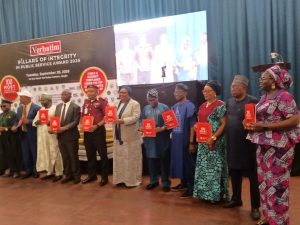
Kogo described the recognition of 100 Ministries, Departments and Agencies at the event as significant, saying the initiative sent an important message that integrity in public service deserved recognition, encouragement and institutional support.
He congratulated the institutions and public servants recognised at the ceremony, while urging them not to regard the awards as an end in themselves.
According to him, the recognition should instead serve as a renewed call for the recipients to sustain the standards and practices that earned them the honour.
He said the real value of an integrity award was its ability to inspire continued commitment to ethical conduct and encourage institutions to institutionalise good practices.
“As a nation, we must continue to strengthen systems that promote transparency, prevent misconduct and encourage responsible leadership,” he said.
The chairman also called for an environment where doing the right thing in public office would not only be expected but supported by strong institutions, effective oversight mechanisms and consistent enforcement of established standards.
He emphasised that the responsibility for building an ethical public service could not be left to a single institution.
Rather, he said, it required sustained collaboration among government institutions, oversight bodies, the media, civil society organisations, professional bodies and individual public officers.
Kogo particularly highlighted the role of the media in promoting accountability and ethical governance.
He said responsible journalism, investigative reporting and public enlightenment could contribute significantly to strengthening accountability and ensuring that integrity remained central to national discourse.
He therefore commended the organisers for recognising institutions that had demonstrated commitment to integrity and encouraged other public institutions to draw lessons from the initiative.
The CCT chairman further urged public institutions to regard integrity as a continuous institutional culture rather than a one-time achievement.
He noted that maintaining ethical standards required constant vigilance, adherence to established rules and a commitment by public officers and institutions to place the public interest above personal considerations.
He also reminded public servants that integrity should not depend on whether their actions were being observed or scrutinised.
According to him, the true test of integrity lies in the principles that guide decisions even when there is no external supervision.
“As we celebrate the achievements being recognised today, let us also remember that integrity is measured not only by what we do when we are being watched, but by the principles that guide our decisions when no one is watching,” he said.
He urged the award recipients to use the recognition as an opportunity to deepen their commitment to ethical standards, strengthen internal accountability mechanisms and promote a culture in which transparency and responsible conduct become institutional norms.
The chairman expressed the hope that the MDA 100 Pillars of Integrity in Public Service Awards would continue to encourage public institutions to uphold the highest standards of conduct and contribute to restoring public confidence in government institutions.

He said a public service founded on integrity would be better positioned to protect public resources, deliver quality services, strengthen citizens’ trust and contribute to national development.
The event brought together senior government officials, representatives of oversight institutions, heads of MDAs, members of the diplomatic corps, media practitioners and other stakeholders in the public sector.
The recognition of the 100 MDAs, the chairman maintained, should therefore be viewed as part of a broader effort to promote ethical governance and strengthen the institutional foundations necessary for Nigeria’s development.
He called on all stakeholders to sustain the momentum generated by the awards by ensuring that integrity remained a daily commitment across Nigeria’s public institutions.