

By Julius Peter
There is jubilation in Aban Community, Sanga Local Government Area of Kaduna State, following the commencement of an electricity project that is expected to bring an end to more than 200 years of darkness in the historic community.
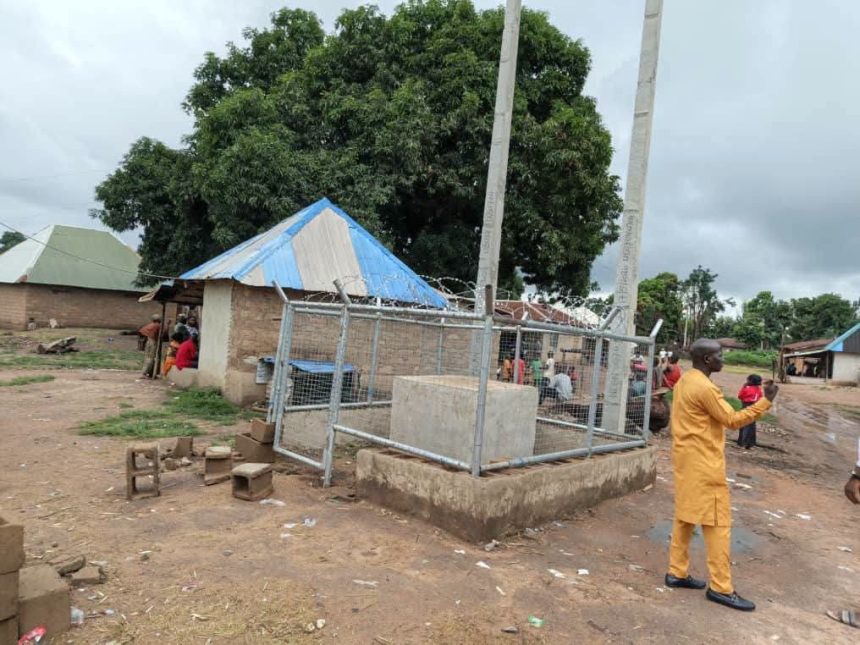
The project, facilitated by Senator Barrister Sunday Marshall Katung, representing Kaduna South Senatorial District, has already commenced with the installation of more than 200 electricity poles along the route linking Aban Community to Gwantu town.
For generations, residents of Aban have lived without access to electricity, relying largely on candles, kerosene lanterns, rechargeable lamps and mobile phone torches to carry out basic activities after sunset.
The prolonged absence of electricity has also affected economic activities, education, healthcare and other aspects of community life, with many businesses unable to operate effectively beyond daylight hours.
However, the situation is gradually changing as the electrification project gets underway.
Although work is still in progress, the erection of electricity poles across the community has generated excitement and renewed optimism among residents, who described the development as the fulfilment of a long-standing dream.
For the people of Aban, the electricity poles are not merely infrastructure. They represent hope, opportunity and the possibility of a new beginning after generations of living without access to public electricity.
The District Head of Aban, His Highness Mallam Mamman Umaru, expressed profound appreciation to Senator Katung for initiating the project, describing it as a historic intervention that would have a lasting impact on the community.
The traditional ruler, who spoke emotionally about the development, said the people of Aban had waited for generations to witness the arrival of electricity.
«“For 200 years, we have waited. Today, our children are seeing the signs that the end of darkness is near. Our women will be able to grind in the evening, our young people will have greater opportunities, and I am grateful to witness the coming of electricity in my lifetime. May God bless Senator Katung.”»
The district head said the project would bring significant changes to the social and economic life of the people, particularly women, youths and small business owners who have been constrained by the lack of electricity.
The electrification is also expected to improve the operation of local businesses, allowing residents to engage in economic activities beyond daylight hours.
Small-scale enterprises such as grinding mills, welding workshops, barbing salons, tailoring businesses, food processing ventures, phone charging centres and other businesses that require electricity are expected to benefit significantly when the project is completed.
The project is equally expected to create a more conducive environment for education. Students and pupils will have improved opportunities to study at night without depending solely on kerosene lamps, candles or other limited sources of lighting.
Healthcare services are also expected to receive a boost, particularly in terms of lighting and the ability to provide services during emergencies at night.
Improved electricity supply could further contribute to community security, as illuminated homes, streets and public spaces can enhance visibility and support security efforts.
Speaking on the significance of the project, Senator Katung said the intervention was driven by the belief that every Nigerian community deserved access to basic infrastructure and opportunities for development, irrespective of its location.
According to him, geographical location should not be a barrier to development, stressing that government and elected representatives must ensure that rural and underserved communities are not left behind.
«“No community should be forgotten because of where it is located. When you light up a village, you do not only provide electricity; you light up possibilities, create opportunities and illuminate the future of generations to come.”»
The senator said the project should be viewed beyond the physical installation of electricity poles, describing access to electricity as an important catalyst for economic growth, human development and improved living standards.
He noted that electricity could transform the fortunes of communities by creating opportunities for businesses, improving education and healthcare and empowering young people and women to pursue productive ventures.
The electrification project, which stretches from Aban to Gwantu town, is therefore expected to serve as an important infrastructure intervention for the community and surrounding areas.
Residents have expressed optimism that the completion of the project would open a new chapter in the history of Aban.
For a community that has endured generations without electricity, the development represents a significant milestone and a visible indication that the long wait may finally be coming to an end.
The arrival of electricity is expected to stimulate local economic activities by making it possible for businesses to operate for longer hours and by creating an environment for new enterprises to emerge.
Women, who often bear a significant burden of household and economic responsibilities, are also expected to benefit from access to electricity-powered equipment that can reduce the time and effort required for some domestic and commercial activities.
Young people in the community are expected to gain access to improved learning conditions, digital opportunities and other activities that require electricity.
Beyond economic and social benefits, residents believe that the project will also strengthen the connection between Aban and the wider development taking place in other parts of Sanga Local Government Area and Kaduna State.
The ongoing installation of the electricity poles has already become a source of excitement among residents, many of whom have described the development as a historic moment for the community.
The project has also renewed discussions about the importance of extending basic infrastructure to rural communities that have historically remained underserved.
As work continues, residents are looking forward to the completion and energisation of the project, which they believe will fundamentally change their daily lives.
For Aban Community, the coming of electricity is more than the arrival of power lines and poles. It is a symbol of inclusion, development and hope.
After generations of waiting, the people are now looking towards a future where their homes, businesses, schools and public spaces can be illuminated.
The project is consequently being celebrated as a landmark development that could mark the beginning of a new era for Aban—an era defined not by darkness and deprivation, but by light, economic opportunity, improved livelihoods and renewed hope.