

By Julius Peter
The Chairman of the Independent Corrupt Practices and Other Related Offences Commission (ICPC), Dr Musa Adamu Aliyu, SAN, has charged staff of the Commission to embrace creativity, professionalism and modern communication strategies in effectively communicating its mandate, activities and achievements to Nigerians.
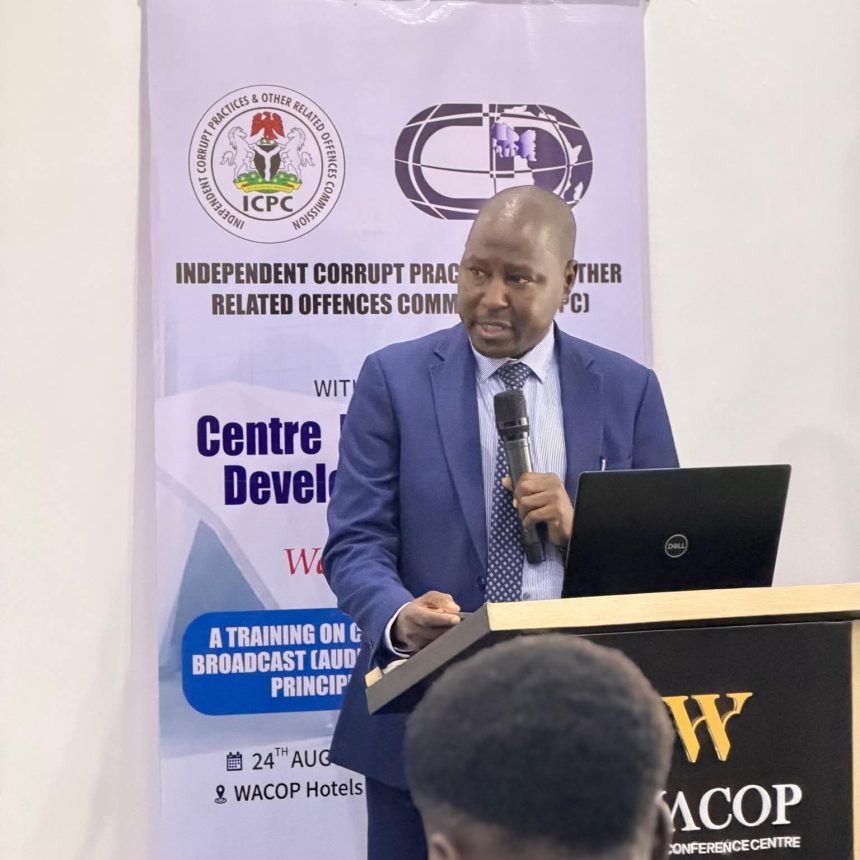
Aliyu gave the charge in Abuja while declaring open a two-day capacity-building training on Content Creation, Editing, Audio-Visual Production and News Writing organised for staff of the Media and Public Communications Unit and the Education Department of the Commission.
The training, held from August 24 to 25, 2026, was organised by the ICPC with the support of the Centre for Democracy and Development (CDD), as part of efforts to strengthen the professional capacity of staff and enhance the Commission’s ability to engage effectively with the public in an increasingly digital and rapidly changing media environment.
Represented at the event by the Head of the External Cooperation Unit, Mr Ahmed Abdul, the ICPC Chairman said effective communication had become an essential component of institutional performance, particularly for an anti-corruption agency whose success depends significantly on public understanding, participation and confidence.
He noted that the rapid transformation of the communication landscape, driven by digital technology and the growing influence of social media and audio-visual platforms, had made it imperative for public institutions to constantly review and improve the way they communicate with citizens.
According to him, the ICPC must ensure that its mandate, programmes, activities and achievements are communicated to Nigerians in ways that are accurate, accessible, creative and professionally presented.
“In today’s rapidly evolving communication environment, effective content creation and strategic use of media are essential to communicating the mandate, activities and achievements of the ICPC accurately, creatively and professionally,” he said.
The Chairman urged participants to take full advantage of the training by actively engaging the facilitators, exchanging professional experiences and acquiring practical skills that could be immediately applied to their respective responsibilities.
He stressed that the success of the capacity-building programme would not be determined merely by attendance or participation, but by the extent to which the knowledge and skills acquired were translated into improved performance and better communication of the Commission’s work.
Aliyu further encouraged the participants to approach their responsibilities with innovation and a clear understanding of the importance of communication in advancing the objectives of the Commission.
He said effective communication should go beyond simply reporting institutional activities, stressing the need to present information in formats and narratives capable of reaching diverse audiences and promoting greater public understanding of the ICPC’s anti-corruption mandate.
The Chairman also commended the Centre for Democracy and Development for supporting the training programme and for its continued commitment to strengthening professional capacity within public institutions.
He described partnerships of this nature as valuable contributions towards developing a competent, innovative and effective workforce capable of responding to the demands of contemporary public communication.
Earlier, the Head of the Media and Public Communications Unit of the ICPC, Mr Okor Odey, underscored the importance of a sound understanding of communication principles for practitioners seeking to remain professionally relevant in the rapidly changing media industry.
Odey noted that the evolving nature of the media environment required communication professionals to continuously acquire new skills and understand emerging trends in content production, editing, storytelling and strategic communication.
He explained that effective communication was not limited to carrying out assigned duties, but also involved understanding the broader strategic objectives behind an organisation’s communication activities.
According to him, practitioners must understand “the distinction between executing, supervising and directing a communication strategy.”
He said such an understanding would enable communication professionals to move beyond routine content production and contribute meaningfully to the development and implementation of institutional communication strategies.
The two-day training featured practical and interactive sessions covering key areas including content creation, editing, audio-visual production and news writing.
The sessions were designed to equip participants with contemporary skills required to produce engaging, accurate and professionally packaged content for different media platforms.
The training also provided an opportunity for participants to examine the changing dynamics of modern journalism and institutional communication, particularly the increasing importance of digital platforms and visual storytelling in reaching wider audiences.
For the ICPC, the initiative represents part of the Commission’s broader efforts to improve its institutional communication and strengthen public engagement around its anti-corruption activities.
As the fight against corruption increasingly requires public participation, awareness and access to credible information, effective communication remains critical to ensuring that citizens understand the role of the Commission and its interventions.
The training therefore sought not only to improve the technical skills of communication personnel but also to enhance their capacity to communicate the ICPC’s anti-corruption message more effectively to different segments of the Nigerian public.
The Commission’s leadership expressed the expectation that participants would apply the knowledge gained from the programme to improve the quality, relevance and impact of the ICPC’s communication outputs.
The initiative also underscores the growing recognition that public institutions must continually adapt their communication approaches to remain relevant in an environment where citizens increasingly consume information through digital, social and audio-visual platforms.
With improved skills in content development, news writing, editing and audio-visual production, the ICPC expects its communication personnel to play a stronger role in accurately projecting the Commission’s activities, deepening public awareness and supporting its broader anti-corruption mandate.