

By Julius Peter.
The Nigeria Customs Service (NCS) has launched a dedicated facility for women engaged in cross-border trade at the Seme-Krake Border Post, in a move aimed at addressing the challenges faced by female traders and promoting safer, more efficient and formalised trade between Nigeria and the Republic of Benin.
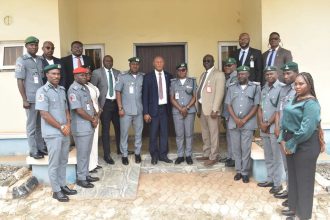
The facility was commissioned on Friday, September 11, 2026, during a joint assessment visit to the Seme-Krake Border Post led by the Comptroller-General of Customs, Adewale Adeniyi.
Speaking at a press briefing during the visit, Adeniyi said the initiative was designed to respond specifically to the needs of women traders, who constitute a significant proportion of informal cross-border traders across Africa.
According to him, women account for more than 70 per cent of informal cross-border traders on the continent, yet many are discouraged from using formal trading channels because of complex procedures, delays, harassment, extortion and other difficulties encountered at border posts.
He said the challenges often place disproportionate burdens on women traders, many of whom operate with limited financial capacity and depend on small consignments to sustain their livelihoods.
Adeniyi explained that when border procedures become slow, complicated, opaque or intimidating, traders with the least capacity to absorb additional costs are more likely to abandon formal channels.
“Where a border is slow, opaque, intimidating, complex, and all those difficulties are experienced, the trader with the least capacity to absorb costs is the one driven around it. And once she is driven around it, we lose her twice. She loses the protection of the law, and the state will lose the revenue,” he said.
The Comptroller-General said the new facility was therefore conceived as part of broader efforts to make the border environment more accessible and responsive to the realities of women involved in legitimate cross-border commerce.
He said the initiative would provide simplified procedures for small consignments, accessible information and points of contact, while also creating mechanisms through which traders could report cases of mistreatment or abuse.
“Its purpose is to bring women into the formal trading system on terms that they can actually meet: simplified procedures for small consignments, clear published information in the languages traders will understand, accessible points of contact, protection against informal demands, and a channel through which a woman who is badly treated can make her claim,” Adeniyi said.
He stressed that improving conditions for women traders was not only a social responsibility but also an important component of trade facilitation, revenue generation and regional economic integration.
According to him, traders who are able to access transparent and predictable border procedures are more likely to operate within the formal system, thereby enabling governments to collect legitimate revenue while providing traders with the protection of the law.
The NCS boss also emphasised the importance of strengthening cooperation between Nigeria and Benin, noting that the success of economic integration should not be judged merely by the number of agreements signed or official engagements held between the two countries.
Rather, he said, the effectiveness of integration should be measured by how efficiently people, goods and legitimate businesses can move across the common border.
He maintained that a well-managed border should simultaneously facilitate legitimate trade and protect national economic and security interests.
The initiative is also expected to contribute to efforts to reduce informal trading activities along the corridor by making formal trade procedures easier for small-scale operators, particularly women who may lack the resources or information required to navigate complicated customs processes.
The Director-General of Benin Customs, Raouf Aboudou, commended the Nigeria Customs Service for the initiative and described closer cooperation between the two countries’ Customs administrations as essential to strengthening economic integration in the sub-region.
Aboudou said enhanced collaboration would help facilitate legitimate trade while improving the capacity of both administrations to prevent and combat illicit activities along the border.
He noted that effective cooperation between the Customs authorities of Nigeria and Benin would benefit traders and businesses operating legally while ensuring that border controls remain strong enough to address smuggling and other forms of cross-border crime.
The Seme-Krake corridor is an important commercial route linking Nigeria with Benin and serving as a major gateway for trade within the West African sub-region. The efficiency of activities along the corridor is therefore considered critical to the broader objectives of regional economic integration.
The new women-focused facility is expected to strengthen confidence among female traders by providing them with clearer procedures, information and channels for addressing grievances.
It is also expected to promote greater transparency in the interaction between traders and border officials and discourage informal charges and other practices that could undermine legitimate trade.
Adeniyi’s remarks underline the NCS’s broader emphasis on modernising border management and improving the trading environment while maintaining effective customs controls.
The commissioning formed part of activities surrounding the joint assessment of the Seme-Krake Border Post, with officials examining issues affecting trade and movement along the corridor.
The visit also featured a friendly football match between the Seme Area Command team and Badagry United Football Club.
The Customs team emerged victorious, defeating Badagry United 2-0.
The event provided an additional opportunity for interaction between Customs personnel, stakeholders and members of the host community, reinforcing the importance of cooperation and positive engagement in strengthening border management.
With the launch of the dedicated facility, the Nigeria Customs Service is seeking to ensure that women traders are not forced out of the formal economy by avoidable barriers, but are instead provided with an environment in which they can trade legally, safely and efficiently.
The initiative is expected to further support Nigeria and Benin’s shared objective of creating a more efficient border environment that promotes legitimate commerce, protects traders and strengthens government revenue while maintaining robust security controls.