

By Julius Peter
The Chairman of the Independent National Electoral Commission (INEC), Prof. Joash O. Amupitan, SAN, has charged the Commission’s field officers and senior officials across the Southwest to confront the challenges of the 2027 General Election with greater commitment, discipline, preparedness and a strong determination to deliver credible elections.
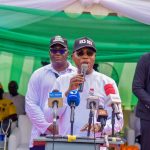
Amupitan gave the charge in Lagos at the opening of the Southwest Zonal Interaction Meeting and Readiness Assessment, the first leg of a six-zone national tour designed to assess the Commission’s operational preparedness ahead of the 2027 General Election.
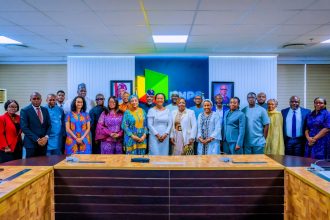
The meeting, held at the Radisson Blu Hotel, Ikeja, brought together Electoral Officers (EOs), Heads of Department (HODs), senior administrative staff and other officials of INEC from the six states of the Southwest.
The Commission is scheduled to conduct the Presidential and National Assembly Elections on Saturday, January 16, 2027, followed by the Governorship and State Houses of Assembly Elections on Saturday, February 6, 2027.
Speaking at the gathering, Amupitan declared that the 2027 election was no longer a distant event but an immediate responsibility requiring the full attention of every official of the Commission.
«“The 2027 General Election is here,” the INEC chairman said, urging officials to confront the task “frontally.”»
He stressed that preparations for the national elections must be informed by lessons drawn from recent off-cycle elections, which, according to him, had provided the Commission with opportunities to test its systems, identify weaknesses and make necessary improvements.
Among the elections he cited were the Anambra State Governorship Election, the Federal Capital Territory (FCT) Area Council Election and the recently concluded Osun State Governorship Election.
Amupitan said the elections should not be viewed merely as isolated electoral exercises but as important milestones in INEC’s continuing efforts to strengthen its processes and prepare adequately for the much larger demands of the 2027 General Election.
“Those off-cycle elections have provided us with the mirror through which we can see into the 2027 elections,” he said.
The INEC chairman explained that his decision to personally engage officials at the zonal and grassroots levels was deliberate, stressing that the credibility and success of any election ultimately depended on what happened in the field.
According to him, while policies and decisions may be developed at the Commission’s headquarters in Abuja, their effectiveness would ultimately be determined by the officials responsible for implementing them across the country.
“The true success of any election is not decided solely in the meeting rooms of our headquarters in Abuja. It is indeed decided in the field,” Amupitan said.
He therefore urged Electoral Officers and Heads of Department to use the Lagos interaction as an opportunity to speak candidly about the operational realities confronting them.
The officials, he said, should identify gaps in the Commission’s preparations, raise concerns that could affect the conduct of the elections and offer practical solutions that could strengthen INEC’s readiness before Election Day.
Amupitan emphasised that preparations for the 2027 elections must be based on continuous learning, evaluation and improvement.
He noted that challenges encountered during one electoral exercise should not be allowed to recur in subsequent elections, but should instead serve as lessons for improving planning, logistics, personnel deployment and other aspects of election administration.
The chairman also commended INEC officials who participated in the recent Osun State Governorship Election, noting that the commendations received by the Commission following the poll were largely a reflection of the dedication of officials who worked throughout the electoral process.
He said the men and women deployed to the field played a critical role in protecting the integrity of the ballot and ensuring that voters’ choices were properly recorded and counted.
The commendation, he stressed, therefore belonged not only to the leadership of the Commission but also to the numerous officials who worked behind the scenes and at polling locations to make the election possible.
The chairman’s remarks underscored the importance of field personnel as INEC begins to shift its focus towards the enormous logistical and administrative demands of a nationwide general election.
Unlike off-cycle elections, the 2027 General Election will involve simultaneous electoral activities across the country and require extensive coordination among INEC’s headquarters, state offices, local government offices and polling units.
Earlier, the Resident Electoral Commissioner (REC) for Lagos State, Prof. Ayobami Salami, who welcomed Amupitan and other participants to Lagos, said the credibility of an election was built long before voters arrived at polling units on Election Day.
Salami identified early preparation, effective coordination, competent personnel and continuous assessment as essential components of a credible electoral process.
He said the readiness assessment being undertaken by the Commission should go beyond the completion of administrative checklists and instead provide an opportunity for INEC to examine the actual capacity of its structures to deliver the elections.
According to him, the assessment should critically examine the adequacy of human resources, logistics, infrastructure, technology, electoral materials and security arrangements, as well as the Commission’s engagement with stakeholders.
He urged Electoral Officers and Heads of Department across the Southwest to speak frankly about their experiences and operational realities.
Such frank assessments, he said, would enable the Commission to identify weaknesses early enough to address them before the 2027 elections.
Salami also encouraged officials to share effective practices and innovative approaches that could improve the Commission’s overall preparations.
The Lagos meeting represents the first phase of INEC’s planned engagement with officials across Nigeria’s six geopolitical zones.
The zonal interactions are expected to provide the Commission’s leadership with direct insight into the conditions under which electoral officials operate at state and grassroots levels.
The approach also signals an emphasis on decentralised feedback as the Commission intensifies preparations for the 2027 elections.
For INEC, the exercise provides an opportunity to bridge the gap between decisions taken at the national level and the practical realities faced by officials responsible for implementing those decisions in communities across the country.
The Southwest engagement, therefore, is expected to serve not only as a readiness assessment but also as a platform for identifying potential challenges before they become obstacles to the conduct of the elections.
With the two rounds of the 2027 elections scheduled for January and February, respectively, the Commission faces a tight preparation window.
The message from the INEC leadership in Lagos was consequently clear: the success of the 2027 elections will depend on the quality of preparations undertaken now, the willingness of officials to confront existing challenges and the ability of the Commission to learn from previous electoral exercises.
As the six-zone tour continues, the Commission is expected to use feedback from its officials across the country to strengthen its operational plans and address emerging gaps ahead of what promises to be one of Nigeria’s most consequential electoral exercises.
For Amupitan, the challenge is not simply to prepare for another election, but to ensure that the lessons of recent polls translate into concrete improvements before Nigerians go to the polls in January and February 2027.