
By Julius Peter, Abuja
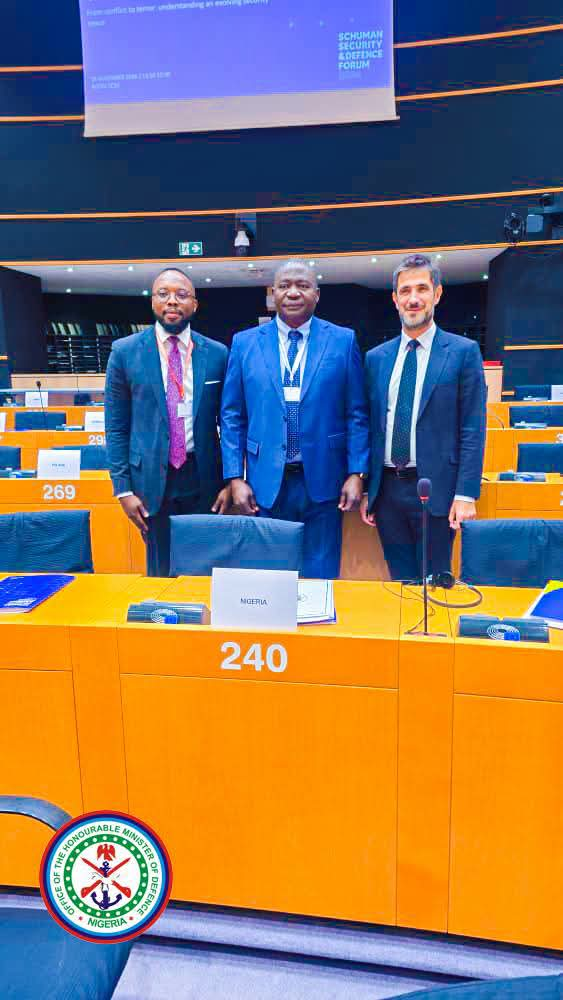
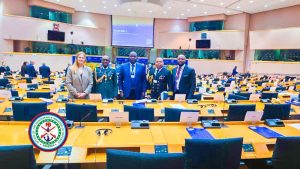
The Minister of Defence, General Christopher Gwabin Musa (Rtd.), OFR, has returned to Abuja after participating in the 2026 Schuman Security and Defence Forum in Brussels, Belgium, describing Nigeria’s engagement as a major milestone in strengthening the country’s counterterrorism diplomacy and international defence partnerships.
The Minister also undertook engagements in Lagos and Ibadan following the high-level security and defence forum, which brought together international stakeholders to discuss global security challenges and opportunities for cooperation.
In a statement issued on Sunday, November 22, 2026, the Ministry of Defence said General Musa described Nigeria’s participation in the forum, organised by the European External Action Service (EEAS), as highly productive, with significant strategic benefits for the country’s security priorities.
The Minister said the outcomes of the engagement were aligned with the security objectives of President Bola Ahmed Tinubu’s administration, particularly efforts to strengthen Nigeria’s capacity to combat terrorism and other security threats through international cooperation, technological advancement and improved operational capabilities.
According to him, Nigeria recorded important gains in its engagement with European Union counterparts, including strengthened counterterrorism alignment, advancement of emerging technology partnerships, international endorsement of the country’s non-kinetic security framework and reinforced regional security diplomacy.
General Musa disclosed that Nigeria secured broad international consensus and renewed commitments from European partners to deepen cooperation in intelligence sharing, counterterrorism financing and border management.
He said the renewed commitment would provide opportunities for enhanced collaboration in addressing the complex security challenges confronting Nigeria and other countries in the region.
The Minister noted that discussions with European Union defence leaders and multilateral partners also opened new avenues for technical cooperation in emerging security technologies.
These areas, he said, include counter-drone technologies, military artificial intelligence, digital forensics and satellite intelligence, which are increasingly important in modern military operations and intelligence gathering.
He added that the engagements would also support Nigeria’s indigenous defence innovation ecosystem, particularly efforts to develop local solutions to security challenges and reduce dependence on foreign technologies.
The Minister emphasised that strengthening domestic defence innovation remained critical to improving the operational effectiveness of the Armed Forces of Nigeria and ensuring that the country could respond more efficiently to evolving threats.
General Musa further disclosed that international stakeholders at the forum commended Nigeria’s comprehensive National Counter Terrorism Strategy (NACTEST), particularly its emphasis on combining military operations with institutional, financial and rehabilitation measures.
He said Nigeria’s approach, which integrates kinetic operations with non-kinetic interventions, had received positive recognition from international partners.
The strategy involves collaboration among relevant institutions, including the Nigerian Financial Intelligence Unit (NFIU), the National Counter Terrorism Centre (NCTC) and Operation SAFE CORRIDOR.
The Minister explained that the synergy among these institutions was essential to addressing the root causes of terrorism, disrupting its financial networks and supporting efforts to rehabilitate and reintegrate individuals who disengage from extremist groups.
He maintained that Nigeria’s counterterrorism strategy recognises the importance of military action alongside intelligence, financial monitoring, institutional coordination and other measures aimed at preventing the spread of violent extremism.
On the sidelines of the plenary sessions in Brussels, the Minister held bilateral consultations with African and European counterparts to strengthen regional security cooperation.
The discussions focused on enhancing joint security frameworks under the Multinational Joint Task Force (MNJTF), particularly in the Lake Chad Basin, as well as cooperation through the Economic Community of West African States (ECOWAS) and the West Africa Police Information System (WAPIS).
The Minister said the engagements were aimed at improving coordination among regional security institutions, strengthening information exchange and developing more effective joint responses to cross-border security threats.
He stressed that regional cooperation remained indispensable in confronting terrorism, organised crime and other security challenges that transcend national boundaries.
General Musa reaffirmed the Federal Government’s commitment to translating the diplomatic and technical gains recorded at the forum into practical operational support for the Armed Forces of Nigeria.

He said the Ministry of Defence would immediately begin working towards the implementation of the outcomes of the Brussels engagements to strengthen military operations across all theatres of operation.
The Minister, however, emphasised that the country’s security operations would continue to be conducted in accordance with the principles of civilian protection, due process and international humanitarian law.
He noted that the protection of civilians and respect for human rights remained essential components of Nigeria’s counterterrorism efforts and its engagements with international security partners.
The Ministry of Defence said Nigeria’s participation in the Schuman Security and Defence Forum underscored the country’s determination to deepen strategic partnerships, strengthen its defence capabilities and contribute more effectively to regional and global security.
The statement was signed by Leah Katung-Babatunde, Special Assistant on Media to the Honourable Minister of Defence.