
By Julius Peter, Abuja
The Minister of Works, Senator David Umahi, has described the 750-kilometre Lagos-Calabar Coastal Highway as a profitable national investment capable of generating revenue, attracting private sector participation and unlocking enormous tourism and industrial opportunities across Nigeria’s coastal corridor.
Umahi reaffirmed President Bola Ahmed Tinubu’s commitment to the completion of the ambitious highway project, declaring that the Federal Government would not abandon the initiative, which traverses nine coastal states.
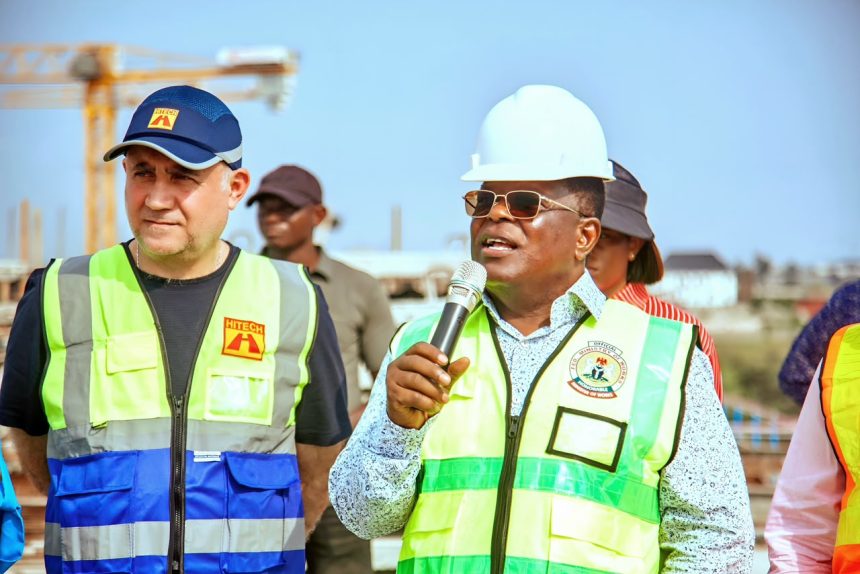
The minister stated this on Sunday, November 22, 2026, during an inspection of bridges on Sections 1 and 2 of the Lagos-Calabar Coastal Highway.
He said the President had given a clear directive that the project must be completed as planned, despite its scale and the financial demands associated with the construction of major infrastructure.
“Nothing will happen to the 750-kilometre Lagos-Calabar Coastal Highway, which passes through the nine coastal states. The President has directed that the project must be completed as envisaged,” Umahi declared.
According to him, the highway is not merely a transportation project but a strategic economic investment that will create opportunities for businesses, improve connectivity and stimulate development along Nigeria’s coastal communities.
The minister explained that the project had been designed to accommodate several economic activities, including tourism facilities, factories, commercial infrastructure and modern security systems, which would contribute to its long-term financial sustainability.
He said the adoption of concrete pavement and solar-powered infrastructure would also provide opportunities for Nigeria to benefit from carbon credit initiatives.
“We are using concrete, and so we are entitled to carbon credits claim. We are also using solar instead of conventional electricity; we are entitled to carbon credits,” he said.
Umahi noted that the use of environmentally friendly construction materials and renewable energy would position the project to attract additional investment and potentially generate revenue through carbon credit mechanisms.
He disclosed that private investors had already expressed interest in participating in arrangements that would enable them to recover their investments, stressing that the highway offered considerable opportunities for public-private sector collaboration.
The minister said the road would support the development of tourism destinations, industrial facilities and other commercial ventures, particularly in communities along the coastal corridor.
He maintained that the economic benefits of the project would extend beyond improved road transportation to include employment generation, increased commercial activities and the expansion of Nigeria’s productive capacity.
Umahi also disclosed that the official commissioning of Section 1 of the Lagos-Calabar Coastal Highway by President Tinubu was expected to take place this month or in early December.
He described the project as one of the major infrastructure initiatives being undertaken by the Tinubu administration to improve connectivity and strengthen economic integration across the country.
The minister further identified the ongoing 1,068-kilometre Sokoto-Badagry Road as another major undertaking of the administration, noting that the government was simultaneously pursuing several strategic road projects across different regions.
Clarifying concerns surrounding the reconstruction of the East-West Road, Umahi said the project was an additional commitment by President Tinubu and would not replace, undermine or affect the Lagos-Calabar Coastal Highway.
He explained that the Federal Government was implementing multiple infrastructure projects at the same time, with the objective of addressing longstanding transportation challenges and improving access to economic centres nationwide.
The minister commended President Tinubu for what he described as the administration’s commitment to infrastructure development and economic reforms.
He cited improvements in the economy, including declining inflation and better foreign exchange access for businesses, as developments that Nigerians should acknowledge.
Umahi also pointed to the absence of strikes by the Academic Staff Union of Universities (ASUU) as another achievement, urging Nigerians to support the administration’s policies and programmes.
He particularly appealed to residents of the South-East living in Lagos to support President Tinubu, saying the administration had delivered significant infrastructure projects to the region.
In a related development, the minister has ordered a nationwide three-week emergency rehabilitation of major federal highways ahead of the festive season and the January 2027 elections.
The directive covers critical highways across the six geopolitical zones and is aimed at ensuring that motorists, transporters and other road users can travel safely and conveniently during the busy period.
Umahi directed Zonal Directors, Controllers of Works, Resident Engineers and contractors to return to the field immediately and ensure that damaged and impassable sections of federal roads were urgently rehabilitated.
He warned that contractors undertaking permanent construction must not allow motorists to continue suffering on failed portions of roads while construction work was ongoing.
According to him, the practice of leaving damaged sections unattended during major construction projects was unacceptable and must be discontinued.
“I feel so sad that a contractor will be on site doing permanent work, yet some sections of the roads remain impassable. This practice must stop,” the minister said.
He instructed contractors to excavate damaged portions of roads and rehabilitate them with appropriate materials, including asphalt where necessary, to restore them to acceptable motorable conditions.
The minister stressed that the emergency intervention was not intended to replace ongoing permanent construction but to provide immediate relief to road users while major rehabilitation and reconstruction works continued.
He directed ministry officials to document the exercise, engage contractors, identify challenges and report any difficulties that could affect the successful completion of the assignment.
Umahi further charged the officials to ensure that the three-week deadline was strictly observed, warning that the exercise must be treated with the urgency it deserved.
He said the rehabilitation programme was particularly important in view of the increased movement of people and goods expected during the festive season.
The intervention, he added, would also facilitate the transportation of election materials, support the movement of security personnel and strengthen security operations ahead of the 2027 general elections.
The minister called on all relevant officials and contractors to demonstrate commitment, dedication and sacrifice, insisting that no effort should be spared in ensuring that federal highways across the country were made safe and passable.
He reiterated that the Federal Government remained committed to improving road infrastructure and easing the burden on Nigerians through the timely execution of critical highway projects.