
By Our Sport Correspondent, Abuja
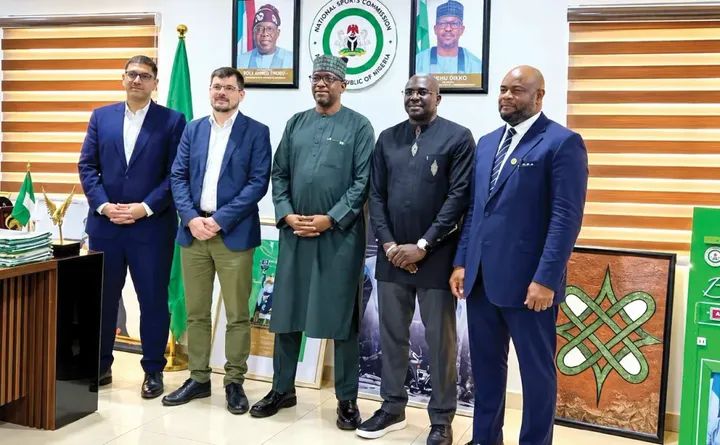
The world football governing body, FIFA, and the Confederation of African Football (CAF) have commenced a joint assessment of the leadership crisis rocking the Nigeria Football Federation (NFF), with the international bodies engaging key stakeholders in Abuja on the way forward for Nigerian football.
The assessment follows the mass resignation of NFF President Ibrahim Musa Gusau, General Secretary Mohammed Sanusi and several members of the federation’s Executive Committee on August 27, 2026.
The development plunged the country’s football administration into uncertainty and raised questions over the legality and sustainability of the federation’s existing governance and electoral arrangements.
The FIFA and CAF intervention is expected to focus on establishing a lawful, credible and broadly acceptable process for restoring a fully functioning NFF Congress and resolving the leadership vacuum within the federation.
Reports indicate that the joint delegation is holding discussions with relevant stakeholders, including officials of the NFF, the National Sports Commission (NSC), members of the federation’s electoral structures and other representatives of the Nigerian football community.
The international football bodies are expected to examine the circumstances that led to the mass resignation of the NFF leadership, the federation’s statutes, its governance structure, the electoral process and the role of government in football administration.
The mission will also consider the possibility of a new timetable for the NFF elective congress, which had originally been scheduled for September 27 in Lafia, Nasarawa State.
The Abuja mission follows an earlier directive by FIFA and CAF for the NFF to suspend its ongoing electoral process pending the outcome of the assessment.
In a letter dated September 7, FIFA Chief Member Associations Officer, Elkhan Mammadov, informed the NFF that FIFA and CAF were reviewing the legal, governance, administrative and electoral implications of the developments within the federation.
The directive effectively put further preparations for the proposed September 27 elective congress on hold.
FIFA said no further electoral steps, decisions or activities should proceed until the assessment is completed.
The world football governing body, however, stressed that the suspension should not be interpreted as a final judgment on the validity of actions taken by any of the stakeholders.
It also indicated that no conclusion had yet been reached on what further measures, if any, would be taken after the assessment.
The present crisis became pronounced after Gusau and other senior NFF officials resigned from their positions.
The resignations came amid mounting criticism of the state of Nigerian football, particularly following the failure of the Super Eagles to qualify for the 2026 FIFA World Cup.
Nigeria’s women’s senior national team also failed to qualify for the 2027 FIFA Women’s World Cup, while the country’s youth teams have faced setbacks in their respective qualification campaigns.
The sequence of disappointing results intensified calls from sections of the football community for changes in the administration and governance of Nigerian football.
The mass resignation subsequently created uncertainty over the leadership of the federation and the process for electing a new board.
The FIFA and CAF mission is expected to go beyond resolving the immediate leadership vacuum and address some of the structural issues that have repeatedly generated controversy within the NFF.
A major issue before the delegation is how to establish a succession process that is acceptable to the various stakeholders while remaining consistent with FIFA and CAF regulations as well as Nigerian law.
The international bodies are also expected to consider reforms to the NFF statutes and electoral framework, issues that have been at the centre of disagreements among stakeholders.
The mission is therefore expected to provide a platform for stakeholders to present their positions on how Nigerian football should be administered and how future elections can be conducted in a transparent, credible and inclusive manner.
FIFA and CAF are also expected to examine the relationship between the Federal Government and the NFF, particularly the extent to which government can participate in efforts to reform the federation without violating the principles of football autonomy.
The National Sports Commission has remained involved in discussions concerning the future of Nigerian football.
A Nigerian delegation led by NSC Chairman Shehu Dikko had earlier met FIFA President Gianni Infantino and other FIFA officials in Zurich following the resignations.
The meeting resulted in continued engagement among FIFA, CAF, the Nigerian government and the NFF administration on a roadmap for comprehensive reforms of Nigerian football.
FIFA had also accepted the resignations of the former NFF principal officers, according to the NFF, while discussions on the next phase of the federation’s administration continued.
Dr Emmanuel Ikpeme has been serving as Acting General Secretary and has remained a key point of contact for FIFA and CAF during the assessment process.
Despite the depth of the crisis, FIFA has not announced any immediate suspension of Nigeria from international football.
The governing body has instead opted for a fact-finding and consultative process to determine the legal and administrative implications of the developments.
FIFA and CAF had earlier cautioned against drawing premature conclusions about the eventual outcome of their review.
This has also put to rest, at least for now, speculation that Nigeria could immediately face international sanctions or that an interim normalisation committee would automatically be appointed.
The outcome of the Abuja meetings is expected to determine the next stage of the process.
One of the most critical issues arising from the assessment is the future of the NFF electoral process.
With the September 27 elective congress effectively suspended, stakeholders are waiting for FIFA and CAF to determine the conditions under which a new electoral timetable can be produced.
The international bodies are expected to work with Nigerian football authorities and stakeholders to establish a process capable of restoring confidence in the federation’s administration.
The ultimate objective, according to reports surrounding the mission, is to return the NFF to a functioning Congress and create a governance framework capable of preventing recurring leadership crises.
The crisis has once again highlighted longstanding concerns over the administration of Nigerian football, with stakeholders calling for greater transparency, stronger institutional structures, broader participation and improved accountability.
As the FIFA and CAF assessment continues in Abuja, attention is now focused on whether the international intervention will produce a comprehensive restructuring of the NFF and pave the way for a fresh, credible and widely accepted electoral process.
For Nigerian football, the outcome could prove crucial not only to resolving the immediate leadership vacuum but also to determining the direction of the sport’s administration in the years ahead.