

By Julius Peter ,Abuja
The Chairman of the Independent Corrupt Practices and Other Related Offences Commission (ICPC), Dr. Musa Adamu Aliyu, SAN, has called on beneficiary institutions of the Tertiary Education Trust Fund (TETFund) to strengthen their procurement processes, improve documentation and reporting, and promote transparency and accountability in the management of public resources.
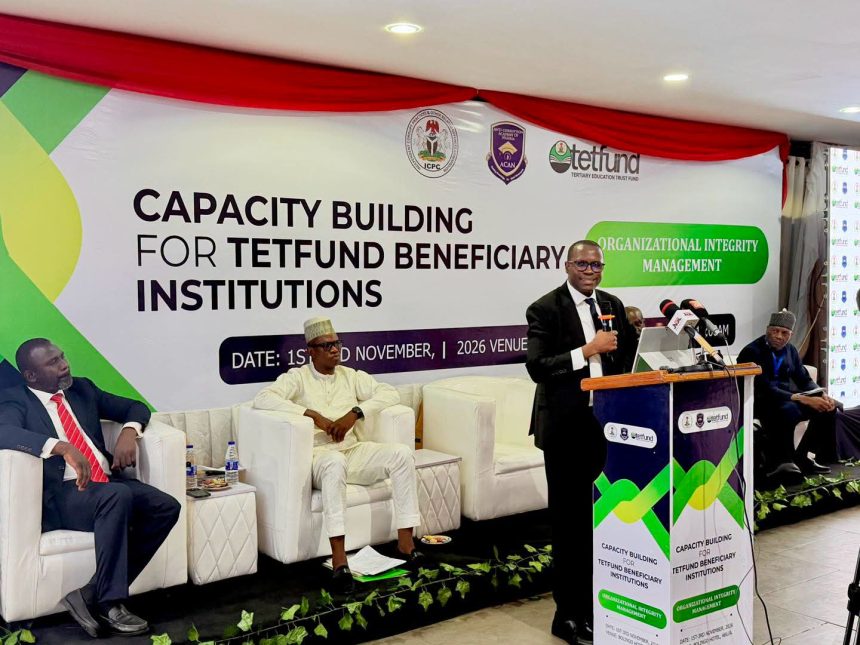
Aliyu made the call while speaking at a capacity-building programme organised for TETFund beneficiary institutions, where he emphasised the importance of translating knowledge acquired during training into practical measures capable of preventing corruption and promoting institutional accountability.
The ICPC chairman stressed that effective procurement management remains a critical component of good governance, particularly in public institutions entrusted with the responsibility of managing government interventions and development funds.
According to him, institutions must ensure that procurement activities are conducted in accordance with established regulations, with proper documentation and transparent procedures that make every stage of the process open to scrutiny.
He noted that strengthening procurement systems would help reduce opportunities for corrupt practices, improve institutional efficiency and ensure that public funds are utilised for their intended purposes.
Aliyu further underscored the need for improved reporting mechanisms, explaining that accurate records and timely reporting are essential tools for monitoring institutional activities, identifying weaknesses and addressing potential irregularities.
He said the objective of capacity-building initiatives should go beyond exposing participants to theoretical knowledge, insisting that the real value of such programmes lies in their practical application within the respective institutions.
The ICPC chairman urged participants to demonstrate commitment to the principles of integrity, transparency and accountability in the discharge of their responsibilities, adding that corruption prevention requires deliberate institutional measures rather than reliance on enforcement actions alone.
He maintained that public institutions must develop effective internal controls and preventive mechanisms capable of identifying and addressing vulnerabilities before they develop into serious administrative or financial infractions.
The programme provided an opportunity to reinforce the importance of sound procurement practices and responsible financial management among TETFund beneficiary institutions.
TETFund plays a significant role in supporting the development of Nigeria’s tertiary education sector through funding for infrastructure, research, academic development and other institutional interventions. Consequently, ensuring transparency and accountability in the utilisation of its resources remains important to achieving the objectives of the Fund.
The ICPC’s engagement with beneficiary institutions also reflects the importance of collaboration between anti-corruption agencies and public institutions in strengthening systems that promote responsible management of public resources.
The Commission has continued to emphasise preventive approaches to corruption, including public sector education, institutional capacity development, compliance monitoring and the promotion of ethical standards.
Aliyu’s message at the capacity-building programme reinforced the need for institutions to move from policy commitments to measurable action by ensuring that procurement procedures are properly followed, records are adequately maintained and reporting systems are strengthened.
He reiterated that the ultimate expectation is for participants to apply the knowledge acquired to improve institutional practices and prevent corruption.
The ICPC chairman’s position was clear: strengthening procurement processes, ensuring proper documentation, promoting transparency and improving reporting must translate into practical preventive action across TETFund beneficiary institutions.
The programme was organised in collaboration with relevant stakeholders, including the Association of Chief Auditors of Nigeria (ACAN), as part of efforts to strengthen institutional capacity and promote accountability in the management of public funds.