
By Julius Peter, Abuja
The Federal Government has intensified efforts to strengthen Nigeria’s military capabilities and combat terrorism following strategic discussions between the Minister of Defence, General Christopher Gwabin Musa (Rtd), and a delegation of the European Union (EU) on the implementation of a €20 million defence support package under the European Peace Facility (EPF).
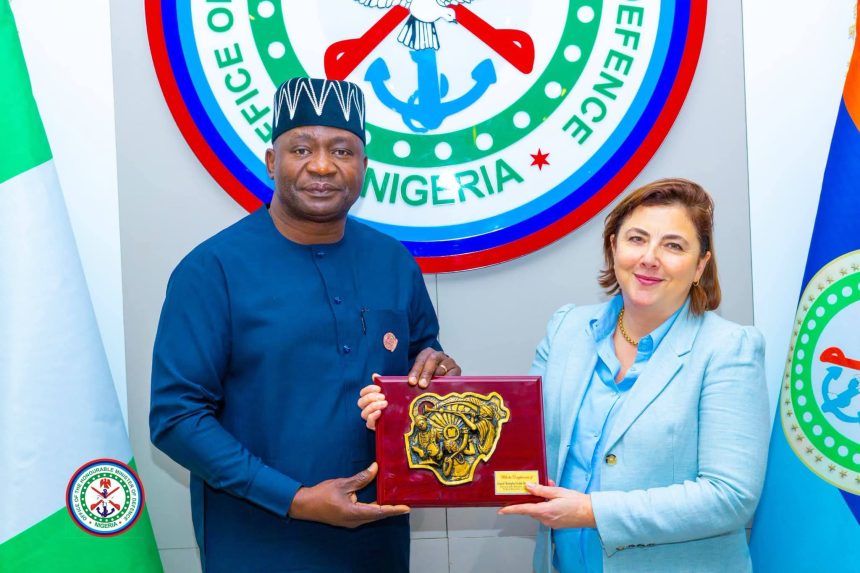
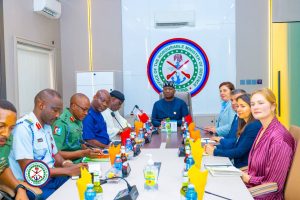
The meeting, held on Friday at the Ministry of Defence Headquarters, Ship House, Abuja, focused on finalising the delivery modalities for the support package, which represents the EU’s first-ever bilateral defence assistance to Nigeria.
The package, sealed in October 2026, is expected to enhance the operational capacity of the Armed Forces of Nigeria, particularly in ongoing counterterrorism operations within the Lake Chad Basin and other security-challenged areas of the country.
Receiving the European External Action Service (EEAS) delegation, led by the Head of the European Peace Facility, Ms. Claire Gaudin, General Musa described the intervention as a significant boost to Nigeria’s efforts to strengthen its defence architecture and address evolving security threats.
The Minister reaffirmed the Federal Government’s commitment to developing indigenous defence capabilities, stressing that Nigeria must progressively build the capacity to produce and maintain essential military equipment locally rather than depend excessively on foreign suppliers.
He called on the European Union to take advantage of the momentum generated by the recently concluded Africa Defence Exhibition (AFRIDEX) to support the establishment of local defence production lines in Nigeria.
According to him, such collaboration would not only strengthen the country’s military preparedness but also promote technology transfer, industrial development and long-term self-reliance in the defence sector.
General Musa also emphasised the need for stronger international cooperation in tackling terrorist financing, declaring Nigeria’s determination to identify, track and dismantle the financial networks sustaining terrorist organisations, irrespective of where such activities originate or operate.
He maintained that the fight against terrorism must go beyond military operations to include concerted efforts to disrupt the financial channels, logistics and other support systems that enable terrorist groups to operate.
While appreciating the European Union’s intervention, the Defence Minister explained that the current phase of the European Peace Facility assistance was focused on non-lethal military equipment, technical training and maintenance support.
He, however, expressed optimism that subsequent phases of the programme would accommodate additional critical areas, particularly military medical services and advanced surveillance capabilities, to further strengthen the effectiveness and protection of Nigerian troops deployed in operational theatres.
Earlier, the head of the EU delegation, Ms. Gaudin, explained that the €20 million support package would provide specialised equipment and other essential resources to improve the operational effectiveness and safety of Nigerian military personnel.
She identified the priority areas of intervention to include Counter-Improvised Explosive Device (C-IED) equipment, Counter-Unmanned Aircraft Systems (C-UAS), night vision capabilities and individual protective equipment for troops deployed on security operations.
Gaudin disclosed that the areas of intervention were jointly identified and agreed upon with the leadership of the Armed Forces of Nigeria after extensive bilateral consultations to determine the country’s most pressing operational requirements.
She explained that the assistance was designed to address specific security challenges confronting Nigerian troops, particularly the growing threats posed by improvised explosive devices, unmanned aerial systems and other emerging technologies increasingly deployed by terrorist organisations.
The EU representative further noted that Nigeria was among more than 20 African countries benefiting from the European Peace Facility, which has 30 beneficiaries globally.
She said the support to Nigeria would complement wider regional stabilisation initiatives, particularly the operations of the Multinational Joint Task Force (MNJTF), which brings together countries in the Lake Chad Basin to confront terrorism and other transnational security threats.
Beyond counterterrorism cooperation, both parties also explored opportunities to expand their security partnership into maritime security, with particular attention to strengthening cooperation across the Gulf of Guinea.
The proposed collaboration is expected to contribute to efforts to address maritime insecurity, protect shipping routes and improve regional responses to security threats within the Gulf of Guinea.
The discussions underscore the growing importance of international partnerships in addressing Nigeria’s complex security challenges, as the country continues to pursue a combination of military capacity development, intelligence cooperation, technological advancement and regional collaboration.
The European Peace Facility, established in March 2021 by the 27 member states of the European Union for the 2021–2027 financial cycle, is an off-budget financial instrument designed to enable the EU to support partner countries in preventing conflicts, building peace and strengthening international security.
Through the facility, the EU provides assistance aimed at improving the operational capabilities of partner armed forces and supporting international and regional efforts to maintain peace and stability.
For Nigeria, the €20 million intervention represents an important milestone in defence cooperation with the European Union, particularly at a time when the country is seeking more effective ways to confront terrorism, insurgency and other security threats.
The latest engagement also highlights the Federal Government’s determination to combine international defence partnerships with domestic industrial development, ensuring that external assistance contributes to building sustainable and self-reliant military capabilities.
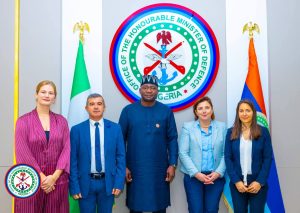
The meeting was attended by officials of the Ministry of Defence and representatives of the European External Action Service.