
By Julius Peter
A remarkable dimension of Nigeria’s ongoing fight against economic and financial crimes is emerging beyond arrests, prosecutions and convictions: assets linked to alleged criminal activities are increasingly being converted into institutions and programmes intended to serve the public.
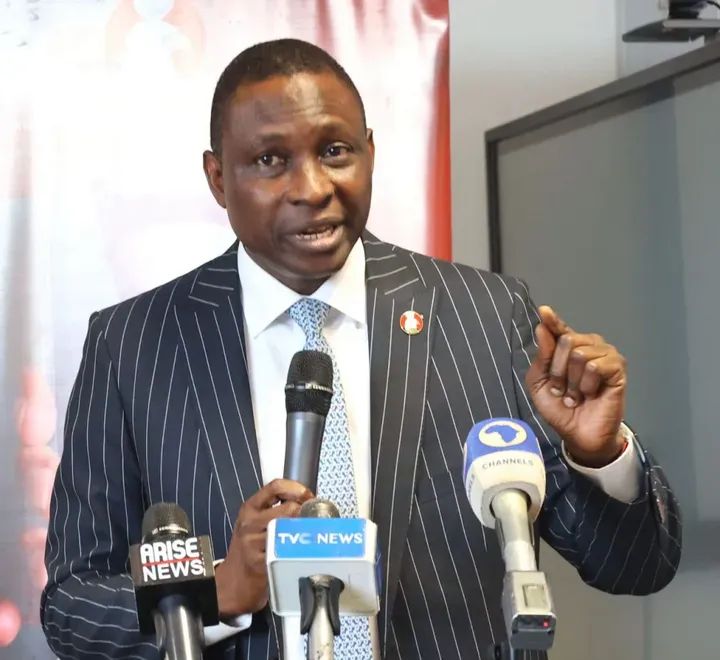
The Chairman of the Economic and Financial Crimes Commission (EFCC), Ola Olukoyede, has provided a striking example of this approach, revealing that a privately owned university forfeited to the Federal Government has been transformed into a federal university and is already providing tertiary education to thousands of Nigerian students.
The institution, formerly known as Nok University in Kachia, Kaduna State, is now the Federal University of Applied Sciences, Kachia (FUASK).
According to Olukoyede, 1,909 students matriculated at the university in December 2025 — turning an asset caught up in forfeiture proceedings into a platform for expanding access to higher education.
The development illustrates what the EFCC chairman described as the broader national value of asset recovery: ensuring that the proceeds of financial crimes do not simply disappear into government coffers but can, where appropriate and legally possible, be converted into productive assets and social investments.
The National Universities Commission (NUC) has listed the Federal University of Applied Sciences, Kachia, as an approved federal university, formerly Nok University. The institution was established in 2025 following the Federal Government’s takeover of the assets of the private university.
The story of the Kachia university began as a private-sector educational project before becoming entangled in forfeiture proceedings.
The EFCC pursued the forfeiture of the university’s assets in connection with proceedings involving Anthony Hassan, a former Director of Finance and Accounts at the Federal Ministry of Health.
Following a final forfeiture order by the Federal High Court, the Federal Government took possession of the property and subsequently approved its conversion into a federal university.
In February 2025, the EFCC formally handed over the institution’s property and assets to the Federal Government. The facilities included academic buildings and other infrastructure associated with the former university.
President Bola Tinubu subsequently ordered the transformation of the institution into the Federal University of Applied Sciences, Kachia.
The Federal Government’s decision was also presented as part of an effort to expand access to specialised higher education in Southern Kaduna.
By September 2025, the new university had commenced academic activities, inheriting much of the infrastructure of its predecessor. Its conversion therefore avoided some of the costs and delays normally associated with building an entirely new university from the ground up.
The university describes its mission around knowledge, innovation and development, with an emphasis on applied sciences and practical research.
For the EFCC, however, the significance goes beyond the physical buildings.
It is about what happens after an asset has been recovered.
Asset recovery has long been one of the most visible components of Nigeria’s anti-corruption campaign. Properties, vehicles, money, businesses and other valuables can become subject to forfeiture proceedings when investigators establish links between them and proceeds of crime.
An asset may have to pass through investigation, prosecution and judicial proceedings before ownership can finally be transferred to the government. In some cases, the government may sell a forfeited property and remit the proceeds. In others, particularly where an asset has an obvious productive or social purpose, authorities may choose to repurpose it.
Olukoyede has increasingly argued that this second stage — what happens after recovery — is just as important as the recovery itself.
Presenting the EFCC’s performance record, he said the commission recovered more than N1.23 trillion during his tenure between October 2023 and July 2026, alongside recoveries in foreign currencies.
But Olukoyede stressed that the meaning of those figures should not be measured simply by the amount of money recovered or the number of convictions secured.
The ultimate test, he suggested, is whether recovered value returns to society.
That philosophy is evident in the Kachia university.
A property that was once part of a private educational institution is now serving as a public university, with students occupying lecture halls, laboratories and other facilities.
Olukoyede said 1,909 students matriculated at the institution in December 2025, describing them as young Nigerians who might otherwise have struggled to obtain tertiary education.
Instead of being viewed solely as property seized from individuals involved in financial-crime proceedings, the facilities are now being used by students pursuing education and skills that could shape their future careers.
A university does not serve only the students enrolled in it. It requires lecturers, researchers, administrative workers, contractors, suppliers, security personnel and other support staff. Its students and employees spend money in surrounding communities, while businesses often emerge around campuses to meet demand for accommodation, transportation, food and other services.
In Kachia, therefore, the conversion has implications that potentially extend beyond the university’s gates.
The Federal University of Applied Sciences itself says Kachia has potential for agricultural and industrial development, with the surrounding area already home to agro-based activities and military training institutions.
The university could consequently become both an educational centre and an economic catalyst for the area.
Another important aspect of Olukoyede’s disclosure is that not all money recovered by the EFCC belongs to the Federal Government.
According to the EFCC’s three-year stewardship figures, N397.26 billion — about 33 per cent of the naira recoveries — constituted direct recoveries for the Federal Government.
The remaining N836.34 billion, representing about 67 per cent, was recovered on behalf of ministries, departments and agencies, state revenue services, companies, individuals and foreign victims.
This distinction is important because asset recovery can involve several categories of beneficiaries.
Where money belongs to a government agency, company or individual, the EFCC cannot simply treat it as general government revenue. The funds must be returned to their rightful beneficiaries in accordance with the law and applicable court orders.
The commission said it had released N661.32 billion and $492.37 million to beneficiaries during the period.
The principle is therefore not simply “recover and spend”.
It is “recover, determine ownership, secure the necessary legal orders and then return or deploy the value in accordance with the law.”
The use of recovered proceeds is not limited to physical infrastructure.
Olukoyede also disclosed that the Federal Government has approved a combined N100 billion from EFCC recoveries for the Nigerian Education Loan Fund (NELFUND) since 2024.
The government initially directed in August 2024 that N50 billion each from recovered proceeds should be allocated to NELFUND and the Nigerian Consumer Credit Corporation.
A further N50 billion allocation for each institution was subsequently approved in 2026.
The move represents another form of conversion: money recovered from financial crime is being redirected towards education financing and consumer credit.
NELFUND was established in 2024 after President Tinubu signed the Student Loans (Access to Higher Education) Act into law, creating a framework for interest-free student loans for eligible beneficiaries.
The fund has since become a major component of the Federal Government’s strategy for expanding access to tertiary education.
According to figures cited in recent reports, NELFUND had received more than 1.8 million applications by July 2026 and had disbursed more than N303 billion to over 1.6 million beneficiaries.
The additional funding from recovered proceeds could therefore increase the number of students able to access financial assistance for higher education.
The emerging model reflects a broader argument about the purpose of anti-corruption enforcement.
Traditionally, public discussion around the EFCC has focused on arrests, investigations, prosecutions, convictions and forfeiture.
But Olukoyede has increasingly framed recovery as a means of restoring value to society.
Under that approach, the punishment of financial criminals is only one part of the equation.
The other part is ensuring that assets and money associated with criminal activity are put to legitimate and productive use once the legal process has been completed.
A university is perhaps one of the clearest illustrations of this philosophy.
The contrast is striking: an asset once associated with a financial-crime forfeiture case becomes lecture theatres, laboratories, offices and classrooms. Students who may know little about the circumstances surrounding the asset can instead experience it simply as their university.
That transformation raises a powerful question about the meaning of public accountability: can the proceeds of wrongdoing ultimately be converted into opportunities for those who were never connected to the wrongdoing?
Olukoyede has disclosed that the EFCC recovered two private universities that were subsequently forfeited to the Federal Government within the past two years.
He specifically identified Nok University as one of them and said another private university of significant value had also recently been finally forfeited to the Federal Government.
Details about the second university were not provided in the EFCC chairman’s latest disclosure.
That means the Kachia institution remains the clearest publicly documented example of a private university being transformed following forfeiture proceedings.
It also underscores the importance of transparency around recovered assets: Nigerians need to know not only what has been recovered but also the legal status, valuation, ownership and eventual use of those assets.
The repurposing of recovered assets offers considerable promise, but it also places greater responsibility on government agencies to maintain transparency.
Forfeited properties can be extremely valuable. Their management, valuation, disposal and conversion must therefore be guided by clear legal procedures and public accountability.
The fact that an asset has been recovered does not automatically mean that the government can use it in whatever manner it chooses. Final forfeiture, transfer of title and the appropriate government decision on utilisation remain important parts of the process.
The institution was not simply taken over because an allegation had been made. Its conversion followed forfeiture proceedings and a final judicial order, after which the Federal Government formally took over the property and established the new institution.
That process provides the legal foundation for turning a recovered asset into a public institution.
The EFCC’s latest disclosures suggest that Nigeria’s anti-corruption conversation may be entering a new phase.
The question is no longer only how many people have been arrested or how much money has been recovered.
Increasingly, the public is likely to ask: What did Nigerians get from the recovery?
A university accommodating thousands of students provides one possible answer.
Other recovered properties, infrastructure and funds may similarly be converted into public value if the government establishes transparent and economically sensible mechanisms for doing so.
The challenge will be ensuring that the principle is sustained beyond individual announcements.
Recovered assets must not become another category of public property vulnerable to neglect, mismanagement or diversion. Universities created from forfeited assets must receive the funding, governance and academic oversight required to function effectively. Recovered cash must be properly accounted for, while beneficiaries must be clearly identified.
If those safeguards are maintained, asset recovery can become more than a mechanism for taking wealth away from those found to have acquired it unlawfully.
For the 1,909 students who matriculated at the Federal University of Applied Sciences, Kachia, the significance is already tangible.
What began as an asset caught up in a financial-crime forfeiture case has become a place where young Nigerians attend lectures, conduct research and prepare for careers.
In that sense, the most powerful symbol of the EFCC’s recovery programme may not be a pile of recovered cash or a list of forfeited properties.