
By Julius Peter
The Inspector-General of Police, IGP Olatunji Rilwan Disu, has pledged to strengthen inclusive policing in Nigeria, particularly through improved engagement with Persons Living with Disabilities (PWDs) and enhanced protection of vulnerable groups.
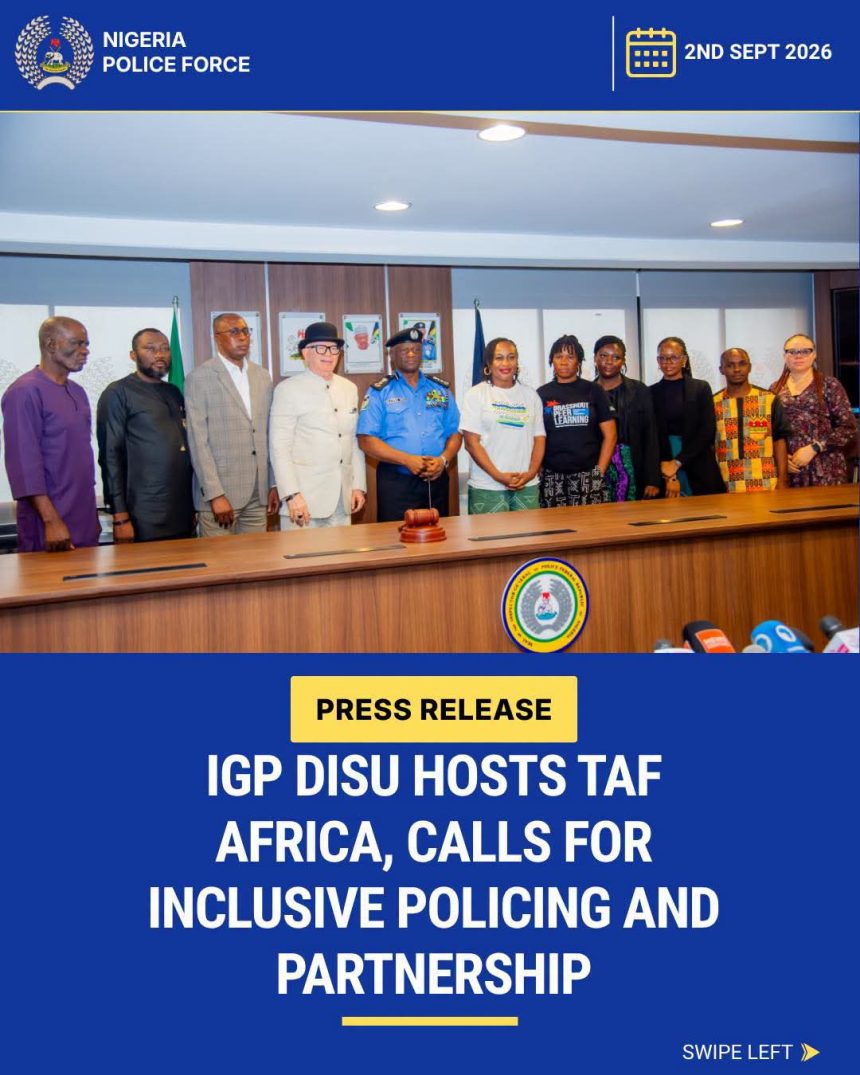
The IGP made the commitment on Wednesday, September 2, 2026, when he received a delegation from TAF Africa at the IGP’s Conference Hall, Force Headquarters, Abuja.
The delegation was led by the Chief Executive Officer and Founder of TAF Africa, Dr Jake Epelle, and comprised representatives of the Nigeria Women Trust Fund (NWTF), Nigeria Association of the Blind (NAB), TAF Africa and other stakeholders advocating greater inclusion of persons with disabilities and women in national security and governance.
Among those on the delegation were the Chief Executive Officer of the Nigerian Women Trust Fund, Mrs Brenda Anyanwu; Executive Director of TAF Africa, Mr Mayowa Aderibigbe; and Chairman of the Nigeria Association of the Blind, Mr Agaba Jacob.
Speaking during the visit, Epelle commended the leadership of IGP Disu, describing his administration as one that has deliberately embraced the principles of inclusive policing in the discharge of the Nigeria Police Force’s mandate of protecting lives and property.
He particularly praised the professionalism and effectiveness displayed by police personnel deployed for the recently concluded off-cycle elections across the country, with specific reference to the Osun State governorship election.
According to him, the Nigeria Police Force has an important role to play in ensuring that Nigeria’s security architecture reflects the needs and realities of every segment of society, including persons living with disabilities.
Epelle therefore called on the IGP to develop and implement a smart security architecture that would adequately incorporate PWDs and address the specific security challenges confronting the community.
He also sought the IGP’s approval and participation in the proposed first Inclusive Security Summit, which is expected to be funded by the European Union.
The proposed summit, he said, would provide a platform for stakeholders to examine ways of strengthening inclusion and accessibility within Nigeria’s security architecture while promoting greater cooperation between security agencies and disability-focused organisations.
Also speaking, the Chief Executive Officer of the Nigerian Women Trust Fund, Mrs Brenda Anyanwu, advocated a strategic partnership between the organisation and the Nigeria Police Force’s Gender Unit.
She said stronger collaboration would help promote gender inclusivity within the Force and ensure that gender considerations receive adequate attention in policing, security planning and institutional development.
The Chairman of the Nigeria Association of the Blind, Mr Agaba Jacob, on his part, called for greater involvement of PWDs in policing and security-related activities.
Jacob argued that persons with disabilities should not be viewed solely as beneficiaries of security protection but should also be recognised as stakeholders capable of contributing meaningfully to national security.
He specifically advocated the involvement of PWDs in intelligence-related assignments, noting that their experiences, networks and understanding of challenges confronting the disability community could provide valuable insights for security agencies.
He further called for stronger protection for PWDs, describing them as among the groups that remain particularly vulnerable to crime and abuse, including sexual offences.
The delegation also urged the Nigeria Police Force to develop structured frameworks for engagement between police personnel and the PWD community.
Such frameworks, they said, would improve communication, trust and cooperation while ensuring that police officers are adequately equipped to respond to the specific needs of persons with different forms of disability.
Responding, IGP Disu described the engagement as an eye-opener and assured the delegation that the Force would continue to strengthen its approach to inclusive policing.
The Inspector-General said the Nigeria Police Force would prioritise the training and retraining of personnel on effective, respectful and dignified engagement with the PWD community.
He stressed that persons living with disabilities have rights that must be respected and protected in accordance with relevant national and international laws.
The IGP further pledged to promote the inclusion of PWDs in policing and security planning, particularly as the country prepares for the forthcoming general elections.
He assured that the Force would put measures in place to ensure that persons living with disabilities are able to participate fully in the electoral process and exercise their constitutional right to vote freely without humiliation, intimidation or unnecessary barriers.
The commitment is particularly significant as Nigeria moves towards the 2027 general elections, with stakeholders increasingly focusing on the need for elections that are accessible, peaceful, credible and inclusive.
The engagement also underscores the growing importance of partnerships between security institutions and civil society organisations in addressing the security needs of vulnerable and historically underrepresented groups.
The Nigeria Police Force reiterated its commitment to protecting the lives and property of all residents without discrimination, while pursuing a more deliberate, responsive and inclusive approach to policing.
The Force Public Relations Officer, CSP Ani Iniedu, in a statement issued on Wednesday, said the Police would continue to strengthen partnerships capable of improving security, promoting human rights and ensuring that every citizen receives equal protection under the law.