


The Nigeria Customs Service (NCS) has reaffirmed its commitment to strengthening trade facilitation, improving operational efficiency and deepening economic cooperation with the United States as it intensifies engagement with American business organisations to improve Nigeria’s investment climate.
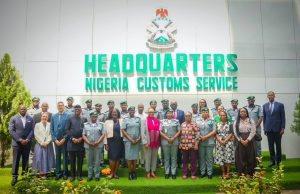
The commitment was reiterated on Wednesday, October 28, 2026, during a quarterly stakeholder engagement involving the NCS, the United States Chamber of Commerce, the US-Africa Business Centre (USAfBC) and the American Business Council (ABC) at the ICT Auditorium of the Customs Headquarters in Maitama, Abuja.
The meeting provided a platform for the Customs Service and representatives of the American business community to discuss ongoing reforms, digital transformation, cargo clearance, tariff administration and measures to address challenges confronting businesses operating in Nigeria.
The Comptroller-General of Customs, Adewale Adeniyi, who was represented by the Deputy Comptroller-General in charge of Tariff and Trade, Caroline Niagwan, said the engagement would further strengthen collaboration and economic cooperation between Nigeria and the United States.
Niagwan, while delivering the Comptroller-General’s message, reaffirmed the Service’s commitment to institutional reforms, transparency, operational efficiency and improved stakeholder relations.
She said the NCS was working towards building a modern Customs administration capable of facilitating legitimate trade while ensuring effective revenue collection, border security and compliance with relevant laws and regulations.
“Our objective is to build a modern, transparent, and responsive Customs administration that facilitates trade while ensuring effective revenue collection, border security, and compliance with applicable rules and regulations,” she said.
According to her, sustained engagement with international business organisations is essential to identifying operational bottlenecks, improving Customs procedures and creating an environment in which businesses can operate more efficiently.
She explained that the meeting offered an opportunity for both parties to exchange views, address emerging concerns and strengthen the partnership between the Customs Service and American companies already operating in Nigeria or considering investment opportunities in the country.
Niagwan stressed that the predictability of Customs procedures, transparency in tariff administration, timely cargo clearance and effective dispute resolution mechanisms remained critical to improving the ease of doing business and strengthening investor confidence.
She noted that businesses required clear procedures and reliable administrative processes to make investment decisions, manage supply chains and move goods across borders without unnecessary delays.
The Deputy Comptroller-General said the NCS remained committed to working with stakeholders to identify practical solutions to challenges affecting legitimate trade and to ensure that its reforms translated into tangible benefits for the business community.
Also speaking at the engagement, the Deputy Comptroller-General of Customs in charge of the ICT and Modernisation Department, Oluyomi Adebakin, outlined some of the Service’s ongoing and planned modernisation initiatives aimed at improving trade processes and strengthening operational efficiency.
Adebakin highlighted the automation of licence and permit applications as part of efforts to simplify administrative procedures, reduce delays and improve service delivery.

She also disclosed plans for the deployment of 22 additional scanners across seaports, airports and border stations to strengthen cargo examination and enhance Customs operations.
The planned deployment is expected to support more efficient cargo inspection and improve the Service’s capacity to monitor cross-border movements of goods while facilitating legitimate commercial activities.
According to her, the introduction of digital platforms and the transition towards paperless administrative processes form important components of the NCS modernisation agenda.
The initiatives are designed to reduce reliance on manual procedures, streamline interactions between Customs officers and traders, and improve the efficiency of processes involved in the movement of goods.
Adebakin urged members of the business community to provide regular feedback on their experiences with Customs procedures, noting that such contributions would help the Service identify operational challenges and develop appropriate responses.
She emphasised that collaboration between Customs authorities and private-sector operators was necessary to ensure that technological investments and administrative reforms addressed the actual needs of businesses.
The engagement also underscored the importance of maintaining open communication between the NCS and international investors as the Service continues to introduce reforms intended to improve transparency and operational performance.
The President of the US-Africa Business Centre at the US Chamber of Commerce, Kendra Gaither, commended the Nigeria Customs Service for its contributions to the country’s economic development and its role in facilitating commercial activities.
Gaither observed that the importance of efficient Customs operations was sometimes overlooked when goods moved smoothly through established trade processes.
She said effective Customs administration had far-reaching implications for businesses, consumers and the wider economy, stressing that the benefits of trade facilitation ultimately extended beyond importers and exporters.
“When Customs works well, when trade is facilitated, people are the ultimate beneficiaries,” she said.
Gaither noted that efficient border management and predictable trade procedures were essential to creating an environment conducive to investment and economic expansion.
She identified agriculture, energy, critical minerals, healthcare and the digital economy as sectors in which effective Customs operations could support greater investment opportunities and stronger commercial relations between Nigeria and the United States.
According to her, businesses in these sectors depend on reliable supply chains, efficient movement of goods and transparent regulatory processes to sustain operations and expand their activities.
She expressed appreciation for the continued collaboration between the NCS and the American business community, noting the importance of sustained engagement in addressing concerns and strengthening the relationship between public institutions and private-sector operators.
Gaither’s remarks highlighted the role of Customs administration in supporting wider economic objectives, including attracting investment, facilitating access to markets and improving the movement of goods across international borders.
The Chief Executive Officer and Executive Secretary of the American Business Council Nigeria, Margaret Olele, also commended the Nigeria Customs Service for the progress recorded in trade facilitation, transparency and stakeholder engagement.
Olele congratulated the Service on its emergence as a top-ranked agency in the Presidential Enabling Business Environment Council (PEBEC) Compliance Assessment.
She noted that improvements in Customs administration were important to businesses seeking a more predictable and transparent operating environment in Nigeria.
The American Business Council also highlighted progress under the Authorised Economic Operator (AEO) Programme, Advance Rulings and dispute resolution mechanisms, describing these areas as important components of efforts to improve the business environment.
The AEO Programme is intended to support trusted businesses that meet established compliance and security requirements, helping to promote more efficient trade processes for eligible operators.
Advance Rulings, meanwhile, provide a mechanism for obtaining decisions on specified Customs matters before transactions are completed, helping businesses make informed decisions and reduce uncertainty regarding the treatment of goods.
Effective dispute resolution also remains important in addressing disagreements between businesses and Customs authorities, particularly where such issues could affect cargo clearance, costs and supply-chain schedules.
According to the Council, the quarterly engagements between the NCS and the private sector have contributed to resolving longstanding business challenges by providing a platform for direct discussions and follow-up on issues raised by stakeholders.
The Council’s commendation reflects the importance of maintaining regular communication between regulatory authorities and businesses to identify implementation gaps and ensure that reforms deliver practical results.
The meeting reinforced the importance of collaboration between Customs authorities, international business organisations and private-sector operators in improving Nigeria’s trade environment.
For businesses engaged in international commerce, the efficiency of Customs procedures can influence the cost of importing raw materials, exporting finished products and maintaining reliable supply chains.
Delays in cargo clearance, uncertainty over tariff treatment and lengthy administrative processes can increase business costs, while transparent procedures and effective dispute resolution can help companies plan their operations more confidently.
The NCS’s emphasis on digital platforms, automated applications and paperless administration therefore represents an important area of engagement between the Service and businesses seeking more efficient regulatory processes.
Similarly, the planned deployment of additional scanners is expected to strengthen cargo examination capacity across key entry points, although the overall impact will depend on effective implementation, operational readiness and integration with existing procedures.
The involvement of the US Chamber of Commerce, the US-Africa Business Centre and the American Business Council also provides an avenue for American businesses to communicate their concerns and engage directly with Nigerian Customs officials on issues affecting trade and investment.
Such engagement is particularly relevant to companies considering expansion into Nigeria or seeking to deepen existing commercial relationships with local partners.
By maintaining regular dialogue, both sides can identify emerging challenges, clarify regulatory expectations and explore measures to improve the movement of legitimate goods while safeguarding government revenue and national security.
The quarterly meeting demonstrated the shared interest of the Nigeria Customs Service and American business organisations in strengthening cooperation on trade facilitation, digital transformation and investment promotion.
For the NCS, the challenge will be to sustain the momentum of its modernisation initiatives and ensure that improvements in technology and administrative procedures translate into faster, more transparent and predictable services for traders.
For the American business community, continued engagement offers an opportunity to provide feedback, seek clarification on regulatory requirements and work with the Service to address obstacles affecting commercial activities.
The discussions also highlighted the need to balance trade facilitation with the Customs Service’s statutory responsibilities, including revenue collection, enforcement of trade regulations and protection of Nigeria’s borders.
As Nigeria seeks to expand investment and strengthen its participation in international commerce, effective Customs administration remains an important factor in creating a business environment that supports enterprise, economic cooperation and sustainable growth.
The NCS and its American business partners are expected to continue using their quarterly engagements to review progress, address outstanding concerns and identify further opportunities for collaboration in support of stronger Nigeria-United States trade and investment relations.