
By Julius Peter
The Independent National Electoral Commission (INEC) has reaffirmed its commitment to strengthening voter education, civic participation and democratic values among Nigerians, particularly young people, as part of efforts to deepen the country’s democratic culture.
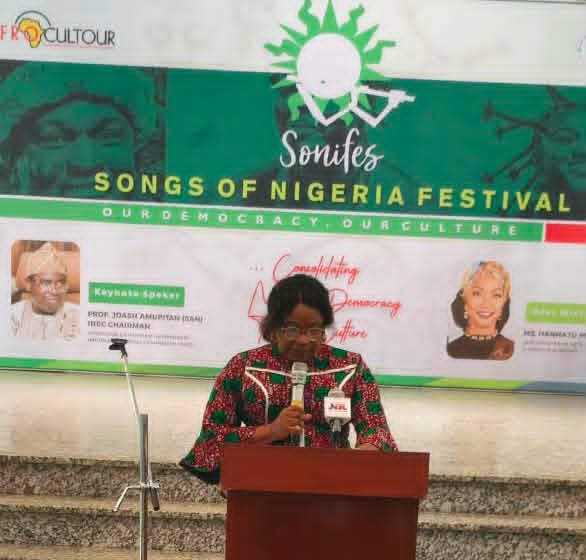
The Commission made the commitment at the Song of Nigeria Festival (SONIFES) held at the Musa Yar’Adua Centre in Abuja, where its Director, Voter Education and Publicity, Mrs. Victoria Eta-Messi, delivered a keynote address on behalf of the INEC Chairman, Prof. Joash Amupitan, SAN.
The festival, which brought together stakeholders from the creative, cultural, civic and public sectors, provided a platform for discussions on the role of arts and culture in promoting national identity, unity, civic consciousness and democratic values.
Representing the INEC Chairman, Eta-Messi underscored the importance of engaging citizens beyond the traditional electoral cycle, stressing that democracy thrives when citizens are adequately informed, actively involved and conscious of their rights and responsibilities.
She noted that voter education remains a critical component of Nigeria’s democratic development, particularly in an era where citizens increasingly rely on digital platforms and other alternative channels for information.
According to her, effective voter education should go beyond informing citizens about election dates and procedures to promoting a deeper understanding of democratic principles, electoral processes and the responsibilities that come with citizenship.
She emphasised the need for stronger collaboration among electoral institutions, civil society organisations, the media, educational institutions, traditional institutions and the creative industry in building a more informed and participatory electorate.
The INEC representative also highlighted the potential of the arts and cultural sector to communicate civic messages in ways that resonate with citizens across different age groups and backgrounds.
She explained that music, drama, poetry and other creative expressions could serve as powerful tools for communicating messages about peaceful participation, electoral responsibility, inclusion and national cohesion.
The choice of the Song of Nigeria Festival as a platform for the message, she suggested, was therefore significant, given the ability of creative expression to reach audiences beyond conventional civic and political spaces.
Eta-Messi said initiatives that combine culture with civic education could help make democratic values more accessible, particularly to young Nigerians, who constitute a significant segment of the country’s population.
She further called for sustained efforts to discourage voter apathy, misinformation, hate speech and other practices capable of undermining public confidence in the electoral process.
The Director reiterated the Commission’s commitment to ensuring that eligible citizens have access to accurate and timely information concerning elections and are better equipped to participate meaningfully in the democratic process.
She stressed that credible elections are not solely the responsibility of the electoral management body, noting that citizens, political parties, the media, security agencies, civil society groups and other stakeholders all have important roles to play.
According to her, a healthy democracy depends not only on the conduct of elections but also on the willingness of citizens to engage constructively with democratic institutions and processes.
The festival also highlighted the broader relationship between culture and nation-building. Through music and other forms of artistic expression, participants were encouraged to reflect on Nigeria’s diversity while promoting a shared sense of national identity.
The event provided an opportunity for stakeholders to examine how the creative industry could contribute to civic engagement and strengthen conversations around Nigeria’s democratic journey.
Observers at the event noted that partnerships between institutions such as INEC and organisations in the creative sector could provide new opportunities for reaching audiences that may not ordinarily engage with conventional voter-education programmes.
Such collaborations could also help counter misinformation by providing citizens with accessible and credible information through familiar cultural platforms.
The participation of INEC at SONIFES therefore underscored the growing recognition of innovative approaches to civic and voter education, particularly as Nigeria continues to seek ways of strengthening citizen participation and public trust in democratic institutions.
The Commission’s message at the festival ultimately reinforced the importance of an informed citizenry in sustaining democracy. By encouraging Nigerians to understand the electoral process, exercise their rights responsibly and participate peacefully in civic affairs, stakeholders can contribute to building a stronger democratic culture.
As Nigeria continues its democratic journey, initiatives that bring together electoral education, culture and civic participation are expected to remain important in reaching wider segments of society and encouraging citizens to take ownership of the democratic process.
The Song of Nigeria Festival thus offered more than a celebration of music and culture; it also served as a platform for reflection on citizenship, national unity and the collective responsibility of Nigerians in shaping the country’s democratic future.