
By Julius Peter, Abuja
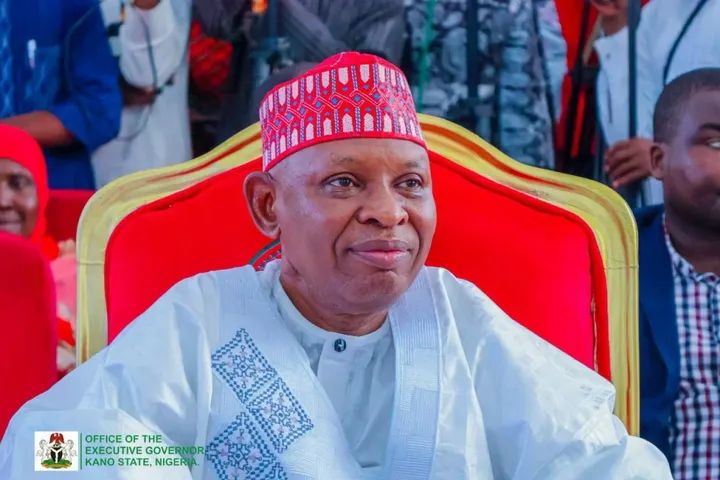
Kano State Governor, Abba Kabir Yusuf, has alleged that his former political mentor and leader of the Kwankwasiyya movement, Senator Rabiu Musa Kwankwaso, personally instructed him to swear on the Qur’an that they would return to the All Progressives Congress (APC) if President Bola Ahmed Tinubu did not interfere in the legal battle over his 2023 governorship election victory.
Yusuf made the disclosure during an interview with the BBC Hausa Service, where he gave an account of the discussions and political understanding that preceded his eventual defection from the New Nigeria Peoples Party (NNPP) to the APC in January 2026.
The governor said the proposed return to the APC was not a unilateral decision taken by him, insisting that Kwankwaso initiated the arrangement and personally sent him to meet President Tinubu to communicate their commitment.
According to Yusuf, the agreement was reached shortly after the 2023 governorship election, when the outcome was challenged by the APC candidate, Nasiru Yusuf Gawuna, at the election petition tribunal.
He explained that Kwankwaso asked him to approach Tinubu and assure the President that they would return to the APC if the Supreme Court upheld his election victory.
Yusuf said the former Kano governor went as far as asking him to swear on the Qur’an to demonstrate the seriousness of the commitment.
“He himself sent me to Tinubu. He begged me to go and tell him that we had made this promise, and that if necessary, I should swear with the Qur’an right there that if we won, he wanted us to come together,” Yusuf said.
The governor maintained that the proposed political realignment was tied to an understanding that Tinubu would allow the judicial process to run its course without interference.
He said the President was approached several times and asked to exercise restraint in the legal proceedings challenging his election.
According to Yusuf, the discussions were not limited to a single meeting, as Kwankwaso allegedly held several engagements with Tinubu and sent delegations to explore the possibility of returning to the ruling party.
He further claimed that lawmakers and local government chairmen were involved in the discussions, adding that the former governor was fully aware of the steps taken to implement the agreement.
“Everything that was done was done with the knowledge of the leader. We reached an agreement, but Kwankwaso did not fulfil it,” the governor said.
Yusuf disclosed that he personally met Tinubu to communicate the pledge and subsequently returned to inform Kwankwaso about the outcome of the meeting.
He said the proposed arrangement was based on the political relationship between Tinubu and Kwankwaso at the time, with the expectation that their supporters would reunite under the APC if the Supreme Court ruled in his favour.
The Kano governorship election was one of the most closely contested political battles following the 2023 general elections.
Yusuf, who contested on the platform of the NNPP with the backing of Kwankwaso, was declared winner by the Independent National Electoral Commission (INEC), polling 1,019,602 votes against Gawuna’s 890,705 votes.
The APC challenged the result, and the Kano State Governorship Election Petition Tribunal subsequently nullified Yusuf’s election. The Court of Appeal upheld the tribunal’s decision before the Supreme Court, in January 2024, reversed the lower courts’ decisions and affirmed Yusuf as the duly elected governor of Kano State.
The Supreme Court victory strengthened the political position of Yusuf and Kwankwaso in Kano, where the NNPP had secured a major electoral breakthrough in 2023.
However, the political relationship between the governor and his former mentor later deteriorated, culminating in Yusuf’s defection to the APC on January 26, 2026.
Kwankwaso had publicly described the governor’s defection as the worst betrayal he had witnessed, a statement that underscored the depth of the political disagreement between the two former allies.
Yusuf, however, rejected the betrayal narrative, arguing that his decision was consistent with the agreement allegedly reached before the Supreme Court judgment.
The Kano governor said the proposed political arrangement eventually collapsed after Kwankwaso allegedly made statements against the agreement, despite having initiated the discussions.
Yusuf claimed that the comments were conveyed to Tinubu and affected the understanding reached between the parties.
He said the development created uncertainty over the proposed return to the APC and contributed to the eventual breakdown of the arrangement.
The governor insisted that he had acted in good faith and that his former mentor could not reasonably accuse him of betrayal when, according to his account, the agreement had been reached with Kwankwaso’s knowledge and involvement.
Yusuf also dismissed the notion that political alliances were permanent, arguing that politicians could change parties based on prevailing circumstances and the interests of their constituencies.
He said his defection should be viewed within the broader context of political negotiations and the need to secure cooperation for the effective administration of Kano State.
Explaining some of the reasons behind his decision to leave the NNPP, Yusuf said the party’s limited nationwide presence affected his administration’s ability to secure the level of cooperation it required from the Federal Government.
He argued that being in an opposition party had created difficulties in accessing federal support and collaboration, particularly in addressing security challenges and other governance concerns.
The governor said the situation had improved since he joined the APC, noting that cooperation with federal authorities had become more effective.
According to him, the political realignment was partly motivated by the need to improve relations between Kano State and the Federal Government and to facilitate the delivery of governance objectives.
Yusuf said politics was not a permanent arrangement, stressing that political actors could move from one party to another depending on the prevailing realities.
Despite the public disagreement and political separation, Yusuf said his relationship with Kwankwaso had not completely broken down.
He disclosed that he still maintained communication with the former governor and had recently sent him messages of greeting.
The governor, however, declined to discuss allegations that Kwankwaso had been exerting pressure on him or interfering in the affairs of his administration, saying such sensitive matters should not be discussed publicly.
The interview represents Yusuf’s detailed account of the events leading to his defection and offers his response to accusations that he abandoned the political movement that brought him to power.
Kwankwaso’s response to the governor’s latest allegations was not included in the interview reports available at the time of filing this story.