
By Julius Peter, Abuja
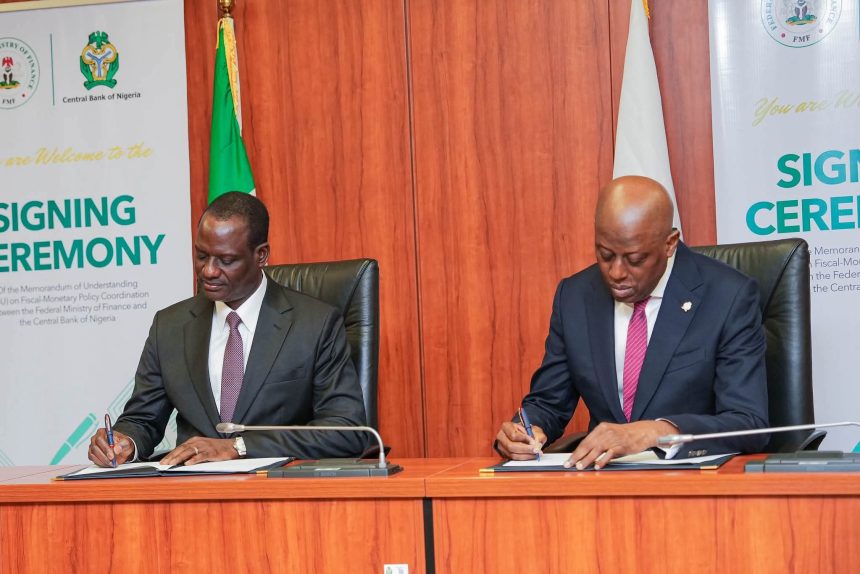
The Federal Ministry of Finance and the Central Bank of Nigeria (CBN) have signed a Memorandum of Understanding (MoU) aimed at strengthening coordination between fiscal and monetary policies and improving Nigeria’s macroeconomic stability.
The agreement was signed in Abuja by the Minister of Finance and Coordinating Minister of the Economy, Taiwo Oyedele, and the Governor of the CBN, Olayemi Cardoso.
The framework is expected to institutionalise closer collaboration between the fiscal and monetary authorities, with particular emphasis on policy consistency, information sharing, economic forecasting and coordinated responses to emerging macroeconomic challenges.
Under the arrangement, both institutions will work more closely in aligning macroeconomic assumptions and exchanging relevant data to strengthen economic planning and policy implementation.
The initiative comes as the Federal Government continues to pursue economic reforms designed to achieve greater stability, bring down inflation sustainably, attract investment, expand economic activity and create employment opportunities.
The MoU is expected to provide a more structured platform for the Federal Ministry of Finance and the CBN to coordinate their respective responsibilities in managing the economy.
While fiscal policy largely concerns government revenue, expenditure, borrowing and public finances, monetary policy focuses on issues such as inflation, interest rates, liquidity and financial conditions. Closer coordination between the two authorities is therefore intended to reduce inconsistencies that could undermine economic management.
Reports on the agreement indicate that the framework will also support improved liquidity forecasting, government borrowing coordination and the transmission of monetary policy, while promoting conditions that can enhance access to credit for the private sector.
The Federal Government has increasingly emphasised policy consistency and predictability as essential to restoring investor confidence and moving the economy from stabilisation towards sustainable growth.
Oyedele recently stressed that reforms must translate into investment, productivity, job creation and improved living standards, noting that investors respond to predictable policies and clear rules consistently applied.
A key element of the new framework is enhanced information sharing between the two institutions.
Better access to timely economic and financial data could assist both authorities in developing more reliable forecasts and making decisions based on a common understanding of prevailing economic conditions.
This is particularly important in an economy where fiscal decisions can influence inflation, liquidity and interest rates, while monetary policy decisions can affect government financing costs, private-sector borrowing and investment.
The institutionalisation of regular collaboration is consequently expected to improve the consistency of economic assumptions used in fiscal planning and monetary-policy decisions.
Inflation management is also central to the new framework.
The agreement is designed to support efforts to sustainably reduce inflation while maintaining an environment conducive to investment, production and job creation.
The government’s 2026 budget framework has similarly placed emphasis on macroeconomic stability, fiscal discipline, revenue mobilisation and economic growth. The Federal Ministry of Finance said the budget was designed to consolidate reforms and create conditions for stronger growth.
The closer fiscal-monetary relationship could therefore provide a more coordinated approach to addressing inflationary pressures, particularly where government spending, borrowing requirements, liquidity conditions and monetary policy interact.
Beyond inflation and stability, the MoU is expected to support the broader objective of creating an environment in which businesses can invest and expand.
The Finance Ministry has identified access to capital, predictable policies, lower business costs and increased productivity as important elements of Nigeria’s next phase of economic development.
Oyedele has said that investment on the scale required to generate decent jobs and improve living standards depends on confidence in the policy environment, while emphasising the need for stronger coordination between government and the private sector.
The fiscal-monetary coordination framework is therefore expected to complement ongoing reforms aimed at strengthening domestic revenue mobilisation, public financial management, capital-market development and access to financing.
Institutionalising economic policy coordination
The agreement also represents an effort to move fiscal and monetary coordination from largely informal engagement towards a more structured institutional framework.
By establishing clearer channels for collaboration, the two institutions are expected to improve the coherence of economic policies and reduce the risk of conflicting policy signals.
The Federal Government and CBN have described the initiative as part of a broader commitment to sound economic management, macroeconomic stability and long-term economic resilience.
For Nigeria, where fiscal and monetary decisions can have significant implications for inflation, exchange-rate conditions, investment, borrowing costs and economic growth, sustained coordination between the two authorities will remain an important component of economic management.
The implementation of the MoU will consequently be closely watched by businesses, investors, financial institutions and other economic stakeholders as the government seeks to consolidate recent reforms and translate macroeconomic stabilisation into broader growth and employment outcomes.
The agreement underscores the shared responsibility of the fiscal and monetary authorities in maintaining economic stability while creating conditions for sustainable and inclusive growth.